From the Department of Health Sciences (J.B., M.H.), University of Leicester; Institute of Human Genetics (M.G.), Newcastle University, UK; Department of Medical Epidemiology and Biostatistics (M.C.), Karolinska Institute, Stockholm, Sweden; and Centre for Health Economics (K.A.), University of York, UK.
Neurology. 2021 Dec 7;97(23):e2304-e2314. doi: 10.1212/WNL.0000000000012910. Epub 2021 Oct 13.
Duchenne muscular dystrophy (DMD) is a rare progressive disease that is often diagnosed in early childhood and leads to considerably reduced life expectancy; because of its rarity, research literature and patient numbers are limited. To fully characterize the natural history, it is crucial to obtain appropriate estimates of the life expectancy and mortality rates of patients with DMD.
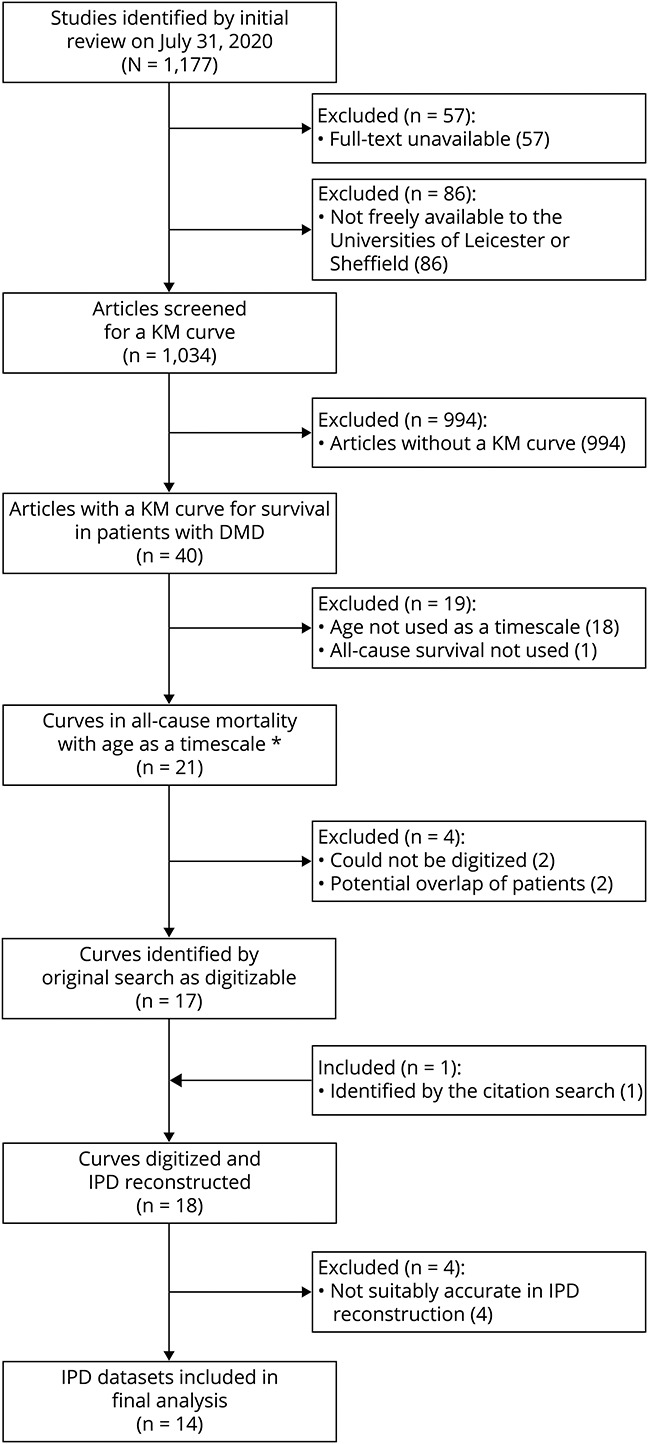
A systematic review of the published literature on mortality in DMD up to July 2020 was undertaken, specifically focusing on publications in which Kaplan-Meier (KM) survival curves with age as a timescale were presented. These were digitized, and individual patient data (IPD) were reconstructed. The pooled IPD were analyzed with the KM estimator and parametric survival analysis models. Estimates were also stratified by birth cohort.
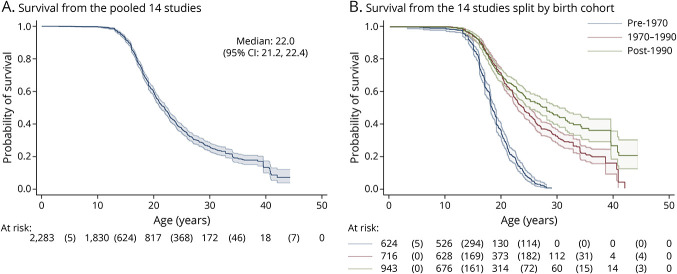
Of 1,177 articles identified, 14 publications met the inclusion criteria and provided data on 2,283 patients, of whom 1,049 had died. Median life expectancy was 22.0 years (95% confidence interval [CI] 21.2, 22.4). Analyses stratified by 3 time periods in which patients were born showed markedly increased life expectancy in more recent patient populations; patients born after 1990 have a median life expectancy of 28.1 years (95% CI 25.1, 30.3).
This article presents a full overview of mortality across the lifetime of a patient with DMD and highlights recent improvements in survival. In the absence of large-scale prospective cohort studies or trials reporting mortality data for patients with DMD, extraction of IPD from the literature provides a viable alternative to estimating life expectancy for this patient population.
杜氏肌营养不良症(DMD)是一种罕见的进行性疾病,通常在儿童早期诊断,并导致预期寿命显著缩短;由于其罕见性,研究文献和患者数量有限。为了全面描述其自然史,获得 DMD 患者的预期寿命和死亡率的适当估计至关重要。
对截至 2020 年 7 月发表的关于 DMD 死亡率的文献进行了系统回顾,特别侧重于发表了 Kaplan-Meier(KM)生存曲线的出版物,这些曲线的时间尺度为年龄。对这些曲线进行了数字化,并重建了个体患者数据(IPD)。使用 KM 估计器和参数生存分析模型对汇总的 IPD 进行了分析。还按出生队列对估计值进行了分层。
在确定的 1177 篇文章中,有 14 篇文章符合纳入标准,并提供了 2283 名患者的数据,其中 1049 人死亡。中位预期寿命为 22.0 年(95%置信区间 [CI] 21.2,22.4)。按患者出生的 3 个时间段进行分层分析显示,最近的患者群体的预期寿命明显延长;出生于 1990 年后的患者中位预期寿命为 28.1 年(95% CI 25.1,30.3)。
本文全面概述了 DMD 患者一生的死亡率,并强调了生存的近期改善。在缺乏大规模前瞻性队列研究或报告 DMD 患者死亡率的试验的情况下,从文献中提取 IPD 是估计该患者群体预期寿命的可行替代方法。