Department of Sports Medical Center, Korea University College of Medicine Anam Hospital, Seoul, Korea.
Department of Pediatrics, Kyung Hee University Medical Center, Seoul, South Korea.
Sci Rep. 2021 Oct 13;11(1):20369. doi: 10.1038/s41598-021-99466-8.
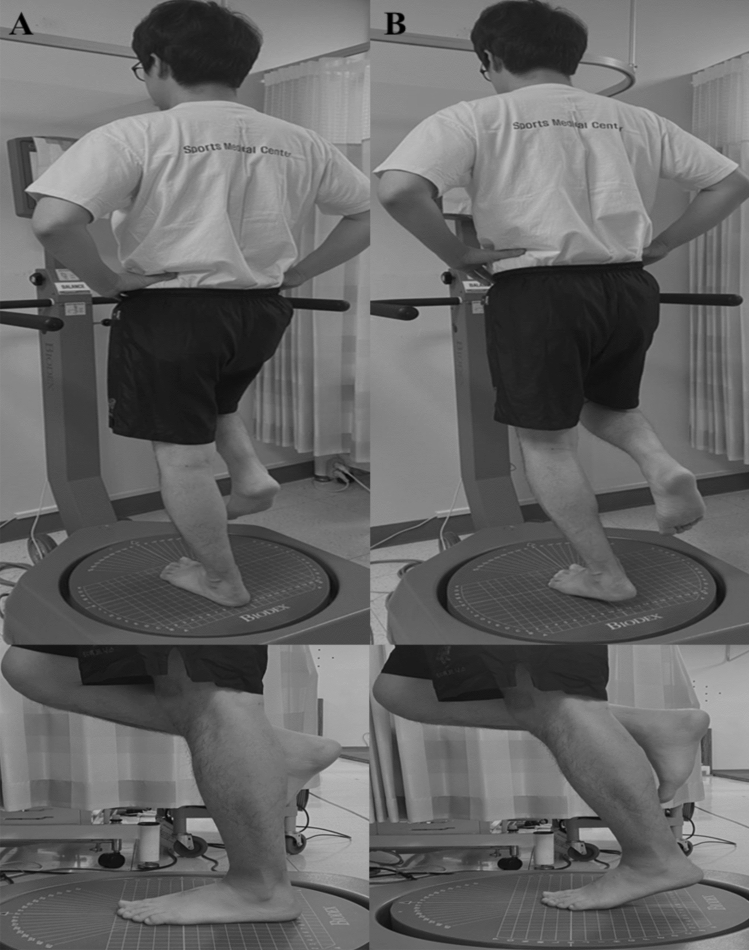
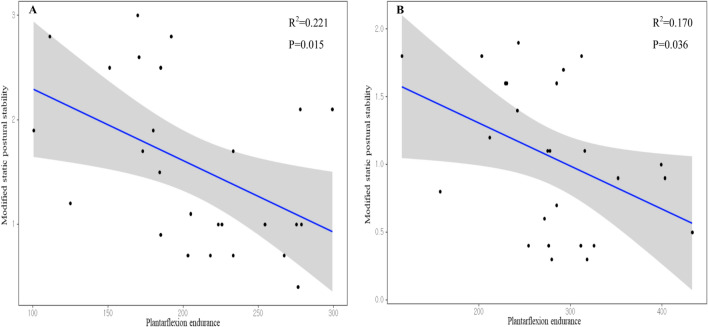
We aimed to analyze the differences in static (including conventional and modified [single-leg heel-raise balance]) and dynamic postural stability and muscle endurance between patients with chronic ankle instability (CAI) and healthy controls, and to determine the reliability and usefulness of the single-leg heel-raise balance test in patients with CAI. In total, 26 patients with CAI and 26 healthy controls were enrolled. Postural stability was assessed using a postural stabilometry system. Muscle endurance was measured in dorsiflexion and plantarflexion using an isokinetic device. Modified static postural stability (P < 0.001) and dynamic postural stability (P < 0.001) were significantly poorer in the affected ankles of patients with CAI than in the controls. Plantarflexion endurance was significantly lower in the affected ankles of the patients with CAI than in the controls (P = 0.023). Modified static postural stability significantly correlated with plantarflexion endurance in both groups (CAI group: r = - 0.470, P = 0.015; healthy controls group: r = - 0.413, P = 0.036). Plantarflexion endurance was a significant risk factor for modified static postural stability in both the CAI group (R = 0.221, P = 0.015) and healthy controls (R = 0.170, P = 0.036). Given the reliability of the modified static postural stability test, clinicians and therapists should consider using it to assess improvements in postural stability and muscle endurance in patients with CAI before and after rehabilitation.
我们旨在分析慢性踝关节不稳定(CAI)患者与健康对照组之间静态(包括常规和改良的[单腿提踵平衡])和动态姿势稳定性以及肌肉耐力的差异,并确定改良单腿提踵平衡测试在 CAI 患者中的可靠性和实用性。共有 26 名 CAI 患者和 26 名健康对照组被纳入研究。使用姿势稳定计系统评估姿势稳定性。使用等速装置在背屈和跖屈方向上测量肌肉耐力。与对照组相比,CAI 患者患侧的改良静态姿势稳定性(P < 0.001)和动态姿势稳定性(P < 0.001)显著更差。CAI 患者患侧的跖屈耐力明显低于对照组(P = 0.023)。改良静态姿势稳定性与两组的跖屈耐力均呈显著负相关(CAI 组:r = -0.470,P = 0.015;健康对照组:r = -0.413,P = 0.036)。在 CAI 组(R = 0.221,P = 0.015)和健康对照组(R = 0.170,P = 0.036)中,跖屈耐力都是改良静态姿势稳定性的显著危险因素。鉴于改良静态姿势稳定性测试的可靠性,临床医生和治疗师应考虑在 CAI 患者康复前后使用该测试评估其姿势稳定性和肌肉耐力的改善情况。