Frahm Niklas, Peters Melanie, Bätzing Jörg, Ellenberger David, Akmatov Manas K, Haas Judith, Rommer Paulus S, Stahmann Alexander, Zettl Uwe K, Holstiege Jakob
MS Forschungs- und Projektentwicklungs- gGmbH (MS Research and Project Development gGmbH [MSFP]), Krausenstr. 50, Hannover, 30171, Germany.
Gesellschaft für Versorgungsforschung mbH (Society for Health Care Research [GfV]), Hannover, Germany.
Ther Adv Neurol Disord. 2021 Oct 6;14:17562864211048336. doi: 10.1177/17562864211048336. eCollection 2021.
The manifestation of multiple sclerosis (MS) in childhood and adolescence occurs in 3%-5% of all MS cases. However, the immunomodulatory and symptomatic treatment options in this population group are still limited.
We aimed to elucidate the prescription frequency of medications used in pediatric patients with multiple sclerosis (PwMS) compared with the general population, considering the entire spectrum of medications prescribed.
Based on nationwide outpatient drug prescription data and statutory health insurance (SHI) physicians' claims data from 2018, we conducted a population-based cross-sectional study in Germany. Children and adolescents aged ⩽17 years ( = 11,381,939) diagnosed with MS ( = 613), and a matched (age, sex, and health insurance sector) control group ( = 6130) were included. The prescription prevalence was measured as the proportion of MS patients with ⩾1 prescription.
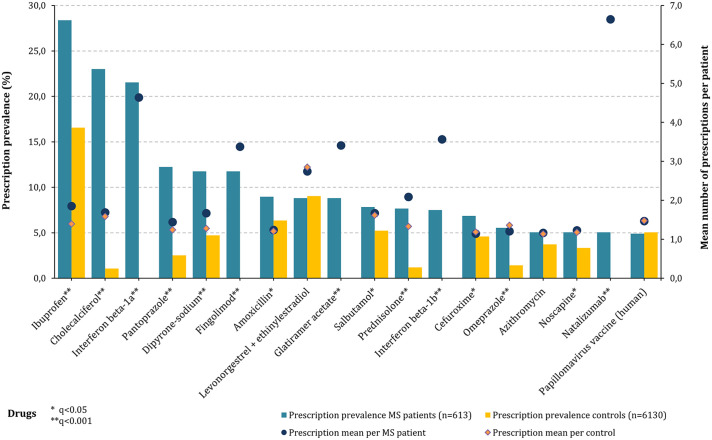
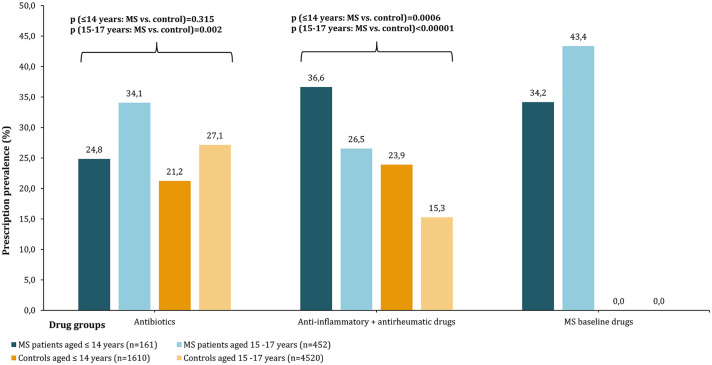
Of the 613 pediatric PwMS with a median age of 16 years, 403 (65.7%) were female. For 15 out of the 18 different active agents analyzed, PwMS had a significantly higher prescription prevalence than the control group (Fisher's exact test: ⩽ 0.037). The most frequently prescribed drugs in PwMS were ibuprofen (28.4%; anti-inflammatory drug), cholecalciferol (23.0%; vitamin D3), and interferon beta-1a (21.5%; disease-modifying drug, DMD). The proportions of DMD prescriptions and antibiotic prescriptions were higher among PwMS aged 15-17 years than among those ⩽14 years (DMD: 43.4% vs 34.2%, = 0.05; antibiotic: 34.1% vs 24.8%, = 0.031). In contrast, younger PwMS were more likely to receive a prescription for anti-inflammatory/anti-rheumatic drugs (36.6% vs 26.5%, = 0.02).
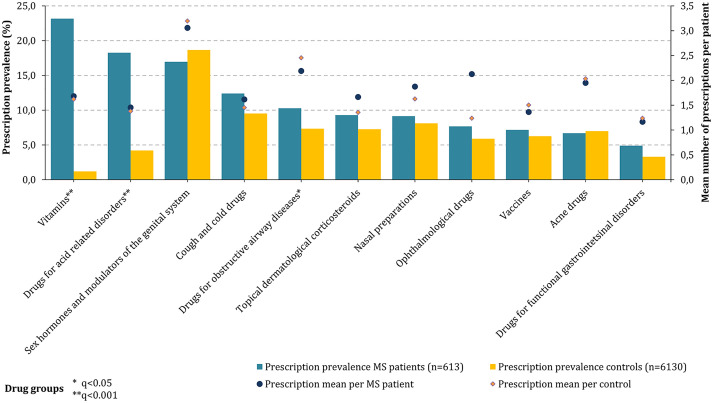
Our study analyzing real-world medication data showed that interferon beta, anti-inflammatory drugs, and vitamins play an essential role in the treatment of pediatric PwMS. Future research should evaluate longitudinal treatment patterns of pediatric PwMS, paying particular attention to the time of diagnosis, time of first DMD initiation, and therapy switches.
儿童和青少年多发性硬化症(MS)的发病率占所有MS病例的3%-5%。然而,这一人群的免疫调节和对症治疗选择仍然有限。
考虑到所开具药物的全谱,我们旨在阐明与普通人群相比,儿科多发性硬化症患者(PwMS)的药物处方频率。
基于2018年全国门诊药物处方数据和法定医疗保险(SHI)医生的报销数据,我们在德国进行了一项基于人群的横断面研究。纳入了年龄小于或等于17岁(n = 11,381,939)且被诊断为MS的儿童和青少年(n = 613),以及一个匹配(年龄、性别和医疗保险部门)的对照组(n = 6130)。处方患病率以至少有1张处方的MS患者比例来衡量。
在613名中位年龄为16岁的儿科PwMS中,403名(65.7%)为女性。在分析的18种不同活性成分中的15种中,PwMS的处方患病率显著高于对照组(Fisher精确检验:p ⩽ 0.037)。PwMS中最常开具的药物是布洛芬(28.4%;抗炎药)、胆钙化醇(23.0%;维生素D3)和干扰素β-1a(21.5%;疾病修饰药物,DMD)。15-17岁的PwMS中DMD处方和抗生素处方的比例高于14岁及以下的患者(DMD:43.4%对34.2%,p = 0.05;抗生素:34.1%对24.8%,p = 0.031)。相比之下,年龄较小的PwMS更有可能接受抗炎/抗风湿药物的处方(36.6%对26.5%,p = 0.02)。
我们分析真实世界用药数据的研究表明,干扰素β、抗炎药物和维生素在儿科PwMS的治疗中起着至关重要的作用。未来的研究应评估儿科PwMS的纵向治疗模式,特别关注诊断时间、首次启动DMD的时间和治疗转换情况。