Shanghai Pulmonary Hospital, Tongji University School of Medicine, Shanghai, China.
State Key Laboratory of Cell Biology, Innovation Center for Cell Signaling Network, CAS Center for Excellence in Molecular Cell Science, Shanghai Institute of Biochemistry and Cell Biology, Chinese Academy of Sciences, University of Chinese Academy of Sciences, Shanghai, China.
Signal Transduct Target Ther. 2021 Oct 15;6(1):355. doi: 10.1038/s41392-021-00751-9.
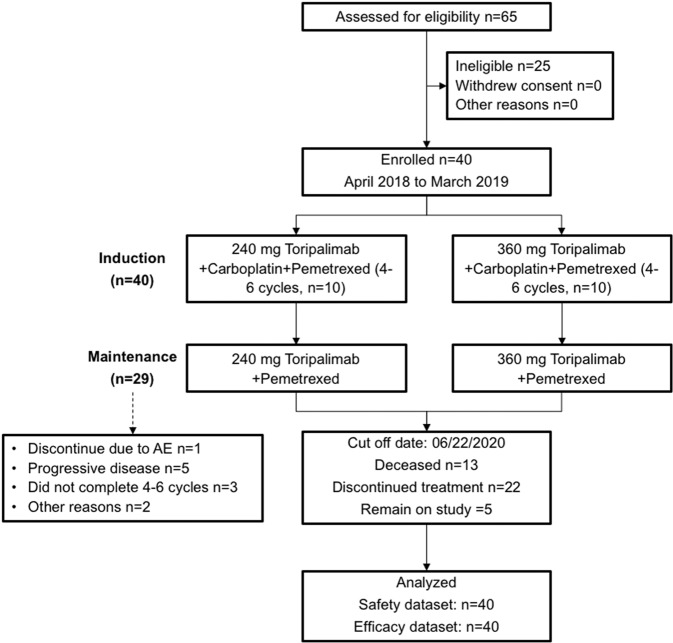
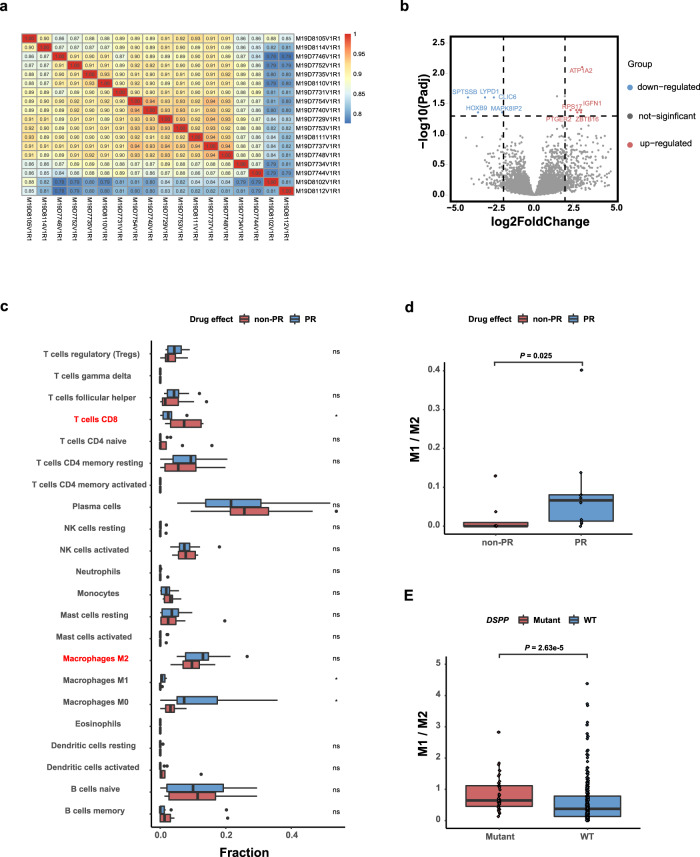
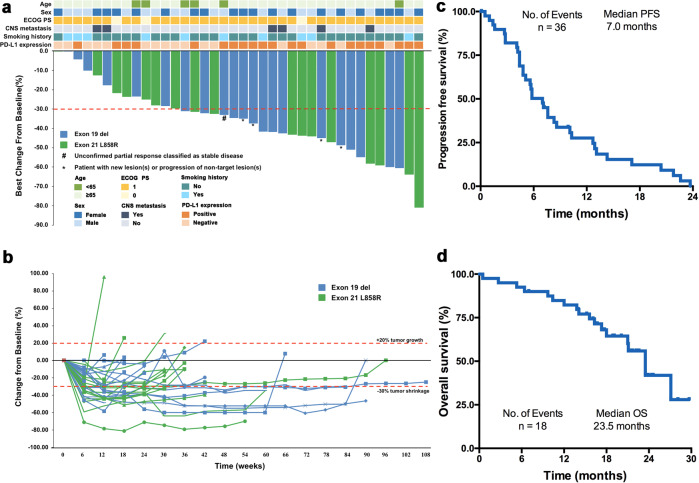
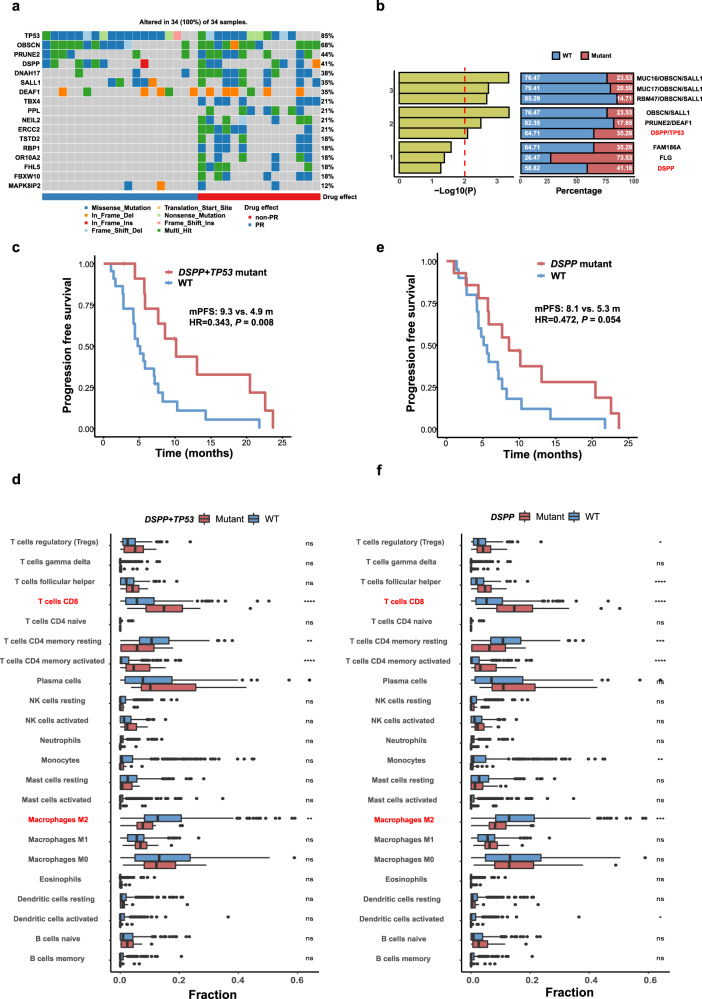
This multicenter phase-II trial aimed to investigate the efficacy, safety, and predictive biomarkers of toripalimab plus chemotherapy as second-line treatment in patients with EGFR-mutant-advanced NSCLC. Patients who failed from first-line EGFR-TKIs and did not harbor T790M mutation were enrolled. Toripalimab plus carboplatin and pemetrexed were administrated every three weeks for up to six cycles, followed by the maintenance of toripalimab and pemetrexed. The primary endpoint was objective-response rate (ORR). Integrated biomarker analysis of PD-L1 expression, tumor mutational burden (TMB), CD8 + tumor-infiltrating lymphocyte (TIL) density, whole-exome, and transcriptome sequencing on tumor biopsies were also conducted. Forty patients were enrolled with an overall ORR of 50.0% and disease-control rate (DCR) of 87.5%. The median progression free survival (PFS) and overall survival were 7.0 and 23.5 months, respectively. The most common treatment-related adverse effects were leukopenia, neutropenia, anemia, ALT/AST elevation, and nausea. Biomarker analysis showed that none of PD-L1 expression, TMB level, and CD8 + TIL density could serve as a predictive biomarker. Integrated analysis of whole-exome and transcriptome sequencing data revealed that patients with DSPP mutation had a decreased M2 macrophage infiltration and associated with longer PFS than those of wild type. Toripalimab plus chemotherapy showed a promising anti-tumor activity with acceptable safety profiles as the second-line setting in patients with EGFR-mutant NSCLC. DSPP mutation might serve as a potential biomarker for this combination. A phase-III trial to compare toripalimab versus placebo in combination with chemotherapy in this setting is ongoing (NCT03924050).
这项多中心 II 期临床试验旨在研究特瑞普利单抗联合化疗作为 EGFR 突变型晚期 NSCLC 二线治疗的疗效、安全性和预测性生物标志物。入组患者为一线 EGFR-TKI 治疗失败且不携带 T790M 突变的患者。特瑞普利单抗联合卡铂和培美曲塞每 3 周给药,最多 6 个周期,随后给予特瑞普利单抗和培美曲塞维持治疗。主要终点为客观缓解率(ORR)。还对 PD-L1 表达、肿瘤突变负担(TMB)、CD8+肿瘤浸润淋巴细胞(TIL)密度、肿瘤活检的全外显子和转录组测序的综合生物标志物进行分析。共入组 40 例患者,总体 ORR 为 50.0%,疾病控制率(DCR)为 87.5%。中位无进展生存期(PFS)和总生存期分别为 7.0 和 23.5 个月。最常见的治疗相关不良反应为白细胞减少、中性粒细胞减少、贫血、ALT/AST 升高和恶心。生物标志物分析表明,PD-L1 表达、TMB 水平和 CD8+TIL 密度均不能作为预测生物标志物。全外显子和转录组测序数据的综合分析显示,DSPP 突变患者 M2 巨噬细胞浸润减少,与野生型相比 PFS 延长。特瑞普利单抗联合化疗作为 EGFR 突变型 NSCLC 的二线治疗方案具有良好的抗肿瘤活性和可接受的安全性。DSPP 突变可能是该联合治疗的潜在生物标志物。一项比较特瑞普利单抗与安慰剂联合化疗在该治疗环境下疗效的 III 期临床试验正在进行中(NCT03924050)。