Aanei Carmen-Mariana, Veyrat-Masson Richard, Rigollet Lauren, Stagnara Jérémie, Tavernier Tardy Emmanuelle, Daguenet Elisabeth, Guyotat Denis, Campos Catafal Lydia
Laboratoire d'Hématologie, Centre Hospitalier Universitaire de Saint-Étienne, Saint-Étienne, France.
Laboratoire d'Hématologie, Centre Hospitalier Universitaire de Clermont-Ferrand, Clermont-Ferrand, France.
Front Cell Dev Biol. 2021 Sep 28;9:735518. doi: 10.3389/fcell.2021.735518. eCollection 2021.
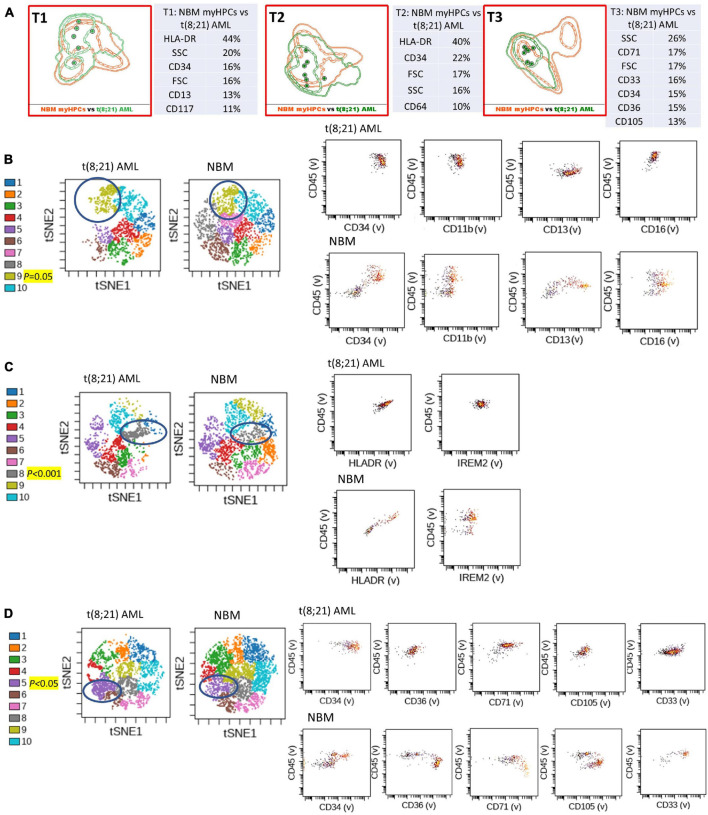
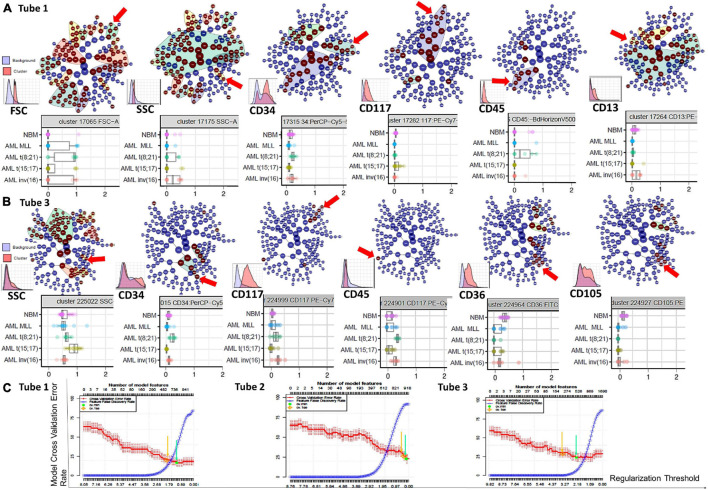
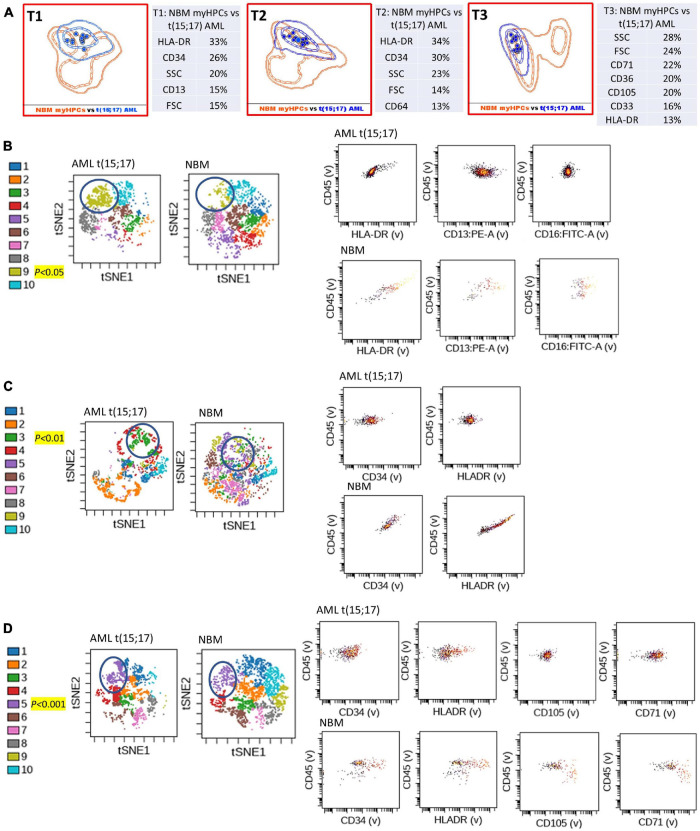
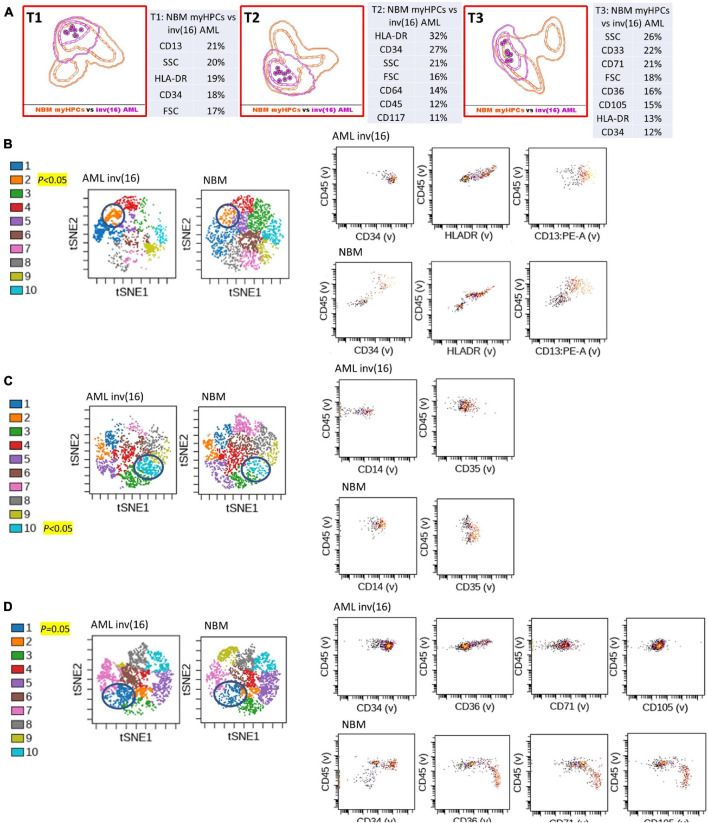
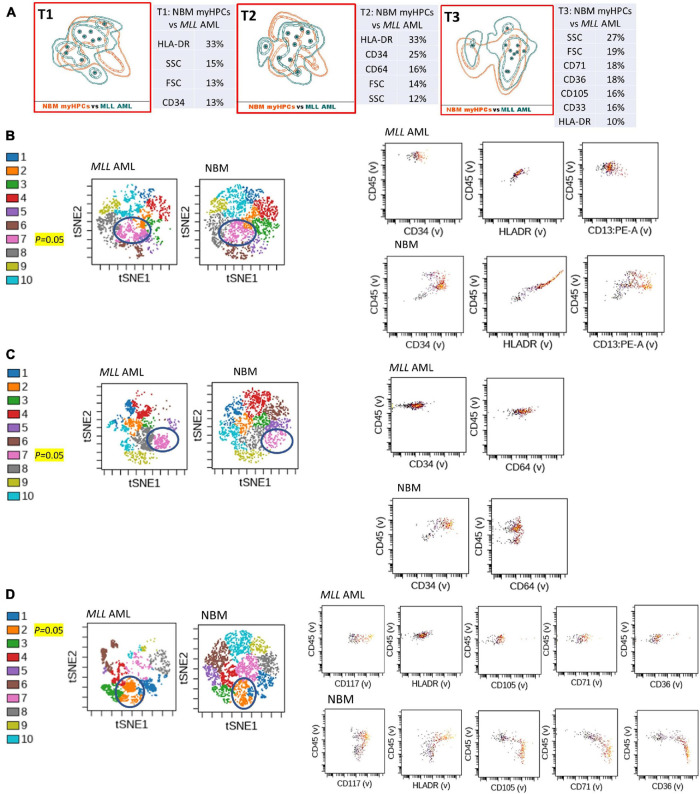
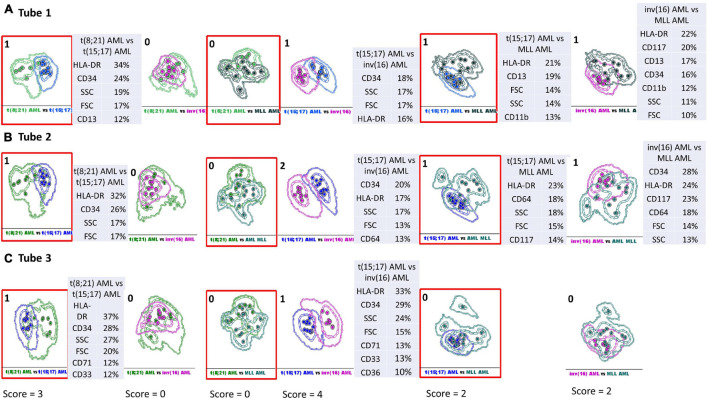
Acute myeloid leukemias (AMLs) are a group of hematologic malignancies that are heterogeneous in their molecular and immunophenotypic profiles. Identification of the immunophenotypic differences between AML blasts and normal myeloid hematopoietic precursors (myHPCs) is a prerequisite to achieving better performance in AML measurable residual disease follow-ups. In the present study, we applied high-dimensional analysis algorithms provided by the Infinicyt 2.0 and Cytobank software to evaluate the efficacy of antibody combinations of the EuroFlow AML/myelodysplastic syndrome panel to distinguish AML blasts with recurrent genetic abnormalities ( = 39 AML samples) from normal CD45 CD117+ myHPCs ( = 23 normal bone marrow samples). Two types of scores were established to evaluate the abilities of the various methods to identify the most useful parameters/markers for distinguishing between AML blasts and normal myHPCs, as well as to distinguish between different AML groups. The Infinicyt Compass database-guided analysis was found to be a more user-friendly tool than other analysis methods implemented in the Cytobank software. According to the developed scoring systems, the principal component analysis based algorithms resulted in better discrimination between AML blasts and myHPCs, as well as between blasts from different AML groups. The most informative markers for the discrimination between myHPCs and AML blasts were CD34, CD36, human leukocyte antigen-DR (HLA-DR), CD13, CD105, CD71, and SSC, which were highly rated by all evaluated analysis algorithms. The HLA-DR, CD34, CD13, CD64, CD33, CD117, CD71, CD36, CD11b, SSC, and FSC were found to be useful for the distinction between blasts from different AML groups associated with recurrent genetic abnormalities. This study identified both benefits and the drawbacks of integrating multiple high-dimensional algorithms to gain complementary insights into the flow-cytometry data.
急性髓系白血病(AML)是一组血液系统恶性肿瘤,其分子和免疫表型特征具有异质性。识别AML原始细胞与正常髓系造血前体细胞(myHPC)之间的免疫表型差异是在AML可测量残留病随访中取得更好效果的前提条件。在本研究中,我们应用Infinicyt 2.0和Cytobank软件提供的高维分析算法,评估欧洲流式细胞术AML/骨髓增生异常综合征检测板抗体组合区分具有复发性基因异常的AML原始细胞(n = 39例AML样本)与正常CD45⁺CD117⁺ myHPC(n = 23例正常骨髓样本)的效果。建立了两种评分来评估各种方法识别区分AML原始细胞与正常myHPC以及区分不同AML组最有用参数/标志物的能力。发现Infinicyt Compass数据库引导分析比Cytobank软件中实施的其他分析方法更便于用户使用。根据所开发的评分系统,基于主成分分析的算法在区分AML原始细胞与myHPC以及不同AML组的原始细胞方面效果更好。区分myHPC与AML原始细胞最具信息性的标志物是CD34、CD36、人类白细胞抗原-DR(HLA-DR)、CD13、CD105、CD71和侧向散射光(SSC),所有评估的分析算法对其评分都很高。发现HLA-DR、CD34、CD13、CD64、CD33,、CD117、CD71、CD36、CD11b、SSC和前向散射光(FSC)有助于区分与复发性基因异常相关的不同AML组的原始细胞。本研究确定了整合多种高维算法以对流式细胞术数据获得互补见解的优点和缺点。