Division of Immunopathology, Department of Pathophysiology and Allergy Research, Center of Pathophysiology, Infectiology and Immunology, Medical University of Vienna, Wien, Austria.
Ministry of Innovation Development, Tashkent, Uzbekistan.
Allergy. 2022 Jun;77(6):1761-1771. doi: 10.1111/all.15143. Epub 2021 Nov 2.
The specificities of IgE and IgG for allergen molecules in patients with inborn errors of immunity (IEI) have not been investigated in detail.
To study IgE and IgG antibody specificities in patients with defined hyper-IgE syndromes (HIES) using a comprehensive panel of allergen molecules.
We used chips containing micro-arrayed allergen molecules to analyze allergen-specific IgE and IgG levels in sera from two groups of HIES patients: Autosomal recessive mutations in phosphoglucomutase-3 (PGM3); Autosomal dominant negative mutations of STAT3 (STAT3); and age-matched subjects with allergic sensitizations. Assays with rat basophil leukemia cells transfected with human FcεRI were performed to study the biological relevance of IgE sensitizations.
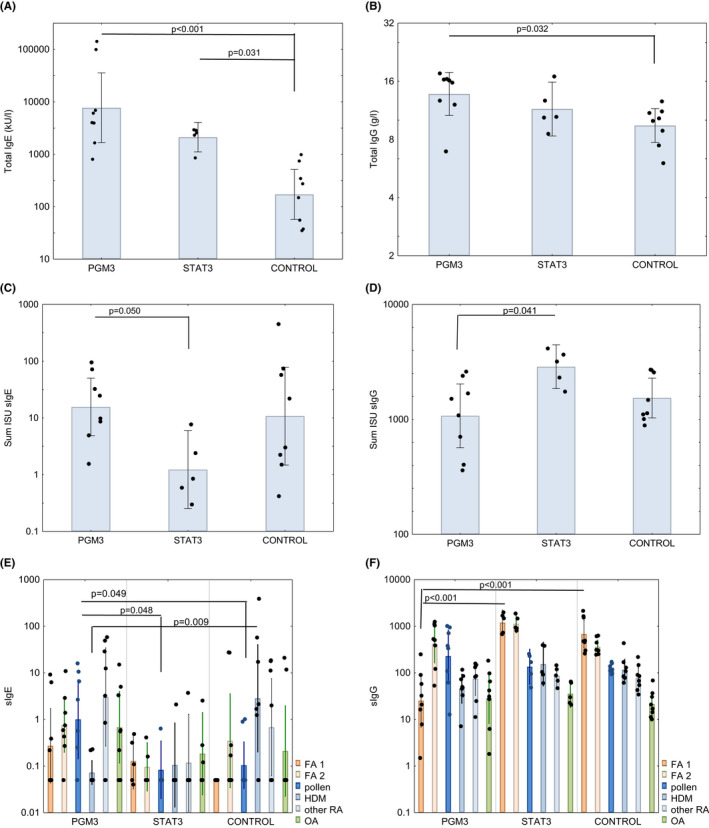
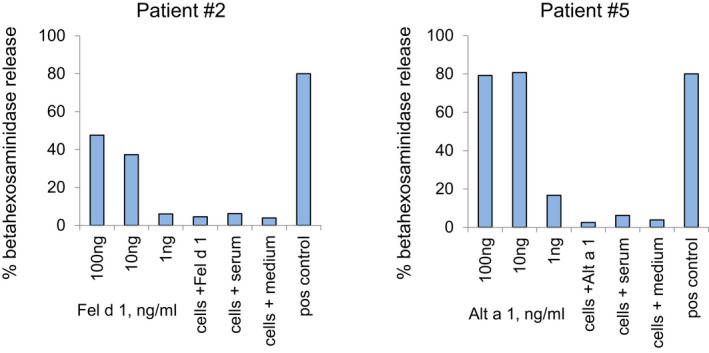
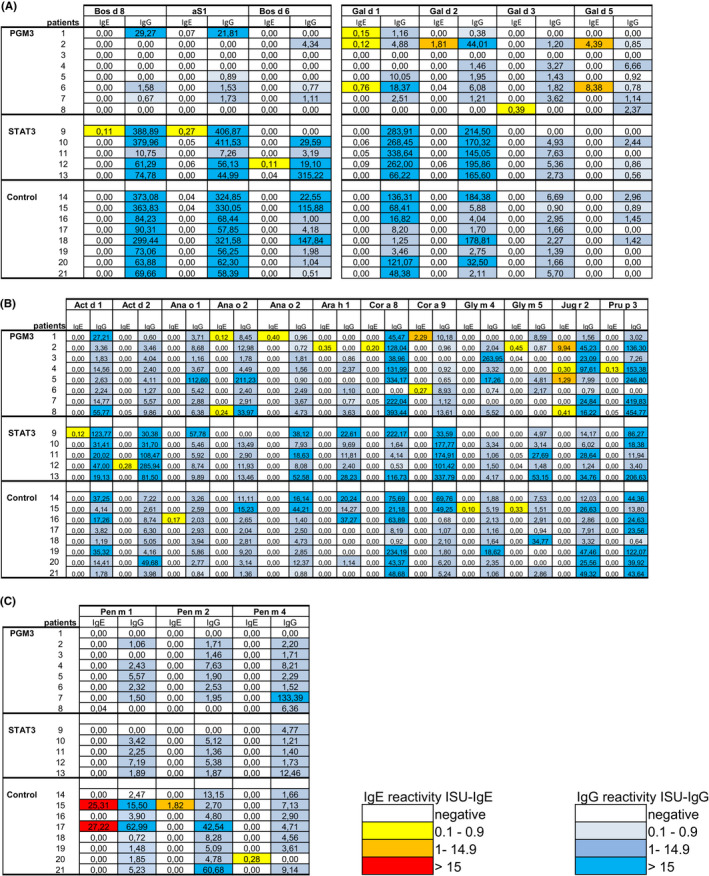
Median total IgE levels were significantly lower in the sensitized control group (212.9 kU/L) as compared to PGM3 (5042 kU/L) and STAT3 patients (2561 kU/L). However, PGM3 patients had significantly higher allergen-specific IgE levels and were sensitized to a larger number of allergen molecules as compared to STAT3 patients. Biological relevance of IgE sensitization was confirmed for PGM3 patients by basophil activation testing. PGM3 patients showed significantly lower cumulative allergen-specific IgG responses in particular to milk and egg allergens as compared to STAT3 patients and sensitized controls whereas total IgG levels were comparable to STAT3 patients and significantly higher than in controls.
The analysis with multiple micro-arrayed allergen molecules reveals profound differences of allergen-specific IgE and IgG recognition in PGM3 and STAT3 patients which may be useful for classification of IEI and clinical characterization of patients.
免疫缺陷患者体内 IgE 和 IgG 针对过敏原分子的特异性尚未得到详细研究。
使用过敏原分子的综合检测面板研究明确的高 IgE 综合征(HIES)患者的 IgE 和 IgG 抗体特异性。
我们使用含有过敏原分子微阵列的芯片分析了两组 HIES 患者(磷酸葡糖变位酶 3 基因(PGM3)常染色体隐性突变;信号转导与转录激活因子 3 基因(STAT3)常染色体显性负性突变)和年龄匹配的过敏致敏患者的血清中过敏原特异性 IgE 和 IgG 水平。使用转染人 FcεRI 的大鼠嗜碱性白血病细胞进行测定,以研究 IgE 致敏的生物学相关性。
与 PGM3(5042 kU/L)和 STAT3 患者(2561 kU/L)相比,致敏对照组的中位总 IgE 水平(212.9 kU/L)明显较低。然而,PGM3 患者的过敏原特异性 IgE 水平显著更高,并且对更多的过敏原分子产生致敏。通过嗜碱性粒细胞激活试验证实了 PGM3 患者 IgE 致敏的生物学相关性。与 STAT3 患者和致敏对照组相比,PGM3 患者的累积过敏原特异性 IgG 反应明显较低,特别是对牛奶和鸡蛋过敏原,而总 IgG 水平与 STAT3 患者相当,且明显高于对照组。
使用多个微阵列过敏原分子的分析揭示了 PGM3 和 STAT3 患者过敏原特异性 IgE 和 IgG 识别的显著差异,这可能有助于免疫缺陷的分类和患者的临床特征描述。