Department of Pediatrics, Harvard Medical School, Boston, MA.
Division of Newborn Medicine, Boston Children's Hospital, Boston, MA.
Blood Adv. 2022 Jan 11;6(1):13-27. doi: 10.1182/bloodadvances.2021004207.
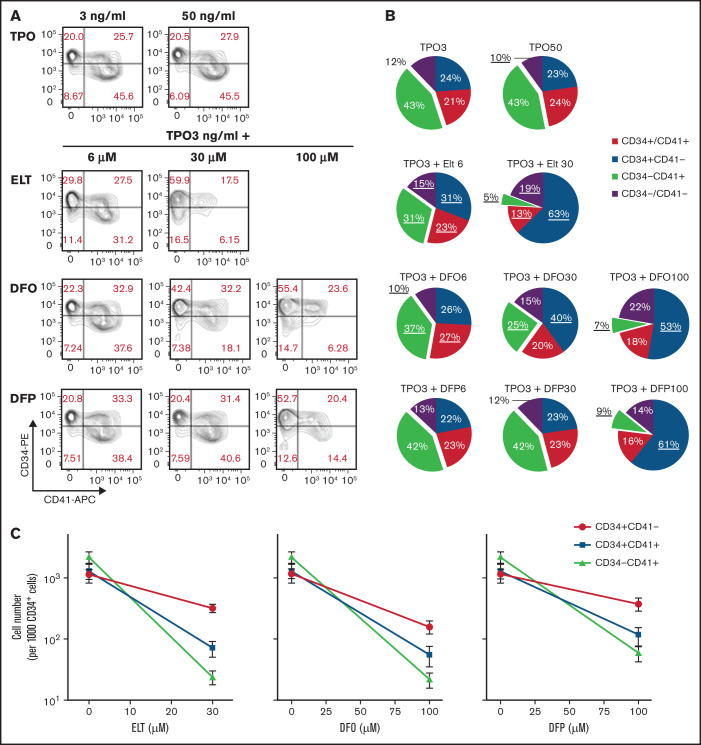
Eltrombopag (ELT) is a thrombopoietic agent approved for immune thrombocytopenia and also a potent iron chelator. Here we found that ELT exhibited dose-dependent opposing effects on in vitro megakaryopoiesis: low concentrations (≤6 µM, ELT6) stimulated megakaryopoiesis, but high concentrations (30 µM, ELT30) suppressed megakaryocyte (MK) differentiation and proliferation. The suppressive effects of ELT30 were reproduced by other iron chelators, supporting iron chelation as a likely mechanism. During MK differentiation, committed MK progenitors (CD34+/CD41+ and CD34-/CD41+ cells) were significantly more sensitive than undifferentiated progenitors (CD34+/CD41- cells) to the suppressive effects of ELT30, which resulted from both decreased proliferation and increased apoptosis. The antiproliferative effects of ELT30 were reversed by increased iron in the culture, as were the proapoptotic effects when exposure to ELT30 was short. Because committed MK progenitors exhibited the highest proliferative rate and the highest sensitivity to iron chelation, we tested whether their iron status influenced their response to ELT during rapid cell expansion. In these studies, iron deficiency reduced the proliferation of CD41+ cells in response to all ELT concentrations. Severe iron deficiency also reduced the number of MKs generated in response to high thrombopoietin concentrations by ∼50%, compared with iron-replete cultures. Our findings support the hypothesis that although iron deficiency can stimulate certain cells and steps in megakaryopoiesis, it can also limit the proliferation of committed MK progenitors, with severity of iron deficiency and degree of thrombopoietic stimulation influencing the ultimate output. Further studies are needed to clarify how megakaryopoiesis, iron deficiency, and ELT stimulation are clinically interrelated.
依洛尤单抗(ELT)是一种已被批准用于治疗免疫性血小板减少症的促血小板生成素,同时也是一种有效的铁螯合剂。在此,我们发现 ELT 在体外巨核细胞生成中表现出剂量依赖性的相反作用:低浓度(≤6µM,ELT6)刺激巨核细胞生成,但高浓度(30µM,ELT30)抑制巨核细胞(MK)分化和增殖。其他铁螯合剂可重现 ELT30 的抑制作用,支持铁螯合可能是一种潜在机制。在 MK 分化过程中,定向 MK 祖细胞(CD34+/CD41+和 CD34-/CD41+细胞)比未分化祖细胞(CD34+/CD41-细胞)对 ELT30 的抑制作用更敏感,这是由于增殖减少和凋亡增加所致。ELT30 的抗增殖作用可通过培养物中增加的铁来逆转,而当暴露于 ELT30 时间较短时,促凋亡作用也可逆转。由于定向 MK 祖细胞表现出最高的增殖率和对铁螯合的最高敏感性,我们测试了它们的铁状态是否会影响它们在快速细胞扩增过程中对 ELT 的反应。在这些研究中,铁缺乏症降低了 CD41+细胞对所有 ELT 浓度的增殖反应。与铁充足的培养物相比,严重的铁缺乏症还降低了对高血小板生成素浓度反应生成的 MK 数量约 50%。我们的研究结果支持以下假说:尽管铁缺乏症可以刺激巨核细胞生成中的某些细胞和步骤,但它也可以限制定向 MK 祖细胞的增殖,铁缺乏症的严重程度和促血小板生成素刺激的程度影响最终输出。需要进一步研究来阐明巨核细胞生成、铁缺乏症和 ELT 刺激在临床上是如何相互关联的。