Institute for Treatment and Rehabilitation 'Niška Banja', Clinic of Cardiology, University of Niš School of Medicine, Niš, Serbia.
Cardiology Department, Santa Maria della Misericordia Hospital, Perugia, Italy.
ESC Heart Fail. 2021 Dec;8(6):5068-5080. doi: 10.1002/ehf2.13575. Epub 2021 Oct 16.
Pulmonary congestion during exercise assessed by lung ultrasound predicts negative outcome in patients with heart failure with preserved ejection fraction (HFpEF). We aimed at assessing predictors of exercise-induced pulmonary B-lines in HFpEF patients.
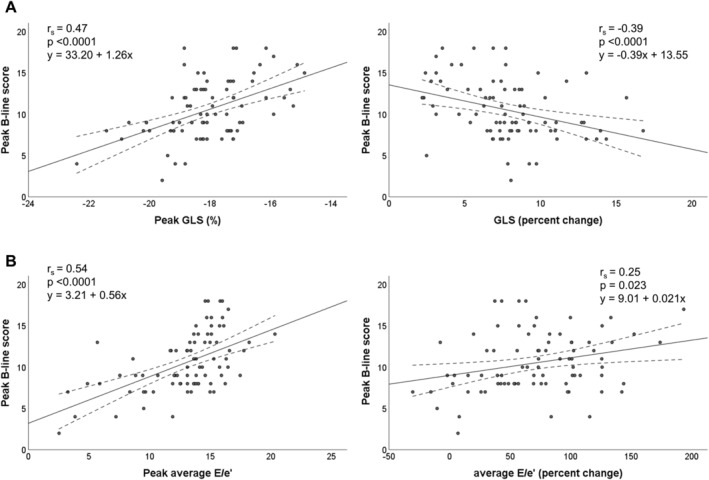
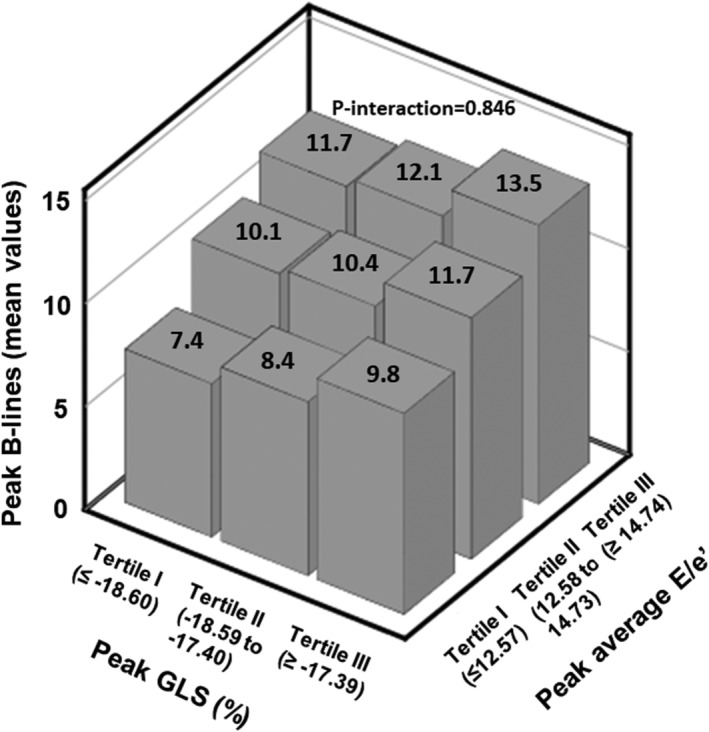
Eighty-one I-II NYHA class HFpEF patients (65.0 ± 8.2 y/o, 56.8% females) underwent standard and strain echocardiography, lung ultrasound, and natriuretic peptide assessment during supine exercise echocardiography (baseline and peak exercise). Peak values and their changes were compared in subgroups according to exercise lung congestion grading (peak B-lines >10 or ≤10). Exercise elicited significant changes for all echocardiographic parameters in both subgroups [39/81 (48.1%) with peak B-lines >10; 42/81 (51.9%) with B-lines ≤10]. Peak values and changes of E-wave (and its derived indices) were significantly higher in patients with >10 peak B-lines compared with those with ≤10 B-line (all P-values <0.03), showing significant correlation with peak B-lines for all parameters; concomitantly, global longitudinal strain (GLS) and global strain rate (GSR) during systole (GSRs), early (GSRe) and late (GSRa) diastole, and isovolumic relaxation (GSRivr) were reduced in patients with B-lines >10 (all P-values <0.05), showing a negative correlation with peak B-lines. By adjusted linear regression analysis, peak and change diastolic parameters (E-wave, E/e', GSRivr, and E/GSRivr) and peak GLS were individually significantly associated with peak B-lines. By covariate-adjusted multivariable model, E/e' and GSRa at peak exercise were retained as independent predictors of peak B-lines, with substantial goodness of fit of model (adjusted R 0.776).
In HFpEF, development of pulmonary congestion upon exercise is mostly concomitant with exercise-induced worsening of diastolic function.
通过肺部超声评估运动时的肺淤血可预测射血分数保留的心力衰竭(HFpEF)患者的不良预后。本研究旨在评估 HFpEF 患者运动性肺 B 线的预测因素。
81 例 I-II 级纽约心脏协会(NYHA)心功能分级 HFpEF 患者(65.0±8.2 岁,女性占 56.8%)在仰卧位运动超声心动图检查时接受标准和应变超声心动图、肺部超声和利钠肽评估(基础状态和运动峰值)。根据运动性肺充血分级(峰值 B 线>10 条或≤10 条)比较亚组的峰值值及其变化。在两个亚组中,所有超声心动图参数均发生显著变化[39/81 例(48.1%)的峰值 B 线>10 条;42/81 例(51.9%)的峰值 B 线≤10 条]。与 B 线≤10 条的患者相比,B 线>10 条的患者的 E 波峰值及其衍生指数的变化显著更高(所有 P 值<0.03),所有参数与峰值 B 线均呈显著相关性;同时,收缩期(GSRs)、舒张早期(GSRe)、舒张晚期(GSRa)和等容舒张期(GSRivr)的整体纵向应变(GLS)和整体应变率(GSR)在 B 线>10 条的患者中降低(所有 P 值<0.05),与峰值 B 线呈负相关。经调整线性回归分析,峰值和变化的舒张参数(E 波、E/e'、GSRivr 和 E/GSRivr)和峰值 GLS 与峰值 B 线均呈显著相关。经协变量调整的多变量模型中,E/e'和峰值运动时的 GSRa 保留为峰值 B 线的独立预测因子,模型拟合度良好(调整 R 0.776)。
在 HFpEF 中,运动时肺充血的发展与运动性舒张功能恶化大多同时发生。