Department of Maternal and Child Health, School of Public Health, Tongji Medical College, Huazhong University of Science and Technology, No.13 Hangkong Road, Wuhan, 430030, China.
Ministry of Education Key Laboratory of Environment and Health, and State Key Laboratory of Environmental Health (Incubating), School of Public Health, Tongji Medical College, Huazhong University of Science and Technology, Wuhan, China.
Cardiovasc Diabetol. 2021 Oct 16;20(1):207. doi: 10.1186/s12933-021-01397-1.
Previous studies suggested an adverse association between higher fasting blood glucose (FBG) variability and cardiovascular disease (CVD). Lifetime risk provides an absolute risk assessment during the remainder of an individual's life. However, the association between FBG variability and the lifetime risk of CVD is uncertain.
We aimed to investigate the effect of the visit-to-visit FBG variability on the lifetime risk of CVD.
This study included participants from the Kailuan Study who did not have CVD at index ages 35, 45, and 55 years. The FBG variability was defined as the coefficient of variation (CV) of three FBG values that were measured during the examination periods of 2006-2007, 2008-2009, and 2010-2011. We used a modified Kaplan-Merrier method to estimate lifetime risk of CVD according to tertiles of FBG variability.
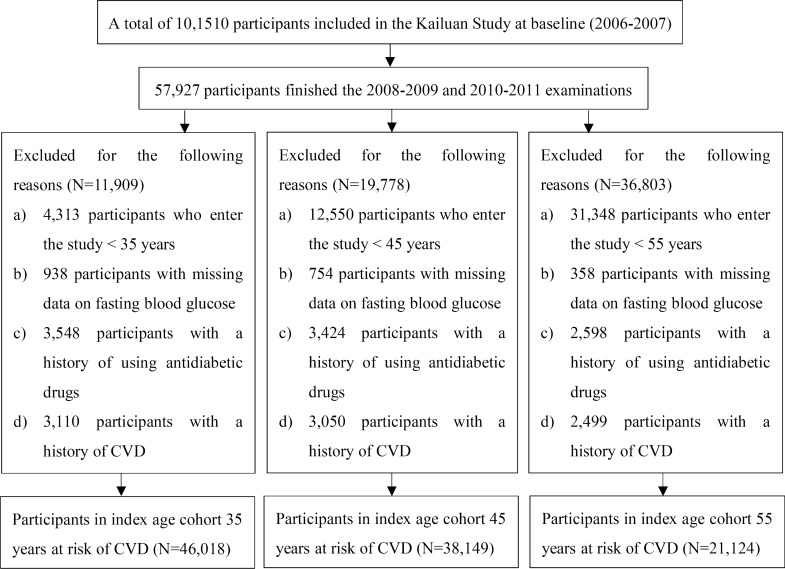
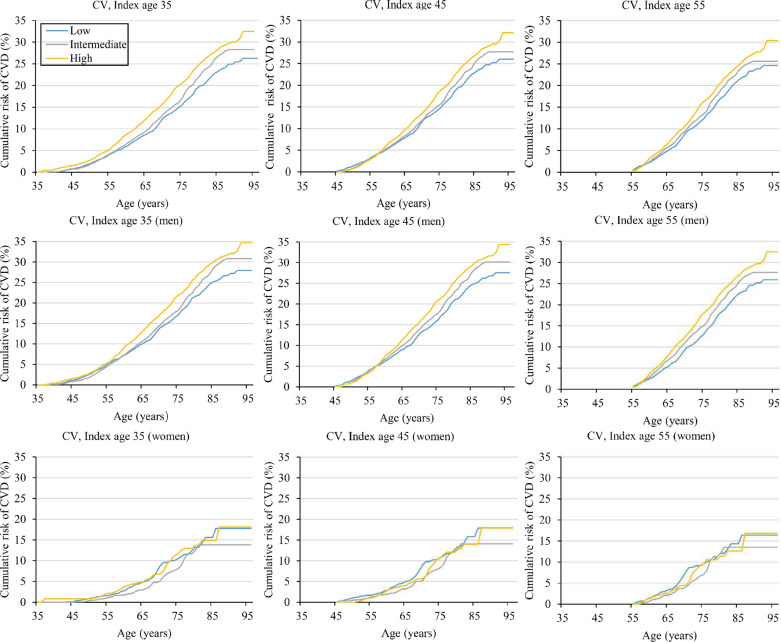
At index age 35 years, the study sample comprised 46,018 participants. During a median follow-up of 7.0 years, 1889 participants developed CVD events. For index age 35 years, participants with high FBG variability had higher lifetime risk of CVD (32.5%; 95% confidence interval [CI]: 28.9-36.1%), compared with intermediate (28.3%; 95% CI: 25.5 -31.1%) and low (26.3%; 95% CI: 23.0-29.5%) FBG variability. We found that higher FBG variability was associated with increased lifetime risk of CVD in men but not women. Similar patterns were observed at index ages 45 and 55 years.
Higher FBG variability was associated with increased lifetime risk of CVD at each index age. Focusing on the FBG variability may provide an insight to the clinical utility for reducing the lifetime risk of CVD.
先前的研究表明,空腹血糖(FBG)变异性较高与心血管疾病(CVD)之间存在不利关联。终生风险提供了个体余生期间的绝对风险评估。然而,FBG 变异性与 CVD 的终生风险之间的关联尚不确定。
我们旨在研究访视间 FBG 变异性对 CVD 终生风险的影响。
本研究纳入了在基线年龄 35、45 和 55 岁时没有 CVD 的开滦研究参与者。FBG 变异性定义为在 2006-2007、2008-2009 和 2010-2011 年检查期间测量的三个 FBG 值的变异系数(CV)。我们使用改良的 Kaplan-Meier 方法根据 FBG 变异性的三分位数估计 CVD 的终生风险。
在基线年龄 35 岁时,研究样本包括 46018 名参与者。在中位随访 7.0 年期间,有 1889 名参与者发生 CVD 事件。对于基线年龄 35 岁的参与者,FBG 变异性较高者发生 CVD 的终生风险较高(32.5%;95%置信区间 [CI]:28.9-36.1%),而中间(28.3%;95% CI:25.5-31.1%)和低(26.3%;95% CI:23.0-29.5%)FBG 变异性者。我们发现,较高的 FBG 变异性与男性而不是女性的 CVD 终生风险增加相关。在基线年龄 45 和 55 岁时也观察到类似的模式。
较高的 FBG 变异性与每个基线年龄的 CVD 终生风险增加相关。关注 FBG 变异性可能为降低 CVD 的终生风险提供临床实用价值。