Division of Endocrinology, Diabetes & Metabolism, Mayo Clinic College of Medicine, Rochester, Minnesota.
Department of Health and Human Performance, College of Charleston, Charleston, South Carolina.
Am J Physiol Endocrinol Metab. 2021 Nov 1;321(5):E728-E736. doi: 10.1152/ajpendo.00284.2021. Epub 2021 Oct 18.
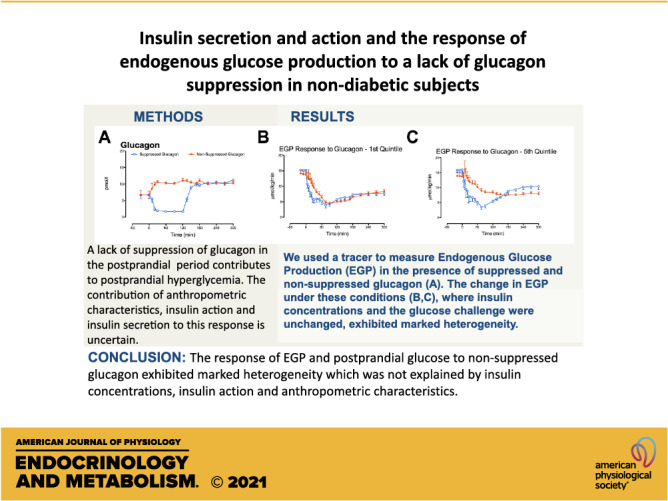
Type 2 diabetes is a disease characterized by impaired insulin secretion and defective glucagon suppression in the postprandial period. We examined the effect of impaired glucagon suppression on glucose concentrations and endogenous glucose production (EGP) at different degrees of insulin secretory impairment. The contribution of anthropometric characteristics, peripheral, and hepatic insulin action to this variability was also examined. To do so, we studied 54 nondiabetic subjects on two occasions in which endogenous hormone secretion was inhibited by somatostatin, with glucagon infused at a rate of 0.65 ng/kg/min, at 0 min to prevent a fall in glucagon (nonsuppressed day) or at 120 min to create a transient fall in glucagon (suppressed day). Subjects received glucose (labeled with [3-H]-glucose) infused to mimic the systemic appearance of 50-g oral glucose. Insulin was infused to mimic a prandial insulin response in 18 subjects, another 18 received 80% of the dose, and the remaining 18 received 60%. EGP was measured using the tracer-dilution technique. Decreased prandial insulin resulted in greater % increase in peak glucose but not in integrated glucose concentrations attributable to nonsuppressed glucagon. The % change in integrated EGP was unaffected by insulin dose. Multivariate regression analysis, adjusted for age, sex, weight, and insulin dose, did not show a relationship between the EGP response to impaired suppression of glucagon and insulin action as measured at the time of screening by oral glucose tolerance. A similar analysis for hepatic insulin action also did not show a relationship with the EGP response. These data indicate that the effect of impaired glucagon suppression on EGP is independent of anthropometric characteristics and insulin action. In prediabetes, anthropometric characteristics as well as insulin action do not alter the hepatic response to glucagon. The postprandial suppression or lack of suppression of glucagon secretion is an important factor governing postprandial glucose tolerance independent of insulin secretion.
2 型糖尿病的特征是在餐后时期胰岛素分泌受损和胰高血糖素抑制作用缺陷。我们研究了胰高血糖素抑制作用受损对葡萄糖浓度和内源性葡萄糖生成(EGP)的影响,以及不同程度的胰岛素分泌受损。我们还检查了人体测量特征、外周和肝脏胰岛素作用对这种变异性的影响。为此,我们在两次研究中研究了 54 名非糖尿病患者,在这两次研究中,生长抑素抑制了内源性激素的分泌,以 0.65ng/kg/min 的速度输注胰高血糖素,在 0 分钟时防止胰高血糖素下降(未抑制日)或在 120 分钟时短暂下降胰高血糖素(抑制日)。给患者输注葡萄糖(用[3-H]-葡萄糖标记),模拟 50g 口服葡萄糖的全身出现。给 18 名患者输注胰岛素以模拟餐后胰岛素反应,给另外 18 名患者输注 80%的剂量,给其余 18 名患者输注 60%的剂量。使用示踪剂稀释技术测量 EGP。进餐时胰岛素减少导致葡萄糖峰值的%增加更大,但不导致归因于未抑制的胰高血糖素的葡萄糖浓度的积分增加。胰岛素剂量对 EGP 的积分变化%没有影响。多变量回归分析,调整年龄、性别、体重和胰岛素剂量,显示出在口服葡萄糖耐量筛选时测量的胰高血糖素抑制作用受损和胰岛素作用之间与 EGP 反应之间没有关系。对肝脏胰岛素作用的类似分析也没有显示与 EGP 反应之间的关系。这些数据表明,胰高血糖素抑制作用受损对 EGP 的影响独立于人体测量特征和胰岛素作用。在糖尿病前期,人体测量特征以及胰岛素作用不会改变肝脏对胰高血糖素的反应。餐后胰高血糖素分泌的抑制或缺乏是独立于胰岛素分泌的餐后葡萄糖耐量的重要因素。