Spiros Athan, Geerts Hugo
In Silico Biosciences, Berwyn, PA, United States.
Certara QSP, Canterbury, United Kingdom.
Front Neurosci. 2021 Sep 29;15:738903. doi: 10.3389/fnins.2021.738903. eCollection 2021.
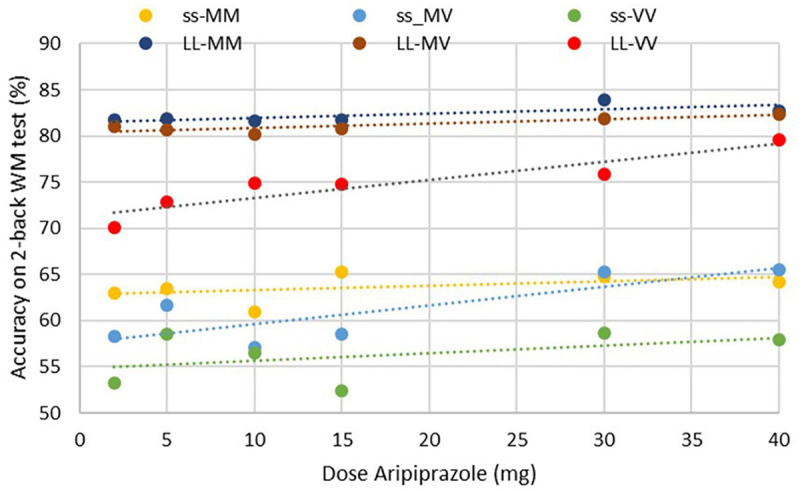
CNS disorders are lagging behind other indications in implementing genotype-dependent treatment algorithms for personalized medicine. This report uses a biophysically realistic computer model of an associative and dorsal motor cortico-striatal-thalamo-cortical loop and a working memory cortical model to investigate the pharmacodynamic effects of COMTVal158Met rs4680, 5-HTTLPR rs 25531 s/L and D2DRTaq1A1 genotypes on the clinical response of 7 antipsychotics. The effect of the genotypes on dopamine and serotonin dynamics and the level of target exposure for the drugs was calibrated from PET displacement studies. The simulations suggest strong gene-gene pharmacodynamic interactions unique to each antipsychotic. For PANSS Total, the D2DRTaq1 allele has the biggest impact, followed by the 5-HTTLPR rs25531. The A2A2 genotype improved efficacy for all drugs, with a more complex outcome for the 5-HTTLPR rs25531 genotype. Maximal range in PANSS Total for all 27 individual combinations is 3 (aripiprazole) to 5 points (clozapine). The 5-HTTLPR L/L with aripiprazole and risperidone and the D2DRTaq1A2A2 allele with haloperidol, clozapine and quetiapine reduce the motor side-effects with opposite effects for the s/s genotype. The COMT genotype has a limited effect on antipsychotic effect and EPS. For cognition, the COMT MM 5-HTTLPR L/L genotype combination has the best performance for all antipsychotics, except clozapine. Maximal difference is 25% of the total dynamic range in a 2-back working memory task. Aripiprazole is the medication that is best suited for the largest number of genotype combinations (10) followed by Clozapine and risperidone (6), haloperidol and olanzapine (3) and quetiapine and paliperidone for one genotype. In principle, the platform could identify the best antipsychotic treatment balancing efficacy and side-effects for a specific individual genotype. Once the predictions of this platform are validated in a clinical setting the platform has potential to support rational personalized treatment guidance in clinical practice.
在实施用于个性化医疗的基因依赖性治疗算法方面,中枢神经系统疾病落后于其他适应症。本报告使用一个具有生物物理真实性的联想性和背侧运动皮质-纹状体-丘脑-皮质环路计算机模型以及一个工作记忆皮质模型,来研究儿茶酚-O-甲基转移酶(COMT)Val158Met rs4680、5-羟色胺转运体相关启动子区域(5-HTTLPR)rs25531 s/L和多巴胺D2受体(D2DR)Taq1A1基因型对7种抗精神病药物临床反应的药效学影响。这些基因型对多巴胺和5-羟色胺动力学以及药物靶点暴露水平的影响,是根据正电子发射断层扫描(PET)置换研究进行校准的。模拟结果表明,每种抗精神病药物都有独特的强基因-基因药效学相互作用。对于阳性和阴性症状量表(PANSS)总分,D2DR Taq1等位基因影响最大,其次是5-HTTLPR rs25531。A2A2基因型提高了所有药物的疗效,而5-HTTLPR rs25531基因型的结果更为复杂。所有27种个体组合的PANSS总分最大范围为3分(阿立哌唑)至5分(氯氮平)。5-HTTLPR L/L与阿立哌唑和利培酮,以及D2DR Taq1A2A2等位基因与氟哌啶醇、氯氮平和喹硫平,可减少运动副作用,而s/s基因型则有相反作用。COMT基因型对抗精神病药物疗效和锥体外系症状(EPS)的影响有限。对于认知功能,COMT MM和5-HTTLPR L/L基因型组合对除氯氮平外的所有抗精神病药物表现最佳。在一个2-back工作记忆任务中,最大差异为总动态范围的25%。阿立哌唑是最适合最多基因型组合(10种)的药物,其次是氯氮平和利培酮(6种)、氟哌啶醇和奥氮平(3种),喹硫平和帕利哌酮各适合一种基因型。原则上,该平台可以为特定个体基因型确定平衡疗效和副作用的最佳抗精神病药物治疗方案。一旦该平台的预测在临床环境中得到验证,它就有可能在临床实践中支持合理的个性化治疗指导。