Mariano Antonella, Di Lorenzo Giorgio, Jannini Tommaso B, Santini Riccardo, Bertinelli Emanuela, Siracusano Alberto, Niolu Cinzia
Department of Systems Medicine, Chair of Psychiatry, University of Rome Tor Vergata, Rome, Italy.
IRCCS - Fondazione Santa Lucia, Rome, Italy.
Front Psychiatry. 2021 Oct 1;12:702789. doi: 10.3389/fpsyt.2021.702789. eCollection 2021.
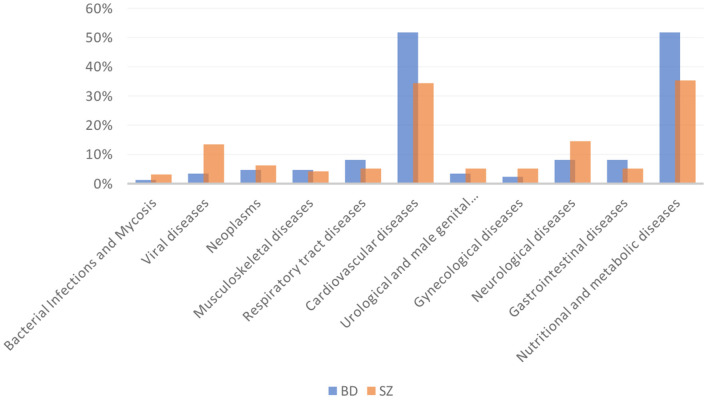
Medical comorbidities (MCs) represent a significant burden in terms of more frequent hospitalizations and overall lower life expectancy among people with severe mental disorders, such as schizophrenia and related psychotic disorders (SZ) and bipolar disorder (BD). The present article aims to compare the prevalence of MCs and to examine the associated characteristics as marital status, job occupation, level of education, and living arrangements, between BD and SZ patients. One-hundred-eight-one patients with MCs (85/47% had BD and 96/53% had SZ) were recruited retrospectively from the Acute Inpatients Psychiatry Unit of Policlinico Tor Vergata, Rome, between January-2017 and December-2020. MCs were: cardiovascular diseases (CVD), bacterial infections, mycoses, viral diseases, neoplasms, musculoskeletal, respiratory tract, urological and male genital, gynecological, neurological, gastrointestinal, metabolic syndrome, nutritional, and metabolic diseases. BD had more MC than SZ (36.2 vs. 28.2%, respectively, = 0.04). CVD and metabolic MC were more common among BD (51.8 vs.34.4%; 51.8 vs.35.3%; = 0.018; = 0.039; respectively), while viral diseases were more frequent in SZ (13.5 vs.3.5%, = 0.035). Hypertension was common in both psychiatric illnesses (81.8% BD vs. 65.6% SZ, = 0.18). Obesity was the most frequent metabolic disease in both BD and SZ (75% BD vs. 73.5% SZ, = 0.91), followed by diabetes mellitus (52.3% BD . 55.9% SZ, = 0.93), metabolic syndrome (54.5% BD vs. 47.1% SZ, = 0.67) and dysthyroidism (47.7% BD vs. 25.7% SZ, = 0.093). After performing a binary logistic regression analysis, only two MCs showed a statistically significant association: patients with SZ had an OR of 2.01 [CI 95% (1.00-4.01)] for CVD compared to BD; on the other hand, patients with BD had an OR of 16.57 [CI 95% (3.58-76.77)] for gynecological diseases compared to SZ patients. MCs are common among people with severe mental illness, especially CVD and metabolic diseases, highlighting the need for a more collaborative relationship between general medical providers and psychiatrists.
在精神分裂症和相关精神障碍(SZ)以及双相情感障碍(BD)等严重精神障碍患者中,共病(MCs)会导致更频繁的住院治疗,并使总体预期寿命降低,这是一个重大负担。本文旨在比较BD和SZ患者共病的患病率,并研究婚姻状况、职业、教育程度和生活安排等相关特征。2017年1月至2020年12月期间,从罗马托尔韦尔加塔综合医院的急性住院精神科病房回顾性招募了181名患有共病的患者(85名/47%为BD患者,96名/53%为SZ患者)。共病包括:心血管疾病(CVD)、细菌感染、真菌病、病毒疾病、肿瘤、肌肉骨骼疾病、呼吸道疾病、泌尿系统和男性生殖系统疾病、妇科疾病、神经系统疾病、胃肠道疾病、代谢综合征、营养和代谢疾病。BD患者的共病比SZ患者更多(分别为36.2%和28.2%,P = 0.04)。CVD和代谢性共病在BD患者中更为常见(分别为51.8%对34.4%;51.8%对35.3%;P = 0.018;P = 0.039),而病毒疾病在SZ患者中更频繁(13.5%对3.5%,P = 0.035)。高血压在两种精神疾病中都很常见(BD患者为81.8%,SZ患者为65.6%,P = 0.18)。肥胖是BD和SZ中最常见的代谢性疾病(BD患者为75%,SZ患者为73.5%,P = 0.91),其次是糖尿病(BD患者为52.3%,SZ患者为55.9%,P = 0.93)、代谢综合征(BD患者为54.5%,SZ患者为47.1%,P = 0.67)和甲状腺功能减退症(BD患者为47.7%,SZ患者为25.7%,P = 0.093)。在进行二元逻辑回归分析后,只有两种共病显示出统计学上的显著关联:与BD患者相比,SZ患者患CVD的比值比(OR)为2.01 [95%置信区间(1.00 - 4.01)];另一方面,与SZ患者相比,BD患者患妇科疾病的OR为16.57 [95%置信区间(3.58 - 76.77)]。共病在严重精神疾病患者中很常见,尤其是CVD和代谢性疾病,这凸显了普通医疗服务提供者和精神科医生之间建立更协作关系的必要性。