Yeh Chia-Wen, Wu Wan-Jhen, Lu Chen-Wen, Wang Sheue-Er, Chuang Wu-Chang, Lee Ming-Chung, Wu Chung-Hsin
School of Life Science, National Taiwan Normal University, Taipei City, Taiwan.
Pathological Department, Saint Paul's Hospital, Taoyuan City, Taiwan.
Evid Based Complement Alternat Med. 2021 Oct 5;2021:2556352. doi: 10.1155/2021/2556352. eCollection 2021.
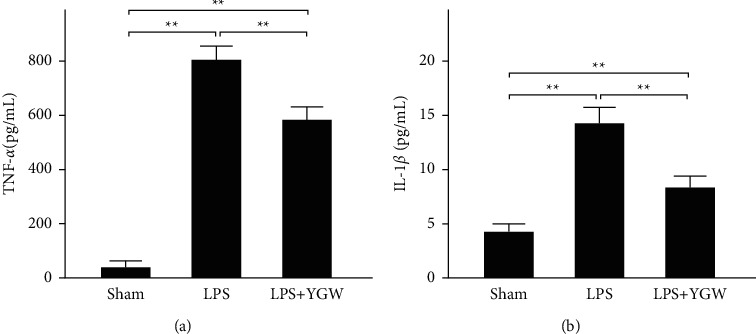
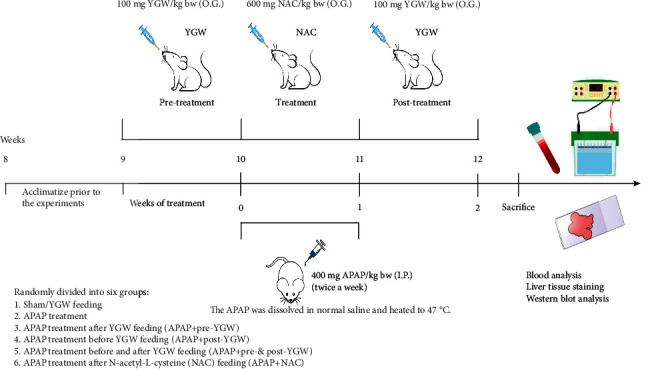
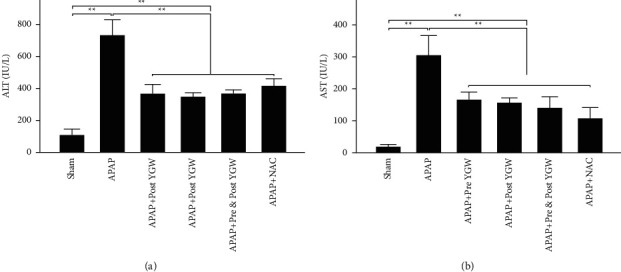
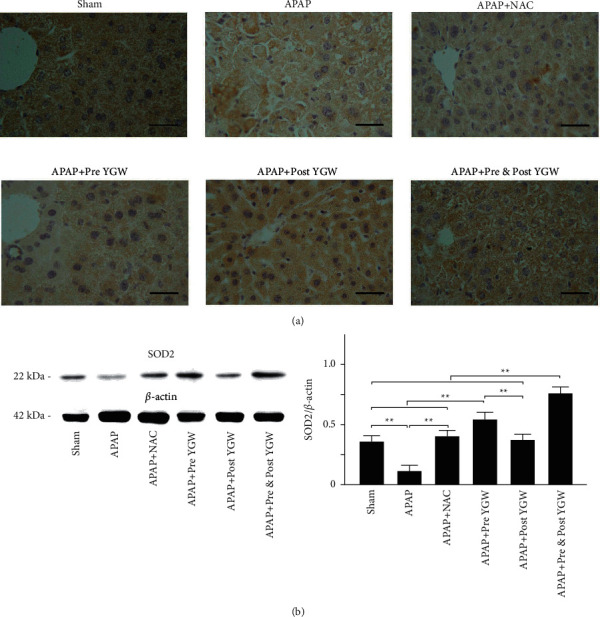
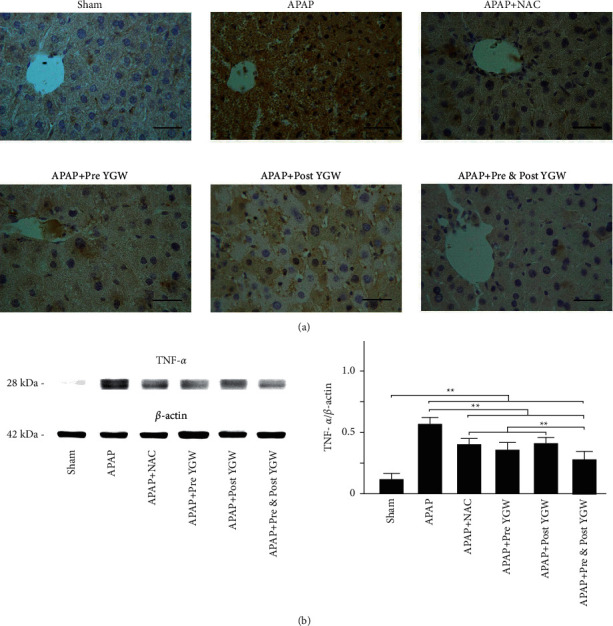
A hepatoprotective medicine, (YGW), was used to treat hepatic damage in cell and mouse models. We performed a 1,1-diphenyl-2- picrylhydrazyl (DPPH) assay and found that YGW exhibited a significantly high free radical scavenging ability. Furthermore, the results of the 3-(4,5-dimethylthiazol-2-yl)-2,5-diphenyltetrazolium bromide (MTT) assay revealed that YGW treatment could alleviate lipopolysaccharide (LPS)-induced damage in Kupffer cells (liver macrophages). Enzyme-linked immunosorbent assay results demonstrated that YGW treatment could alleviate LPS-induced inflammation in Kupffer cells by inhibiting the expression of tumor necrosis factor (TNF)- and interleukin (IL)-1. By quantifying the serum levels of alanine aminotransferase (ALT) and aspartate aminotransferase (AST), we found that YGW treatment could alleviate hepatic damage and improve immunity in acetaminophen- (APAP-) treated mice by inhibiting the expression of ALT and AST. The findings of hematoxylin and eosin and Masson's trichrome staining indicated that YGW treatment could alleviate hepatic damage and reduce collagen fiber formation in the liver tissue of APAP-treated mice. Furthermore, immunohistochemistry staining and Western blot results showed that YGW treatment could alleviate oxidative stress, inflammation, and apoptosis in the liver tissue of APAP-treated mice by enhancing superoxide dismutase 2 (SOD2) expression but inhibiting TNF- and caspase 3 expression. Our results suggest that YGW treatment exerted hepatoprotective effects on LPS-treated Kupffer cells and APAP-treated mice by inhibiting oxidation, inflammation, and apoptosis.
一种保肝药物(YGW)被用于细胞和小鼠模型中治疗肝损伤。我们进行了1,1-二苯基-2-苦基肼基(DPPH)测定,发现YGW具有显著高的自由基清除能力。此外,3-(4,5-二甲基噻唑-2-基)-2,5-二苯基四氮唑溴盐(MTT)测定结果显示,YGW处理可减轻脂多糖(LPS)诱导的库普弗细胞(肝巨噬细胞)损伤。酶联免疫吸附测定结果表明,YGW处理可通过抑制肿瘤坏死因子(TNF)和白细胞介素(IL)-1的表达减轻LPS诱导的库普弗细胞炎症。通过定量丙氨酸氨基转移酶(ALT)和天冬氨酸氨基转移酶(AST)的血清水平,我们发现YGW处理可通过抑制ALT和AST的表达减轻对乙酰氨基酚(APAP)处理小鼠的肝损伤并提高免疫力。苏木精和伊红染色以及Masson三色染色结果表明,YGW处理可减轻APAP处理小鼠肝组织中的肝损伤并减少胶原纤维形成。此外,免疫组织化学染色和蛋白质印迹结果显示,YGW处理可通过增强超氧化物歧化酶2(SOD2)表达但抑制TNF和半胱天冬酶3表达来减轻APAP处理小鼠肝组织中的氧化应激、炎症和细胞凋亡。我们的结果表明,YGW处理通过抑制氧化、炎症和细胞凋亡对LPS处理的库普弗细胞和APAP处理的小鼠发挥保肝作用。