Morelli Nathan, Johnson Nathan F, Cassity Evan P, Kalema Anna G, Morris Peter E, Montgomery-Yates Ashley A, Mayer Kirby P
Department of Physical Therapy, High Point University, High Point, USA.
Department of Physical Therapy, University of Kentucky, Lexington, USA.
Cureus. 2021 Sep 7;13(9):e17785. doi: 10.7759/cureus.17785. eCollection 2021 Sep.
There is a paucity of research regarding the feasibility and association of cerebral cortex function to patient outcomes after acute respiratory failure (ARF).
To determine the feasibility of functional connectivity measures and examine the association of functional connectivity to a multifaceted battery of outcomes in survivors of ARF.
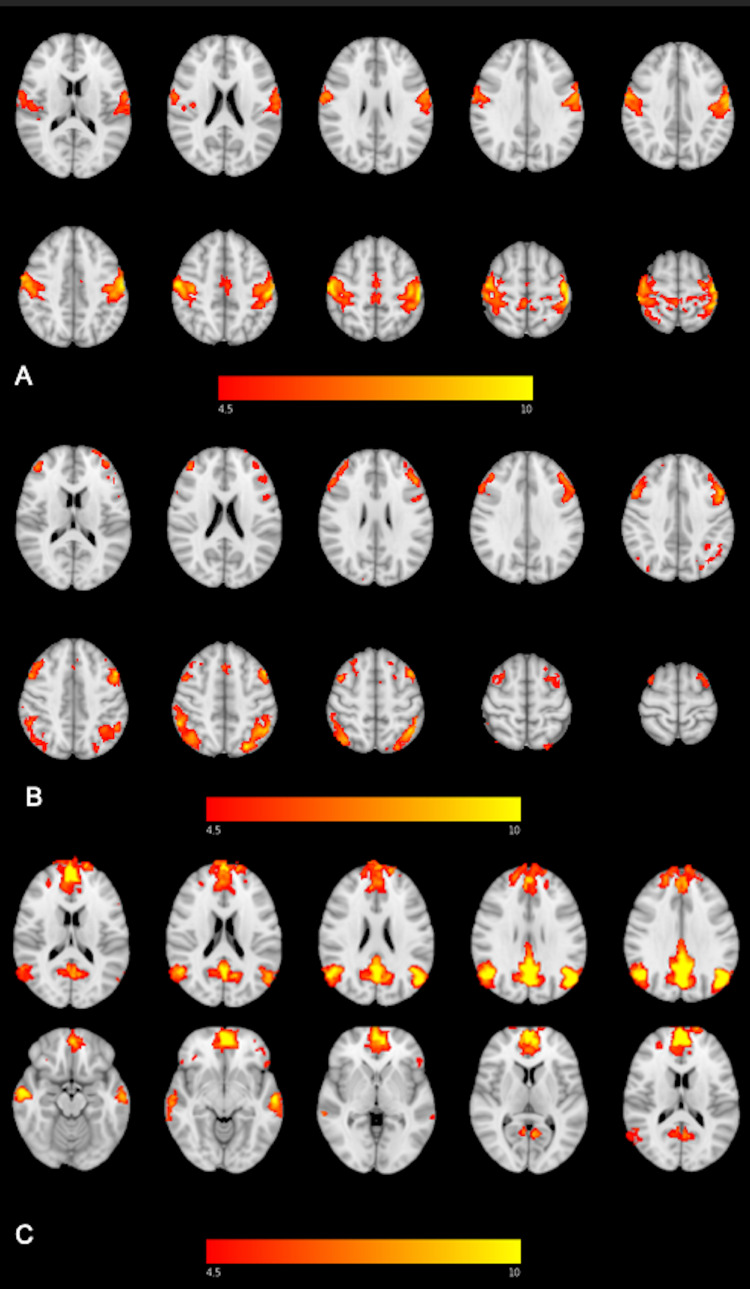
Eight ARF patients (age:58±3.7, ICU days:10.4±8.6) completed functional magnetic resonance imaging (fMRI), cognitive, physical-function, anxiety, depression, and driving simulator tests at one month post-hospital discharge. Pearson's correlations assessed the relationship between functional connectivity within the default mode network (FPN), sensorimotor network (SMN), and frontoparietal network (FPN) to outcomes.
Low physical-function (r=0.75, p=0.03) and divided-attention (r=-0.86, p=0.03) during the driving simulator task correlated with low FPN connectivity. Low SMN connectivity demonstrated relationships to slower gait speed (r=0.82, p=0.01) and low short physical performance battery (SPPB) scores (r=0.81, p=0.01).
fMRI is feasible to assess ARF patients' post-ICU limitations, as low post-ARF brain connectivity may be linked to low physical function, providing potential development of therapeutic interventions.
关于急性呼吸衰竭(ARF)后大脑皮层功能与患者预后的可行性及相关性的研究较少。
确定功能连接测量的可行性,并研究ARF幸存者中功能连接与多方面预后指标的相关性。
8名ARF患者(年龄:58±3.7岁,重症监护病房住院天数:10.4±8.6天)在出院后1个月完成了功能磁共振成像(fMRI)、认知、身体功能、焦虑、抑郁和驾驶模拟器测试。Pearson相关性分析评估了默认模式网络(FPN)、感觉运动网络(SMN)和额顶网络(FPN)内的功能连接与预后之间的关系。
驾驶模拟器任务期间身体功能低下(r = 0.75,p = 0.03)和注意力分散(r = -0.86,p = 0.03)与FPN连接性低相关。SMN连接性低与步态速度较慢(r = 0.82,p = 0.01)和简短身体功能测试(SPPB)得分低(r = 0.81,p = 0.01)有关。
fMRI可用于评估ARF患者重症监护病房后的功能限制,因为ARF后脑连接性低可能与身体功能低下有关,这为治疗干预措施的潜在发展提供了依据。