Research Group for Evolutionary Physiology, Max Planck Institute for Ornithology, Eberhard-Gwinner-Straße, 82319, Seewiesen, Germany.
Department of Biology, University of Konstanz, Universitätsstraße 10, 78464, Konstanz, Germany.
Integr Comp Biol. 2022 Aug 13;62(1):58-70. doi: 10.1093/icb/icab196.
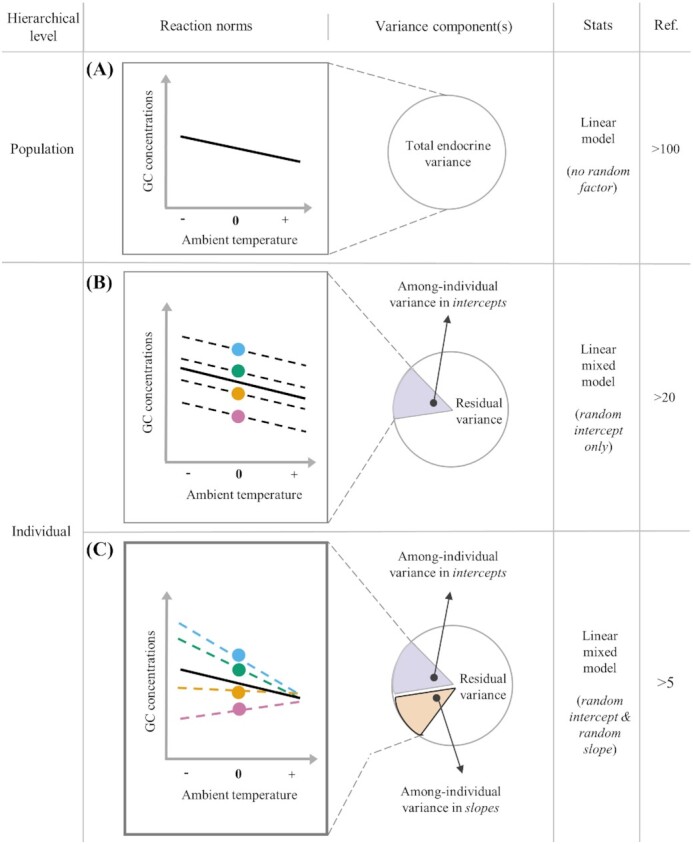
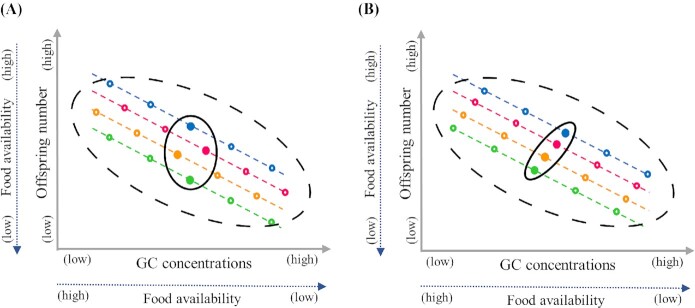
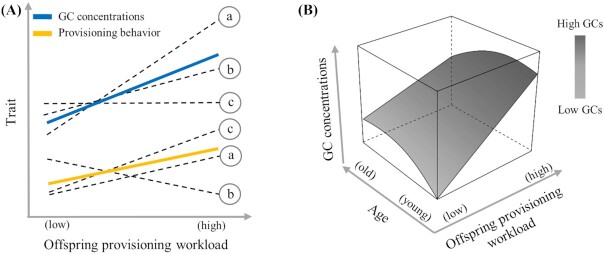
Hormones are highly responsive internal signals that help organisms adjust their phenotype to fluctuations in environmental and internal conditions. Our knowledge of the causes and consequences of variation in circulating hormone concentrations has improved greatly in the past. However, this knowledge often comes from population-level studies, which generally tend to make the flawed assumption that all individuals respond in the same way to environmental changes. Here, we advocate that we can vastly expand our understanding of the ecology and evolution of hormonal traits once we acknowledge the existence of individual differences by quantifying hormonal plasticity at the individual level, where selection acts. In this review, we use glucocorticoid (GC) hormones as examples of highly plastic endocrine traits that interact intimately with energy metabolism but also with other organismal traits like behavior and physiology. First, we highlight the insights gained by repeatedly assessing an individual's GC concentrations along a gradient of environmental or internal conditions using a "reaction norm approach." This study design should be followed by a hierarchical statistical partitioning of the total endocrine variance into the among-individual component (individual differences in average hormone concentrations, i.e., in the intercept of the reaction norm) and the residual (within-individual) component. The latter is ideally further partitioned by estimating more precisely hormonal plasticity (i.e., the slope of the reaction norm), which allows to test whether individuals differ in the degree of hormonal change along the gradient. Second, we critically review the published evidence for GC variation, focusing mostly on among- and within-individual levels, finding only a good handful of studies that used repeated-measures designs and random regression statistics to investigate GC plasticity. These studies indicate that individuals can differ in both the intercept and the slope of their GC reaction norm to a known gradient. Third, we suggest rewarding avenues for future work on hormonal reaction norms, for example to uncover potential costs and trade-offs associated with GC plasticity, to test whether GC plasticity varies when an individual's reaction norm is repeatedly assessed along the same gradient, whether reaction norms in GCs covary with those in other traits like behavior and fitness (generating multivariate plasticity), or to quantify GC reaction norms along multiple external and internal gradients that act simultaneously (leading to multidimensional plasticity). Throughout this review, we emphasize the power that reaction norm approaches offer for resolving unanswered questions in ecological and evolutionary endocrinology.
激素是高度响应的内部信号,有助于生物调整其表型以适应环境和内部条件的波动。过去,我们对循环激素浓度变化的原因和后果的了解有了很大的提高。然而,这种知识通常来自于群体水平的研究,这些研究往往有一个有缺陷的假设,即所有个体对环境变化的反应方式都是相同的。在这里,我们主张,一旦我们承认个体差异的存在,并通过在个体水平上量化激素可塑性来研究选择作用的地方,我们就可以极大地扩展对激素特征的生态学和进化的理解。在这篇综述中,我们使用糖皮质激素 (GC) 激素作为高度可塑的内分泌特征的例子,这些特征与能量代谢密切相关,但也与行为和生理学等其他生物体特征相关。首先,我们强调了通过沿着环境或内部条件的梯度反复评估个体的 GC 浓度来使用“反应规范方法”获得的见解。这种研究设计之后应该对总内分泌方差进行层次统计分割,将其分为个体间成分(个体激素浓度平均值的个体差异,即反应规范的截距)和残差(个体内)成分。后者理想情况下可以通过更精确地估计激素可塑性(即反应规范的斜率)进一步分割,这允许测试个体在梯度上的激素变化程度是否不同。其次,我们批判性地回顾了已发表的关于 GC 变异的证据,主要集中在个体间和个体内水平上,只发现少数几项使用重复测量设计和随机回归统计来研究 GC 可塑性的研究。这些研究表明,个体在其 GC 反应规范的截距和斜率方面都可以有所不同,以适应已知的梯度。第三,我们提出了未来关于激素反应规范的工作奖励途径,例如揭示与 GC 可塑性相关的潜在成本和权衡,测试当个体的反应规范沿着相同的梯度反复评估时,GC 可塑性是否会发生变化,GC 反应规范是否与行为和适应性等其他特征的反应规范相关(产生多变量可塑性),或者沿着同时作用的多个外部和内部梯度量化 GC 反应规范(导致多维可塑性)。在整篇综述中,我们强调了反应规范方法为解决生态和进化内分泌学中未解决的问题提供的力量。