Tarar Muhammad Yasir, Toe Ko Ko Zayar, Javed Komal, Shah Numan, Khalid Aizaz
Trauma and Orthopaedics, Salford Royal NHS Foundation Trust, Manchester, GBR.
Orthopaedics and Trauma, Salford Royal NHS Foundation Trust, Manchester, GBR.
Cureus. 2021 Oct 14;13(10):e18777. doi: 10.7759/cureus.18777. eCollection 2021 Oct.
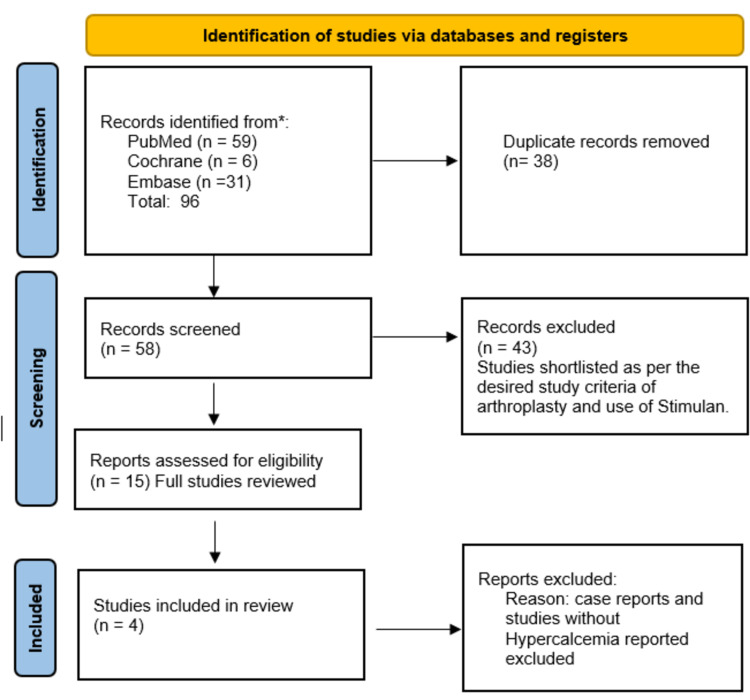
Calcium sulphate beads are increasingly being used in the management of prosthetic joint infections (PJI). Traditionally their use was limited to a void or dead space-filling combined with other additives such as Hydroxyapatite. Over the last decade, they have been developed to act more frequently as an antibiotics delivery system. Stimulan, a bio-absorbable form of Calcium sulfate, theoretically has an increased risk of hypercalcemia. Over the last few years, there have been published case reports which report it as an isolated cause of iatrogenic hypercalcemia. The sparsity of literature on this topic makes it difficult for surgeons to decide on the use of Calcium sulphate beads in patients with hypercalcemia predisposition in conditions like autoimmune disorders, sarcoidosis, malignancy, granulomatous diseases, heterotopic ossification, and hyperparathyroidism. The study was performed to assess the risk of hypercalcemia in patients after Calcium sulphate beads implantation in PJI. Two reviewers searched relevant literature in 3 online databases using cochrane methodology for systematic reviews. Studies reporting complications with the use of calcium sulphate beads in prosthetic joints were included. Studies reporting on less than five patients and studies reporting use in any other surgeries were excluded. The search of databases resulted in a total of 96 articles. After screening, a total of four articles were deemed suitable to be included in the analysis. A total of 1049 patients underwent calcium sulfate beads implantation, out of which 44 (4.2%) reported hypercalcemia with 41 (3.91%) transient in nature and 3 (0.28%) required management, including one with ICU admission. The result of this systematic review shows that calcium sulphate beads are safe and effective against PJI. There is a significant risk of transient hypercalcemia in susceptible patients and a low risk of symptomatic hypercalcemia.
硫酸钙珠粒在人工关节感染(PJI)的治疗中应用越来越广泛。传统上,其应用仅限于与羟基磷灰石等其他添加剂联合用于填充空洞或死腔。在过去十年中,它们更多地被开发用作抗生素递送系统。Stimulan是硫酸钙的一种可生物吸收形式,理论上有更高的高钙血症风险。在过去几年中,已有病例报告将其作为医源性高钙血症的单独病因。关于该主题的文献稀少,使得外科医生在自身免疫性疾病、结节病、恶性肿瘤、肉芽肿性疾病、异位骨化和甲状旁腺功能亢进等情况下,难以决定是否对有高钙血症倾向的患者使用硫酸钙珠粒。本研究旨在评估硫酸钙珠粒植入PJI患者后发生高钙血症的风险。两名评审员使用Cochrane系统评价方法在3个在线数据库中检索相关文献。纳入报告使用硫酸钙珠粒治疗人工关节并发症的研究。排除报告患者少于5例的研究以及报告在任何其他手术中使用情况的研究。数据库检索共得到96篇文章。筛选后,共有4篇文章被认为适合纳入分析。共有1049例患者接受了硫酸钙珠粒植入,其中44例(4.2%)报告发生高钙血症,41例(3.91%)为短暂性,3例(0.28%)需要治疗,包括1例入住重症监护病房。该系统评价结果表明,硫酸钙珠粒治疗PJI安全有效。易感患者有显著的短暂性高钙血症风险,而有症状高钙血症风险较低。