Al-Selwi Yara, Shaw James Am, Kattner Nicole
Translational and Clinical Research Institute, Newcastle University, Newcastle upon Tyne, UK.
Institute of Transplantation, Freeman Hospital, Newcastle upon Tyne Hospitals NHS Foundation Trust, Newcastle upon Tyne, UK.
Clin Med Insights Endocrinol Diabetes. 2021 Oct 12;14:11795514211048813. doi: 10.1177/11795514211048813. eCollection 2021.
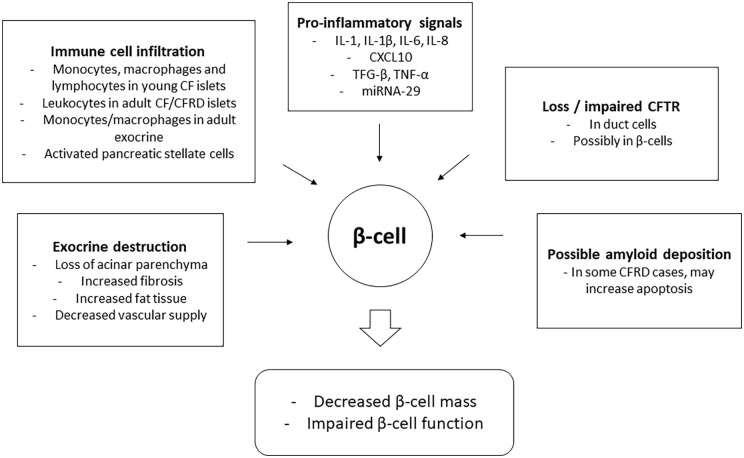
Cystic fibrosis (CF) is an autosomal recessive chronic condition effecting approximately 70 000 to 100 000 people globally and is caused by a loss-of-function mutation in the CF transmembrane conductance regulator. Through improvements in clinical care, life expectancy in CF has increased considerably associated with rising incidence of secondary complications including CF-related diabetes (CFRD). CFRD is believed to result from β-cell loss as well as insufficient insulin secretion due to β-cell dysfunction, but the underlying pathophysiology is not yet fully understood. Here we review the morphological and cellular changes in addition to the architectural remodelling of the pancreatic exocrine and endocrine compartments in CF and CFRD pancreas. We consider also potential underlying proinflammatory signalling pathways impacting on endocrine and specifically β-cell function, concluding that further research focused on these mechanisms may uncover novel therapeutic targets enabling restoration of normal insulin secretion.
囊性纤维化(CF)是一种常染色体隐性慢性疾病,全球约有7万至10万人受其影响,它由囊性纤维化跨膜传导调节因子的功能丧失性突变引起。通过临床护理的改善,CF患者的预期寿命显著增加,这与包括CF相关糖尿病(CFRD)在内的继发性并发症发病率上升有关。CFRD被认为是由于β细胞丢失以及β细胞功能障碍导致胰岛素分泌不足所致,但其潜在的病理生理学尚未完全明确。在此,我们综述了CF和CFRD胰腺中外分泌和内分泌区室的形态和细胞变化以及结构重塑。我们还考虑了影响内分泌尤其是β细胞功能的潜在促炎信号通路,得出结论认为,针对这些机制的进一步研究可能会发现新的治疗靶点,从而恢复正常的胰岛素分泌。