Foster Nicholas E V, Beffa Lauriane, Lehmann Alexandre
Department of Otolaryngology Head and Neck Surgery, McGill University, Montreal, QC, Canada.
International Laboratory for Brain, Music and Sound Research (BRAMS), Montreal, QC, Canada.
Front Psychol. 2021 Oct 5;12:709979. doi: 10.3389/fpsyg.2021.709979. eCollection 2021.
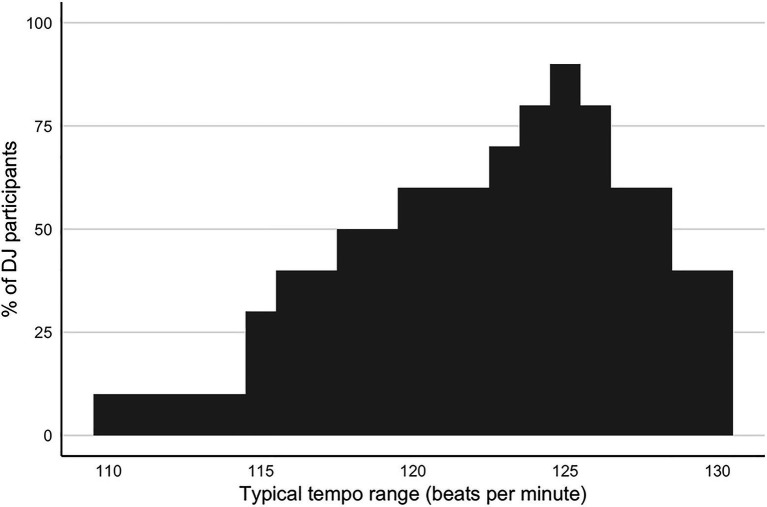
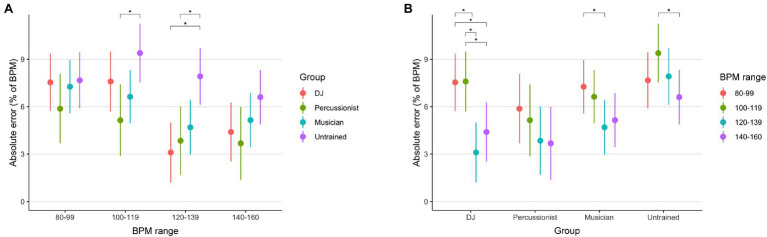
Professional disk jockeys (DJs) are an under-studied population whose performance involves creating new musical experiences by combining existing musical materials with a high level of temporal precision. In contemporary electronic dance music, these materials have a stable tempo and are composed with the expectation for further transformation during performance by a DJ for the audience of dancers. Thus, a fundamental aspect of DJ performance is synchronizing the tempo and phase of multiple pieces of music, so that over seconds or even minutes, they may be layered and transitioned without disrupting the rhythmic pulse. This has been accomplished traditionally by manipulating the speed of individual music pieces "by ear," without additional technological synchronization aids. However, the cumulative effect of this repeated practice on auditory tempo perception has not yet been evaluated. Well-known phenomena of experience-dependent plasticity in other populations, such as musicians, prompts the question of whether such effects exist in DJs in their domain of expertise. This pilot study examined auditory judgments of tempo in 10 professional DJs with experience mixing by ear, compared to 7 percussionists, 12 melodic instrumental musicians, and 11 untrained controls. Participants heard metronome sequences between 80 and 160 beats per minute (BPM) and estimated the tempo. In their most-trained tempo range, 120-139 BPM, DJs were more accurate (lower absolute percent error) than untrained participants. Within the DJ group, 120-139 BPM exhibited greater accuracy than slower tempos of 80-99 or 100-119 BPM. DJs did not differ in accuracy compared to percussionists or melodic musicians on any BPM range. Percussionists were more accurate than controls for 100-119 and 120-139 BPM. The results affirm the experience-dependent skill of professional DJs in temporal perception, with comparable performance to conventionally trained percussionists and instrumental musicians. Additionally, the pattern of results suggests a tempo-specific aspect to this training effect that may be more pronounced in DJs than percussionists and musicians. As one of the first demonstrations of enhanced auditory perception in this unorthodox music expert population, this work opens the way to testing whether DJs also have enhanced rhythmic production abilities, and investigating the neural substrates of this skill compared to conventional musicians.
专业唱片骑师(DJ)是一个研究较少的群体,他们的表演需要通过将现有的音乐素材以高度的时间精度进行组合,从而创造出新的音乐体验。在当代电子舞曲中,这些素材具有稳定的节奏,并且其创作预期是在DJ为舞者观众进行表演时会进一步被转换。因此,DJ表演的一个基本方面是同步多首音乐的节奏和相位,以便在数秒甚至数分钟内,它们可以被分层和过渡而不打乱节奏脉搏。传统上,这是通过“凭听觉”操纵单个音乐片段的速度来完成的,无需额外的技术同步辅助工具。然而,这种重复练习对听觉节奏感知的累积影响尚未得到评估。在其他人群(如音乐家)中,众所周知的经验依赖性可塑性现象引发了一个问题,即这种影响在DJ的专业领域中是否存在。这项初步研究考察了10名有凭听觉混音经验的专业DJ、7名打击乐手、12名旋律乐器演奏者和11名未受过训练的对照组人员对节奏的听觉判断。参与者听每分钟80至160拍(BPM)的节拍器序列并估计节奏。在他们训练最多的节奏范围内,即120 - 139 BPM,DJ比未受过训练的参与者更准确(绝对百分比误差更低)。在DJ组中,120 - 139 BPM比80 - 99或100 - 119 BPM的较慢节奏表现出更高的准确性。在任何BPM范围内,DJ与打击乐手或旋律乐器演奏者在准确性上没有差异。对于100 - 119和120 - 139 BPM,打击乐手比对照组更准确。结果证实了专业DJ在时间感知方面依赖经验的技能,其表现与传统训练的打击乐手和乐器演奏者相当。此外,结果模式表明这种训练效果存在节奏特定的方面,在DJ中可能比打击乐手和音乐家更明显。作为在这个非传统音乐专家群体中增强听觉感知的首批证明之一,这项工作为测试DJ是否也具有增强的节奏制作能力,以及与传统音乐家相比研究这种技能的神经基础开辟了道路。