Silistre Hazel, Raoux-Barbot Dorothée, Mancinelli Federica, Sangouard Flora, Dupin Alice, Belyy Alexander, Deruelle Vincent, Renault Louis, Ladant Daniel, Touqui Lhousseine, Mechold Undine
Unité de Biochimie des Interactions Macromoléculaires, Département de Biologie Structurale et Chimie, Institut Pasteur, CNRS UMR 3528, Paris, France.
Université Paris-Saclay, CEA, CNRS, Institute for Integrative Biology of the Cell (I2BC), Gif-sur-Yvette, France.
Front Microbiol. 2021 Oct 4;12:666097. doi: 10.3389/fmicb.2021.666097. eCollection 2021.
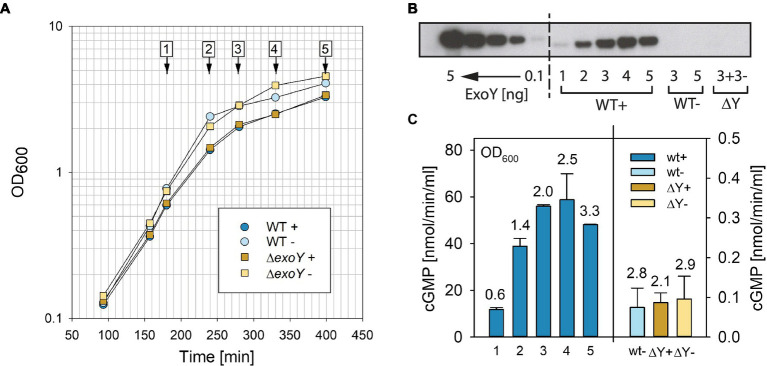
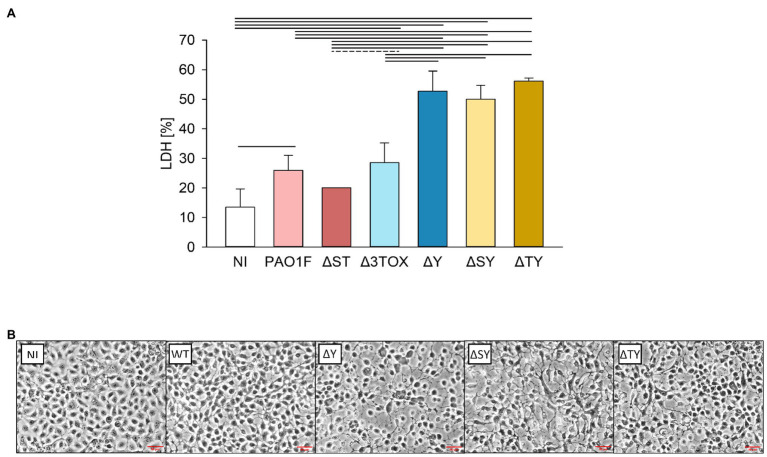
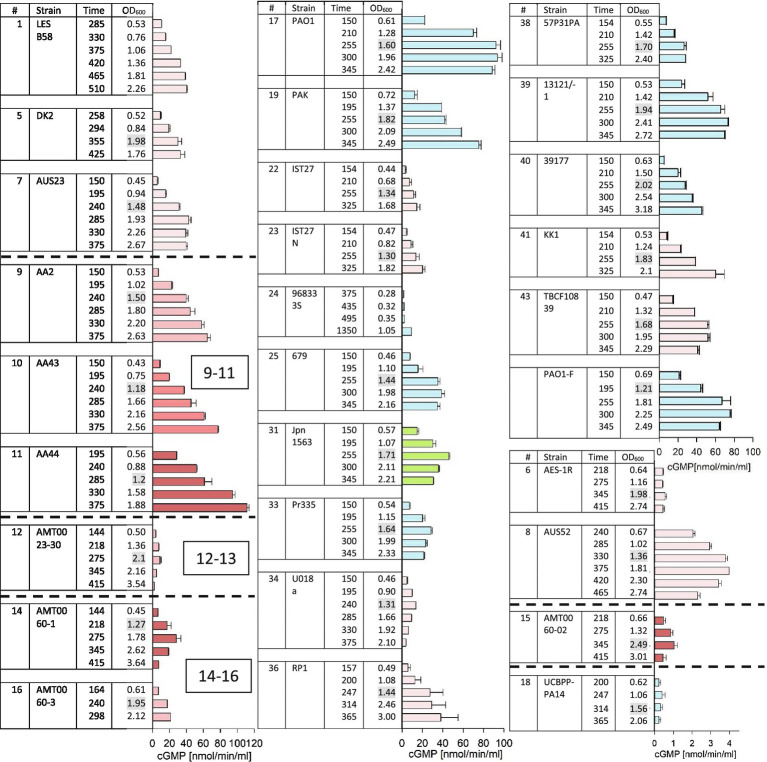
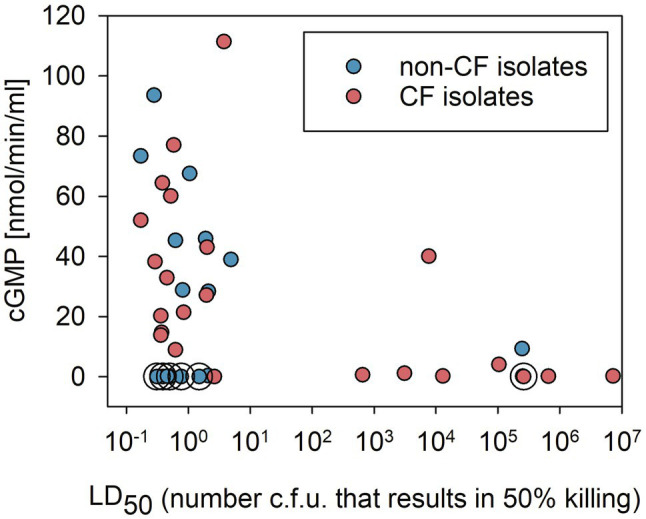
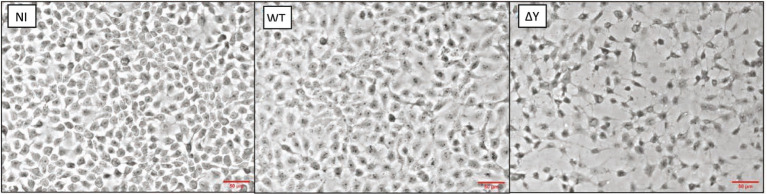
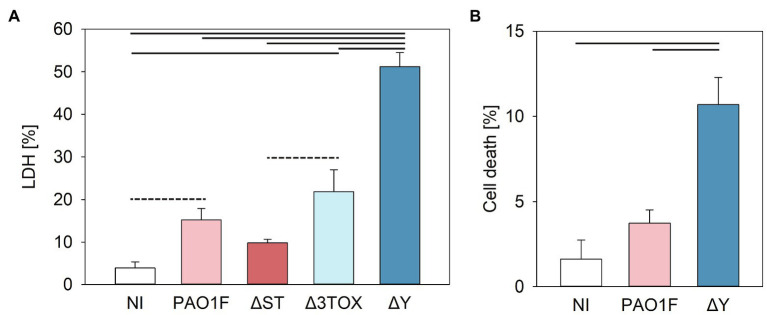
ExoY is among the effectors that are injected by the type III secretion system (T3SS) of into host cells. Inside eukaryotic cells, ExoY interacts with F-actin, which stimulates its potent nucleotidyl cyclase activity to produce cyclic nucleotide monophosphates (cNMPs). ExoY has broad substrate specificity with GTP as a preferential substrate . How ExoY contributes to the virulence of remains largely unknown. Here, we examined the prevalence of active ExoY among strains from the international reference panel, a collection of strains that includes environmental and clinical isolates, commonly used laboratory strains, and sequential clonal isolates from cystic fibrosis () patients and thus represents the large diversity of this bacterial species. The ability to secrete active ExoY was determined by measuring the F-actin stimulated guanylate cyclase (GC) activity in bacterial culture supernatants. We found an overall ExoY activity prevalence of about 60% among the 40 examined strains with no significant difference between and non- isolates. In parallel, we used cellular infection models of human lung epithelial cells to compare the cytotoxic effects of isogenic reference strains expressing active ExoY or lacking the gene. We found that strains lacking ExoY were in fact more cytotoxic to the epithelial cells than those secreting active ExoY. This suggests that under certain conditions, ExoY might partly alleviate the cytotoxic effects of other virulence factors of .
ExoY是由[细菌名称]的III型分泌系统(T3SS)注入宿主细胞的效应蛋白之一。在真核细胞内,ExoY与F-肌动蛋白相互作用,刺激其强大的核苷酸环化酶活性以产生环核苷酸单磷酸(cNMPs)。ExoY具有广泛的底物特异性,以GTP作为优先底物。ExoY如何促进[细菌名称]的毒力在很大程度上仍不清楚。在此,我们检测了国际[细菌名称]参考菌株库中菌株的活性ExoY流行情况,该菌株库包含环境和临床分离株、常用实验室菌株以及囊性纤维化(CF)患者的连续克隆分离株,因此代表了该细菌物种的广泛多样性。通过测量细菌培养上清液中F-肌动蛋白刺激的鸟苷酸环化酶(GC)活性来确定分泌活性ExoY的能力。我们发现,在40株检测菌株中,ExoY活性总体流行率约为60%,CF分离株和非CF分离株之间无显著差异。同时,我们使用人肺上皮细胞的细胞感染模型来比较表达活性ExoY或缺失[ExoY基因名称]基因的同基因参考菌株的细胞毒性作用。我们发现,缺乏ExoY的[细菌名称]菌株实际上比分泌活性ExoY的菌株对上皮细胞的细胞毒性更大。这表明在某些条件下,ExoY可能部分减轻[细菌名称]其他毒力因子的细胞毒性作用。