Liu Qian, Shi Yu, Cai Jun, Duan Yaqi, Wang Rongshuai, Zhang Hongyan, Ruan Qiurong, Li Jiansha, Zhao Lei, Ping Yifang, Chen Rong, Ren Liang, Fei Xiaochun, Zhang Heng, Tang Rui, Wang Xi, Luo Tao, Liu Xindong, Huang Xuequan, Liu Zhenhua, Ao Qilin, Ren Yong, Xiong Jing, He Zhicheng, Wu Haibo, Fu Wenjuan, Zhao Pengnan, Chen Xinwei, Qu Guoqiang, Wang Yunyun, Wang Xi, Liu Jia, Xiang Dongfang, Xu Sanpeng, Zhou Xiaowei, Li Qingrui, Ma Jinghong, Li Heng, Zhang Jie, Huang Sizhe, Yao Xiaohong, Zhou Yiwu, Wang Chaofu, Zhang Dingyu, Wang Guoping, Liu Liang, Bian Xiu-Wu
Department of Forensic Medicine, Tongji Medical College, Huazhong University of Science and Technology, Wuhan 430030, China.
Institute of Pathology, Southwest Hospital, Third Military Medical University (Army Medical University), Chongqing 400038, China.
Natl Sci Rev. 2020 Sep 29;7(12):1868-1878. doi: 10.1093/nsr/nwaa247. eCollection 2020 Dec.
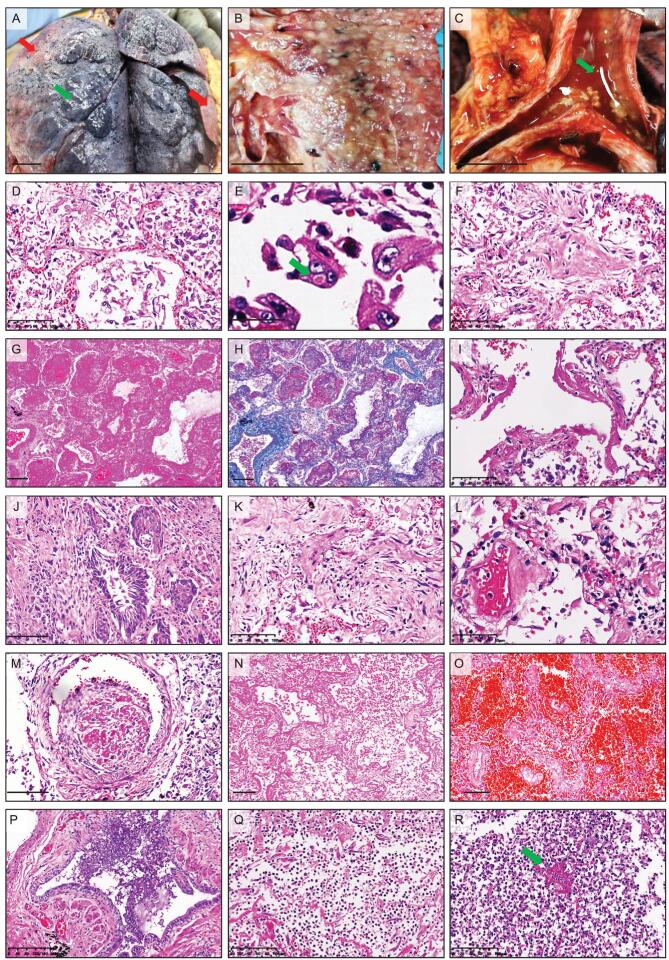
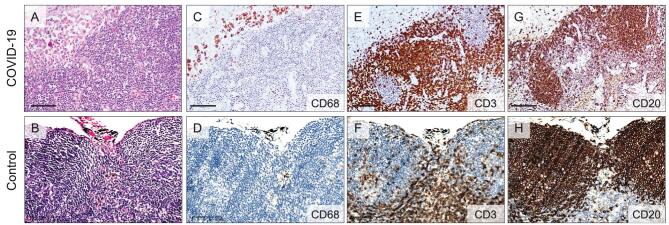
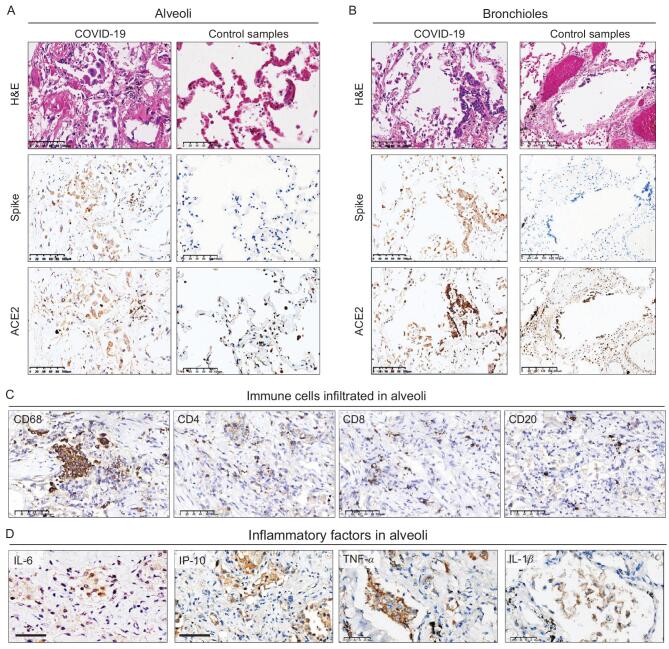
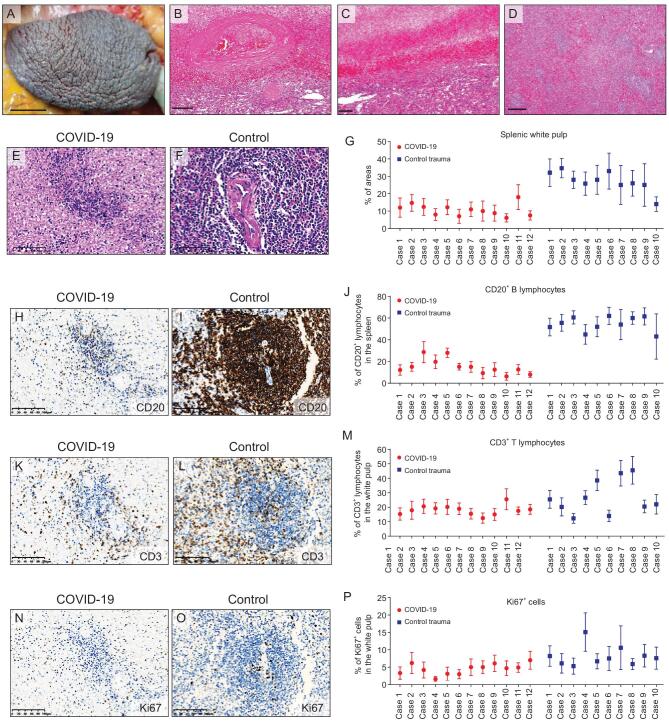
Systematic autopsy and comprehensive pathological analyses of COVID-19 decedents should provide insights into the disease characteristics and facilitate the development of novel therapeutics. In this study, we report the autopsy findings from the lungs and lymphatic organs of 12 COVID-19 decedents-findings that evaluated histopathological changes, immune cell signature and inflammatory factor expression in the lungs, spleen and lymph nodes. Here we show that the major pulmonary alterations included diffuse alveolar damage, interstitial fibrosis and exudative inflammation featured with extensive serous and fibrin exudates, macrophage infiltration and abundant production of inflammatory factors (IL-6, IP-10, TNFα and IL-1β). The spleen and hilar lymph nodes contained lesions with tissue structure disruption and immune cell dysregulation, including lymphopenia and macrophage accumulation. These findings provide pathological evidence that links injuries of the lungs and lymphatic organs with the fatal systematic respiratory and immune malfunction in critically ill COVID-19 patients.
对新冠病毒病死者进行系统尸检和全面病理分析,应能深入了解该疾病特征,并推动新型治疗方法的研发。在本研究中,我们报告了12例新冠病毒病死者肺和淋巴器官的尸检结果,这些结果评估了肺、脾和淋巴结的组织病理学变化、免疫细胞特征及炎症因子表达。我们在此表明,主要肺部改变包括弥漫性肺泡损伤、间质纤维化和渗出性炎症,其特征为广泛的浆液和纤维蛋白渗出、巨噬细胞浸润以及炎症因子(IL-6、IP-10、TNFα和IL-1β)大量产生。脾和肺门淋巴结存在组织结构破坏和免疫细胞失调的病变,包括淋巴细胞减少和巨噬细胞积聚。这些发现提供了病理学证据,将肺和淋巴器官损伤与危重症新冠病毒病患者致命的系统性呼吸和免疫功能障碍联系起来。