Reese Kristen L, Fisher Carolyn L, Lane Pamela D, Jaryenneh James D, Jones A Daniel, Frank Matthias, Lane Todd W
Biosciences and Biotechnology Division, Physical & Life Sciences Directorate, Lawrence Livermore National Laboratory, Livermore, CA 94550, USA.
Forensic Science Center, Nuclear and Chemical Sciences Division, Lawrence Livermore National Laboratory, Livermore, CA 94550, USA.
Metabolites. 2021 Oct 15;11(10):707. doi: 10.3390/metabo11100707.
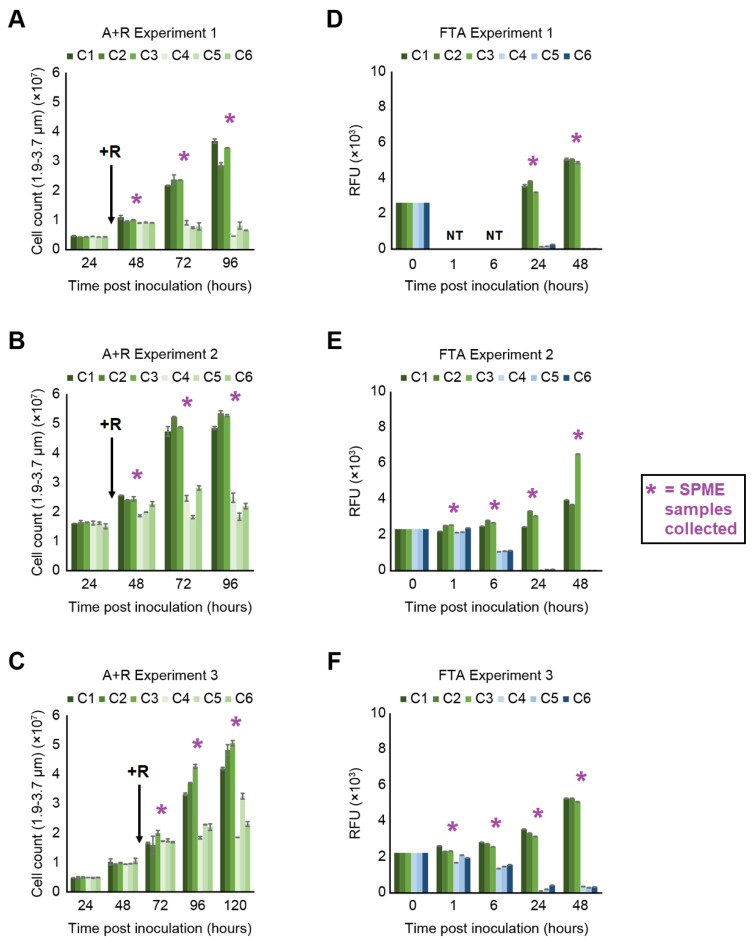
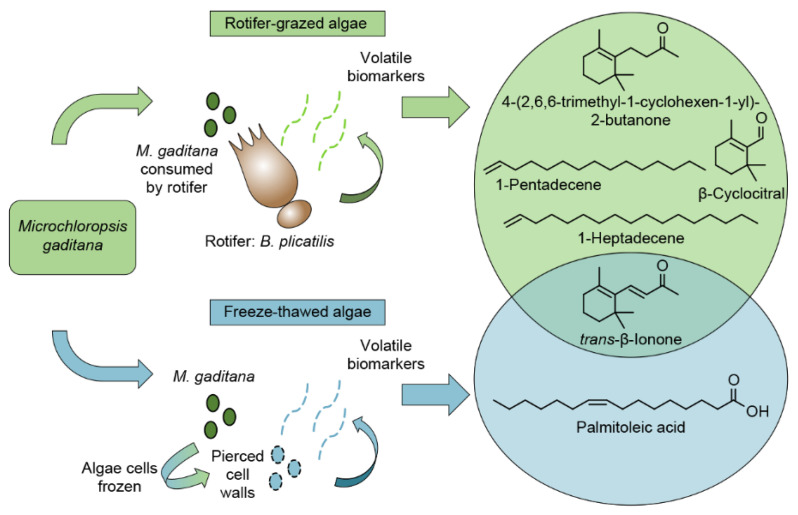
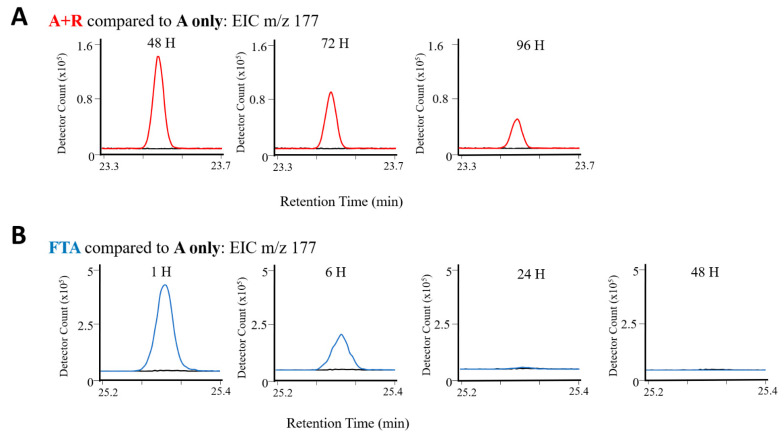
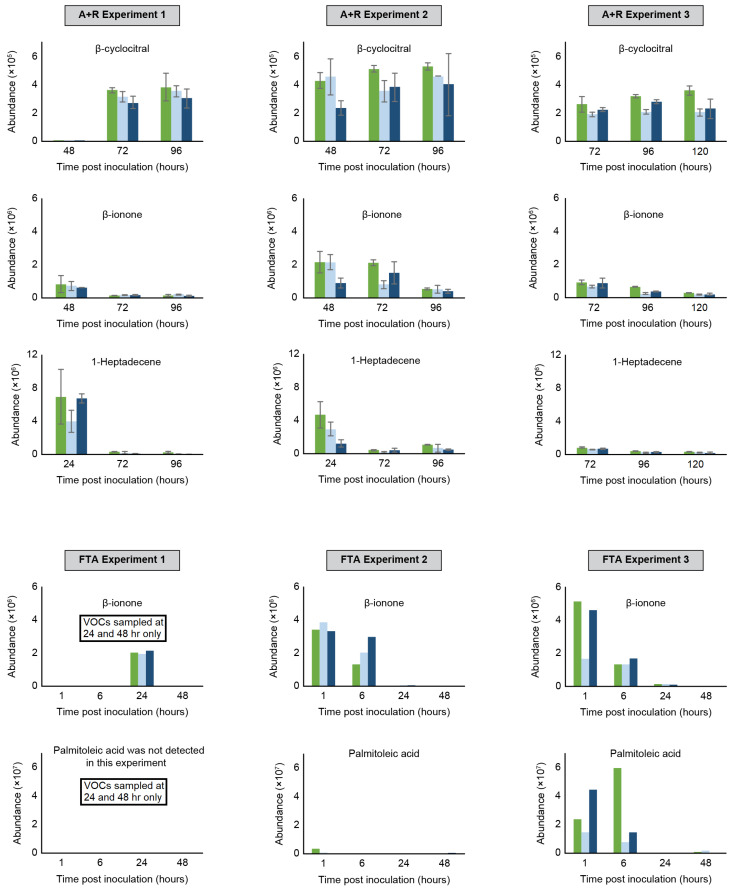
Open microalgal ponds used in industrial biomass production are susceptible to a number of biotic and abiotic environmental stressors (e.g., grazers, pathogens, pH, temperature, etc.) resulting in pond crashes with high economic costs. Identification of signature chemicals to aid in rapid, non-invasive, and accurate identification of the stressors would facilitate targeted and effective treatment to save the algal crop from a catastrophic crash. Specifically, we were interested in identifying volatile organic compounds (VOCs) that can be used to as an early diagnostic for algal crop damage. Cultures of were subjected to two forms of algal crop damage: (1) active grazing by the marine rotifer, , or (2) repeated freeze-thaw cycles. VOCs emitted above the headspace of these algal cultures were collected using fieldable solid phase microextraction (SPME) fibers. An untargeted analysis and identification of VOCs was conducted using gas chromatography-mass spectrometry (GC-MS). Diagnostic VOCs unique to each algal crop damage mechanism were identified. Active rotifer grazing of was characterized by the appearance of carotenoid degradation products, including β-cyclocitral and various alkenes. Freeze-thaw algae produced a different set of VOCs, including palmitoleic acid. Both rotifer grazing and freeze-thawed algae produced β-ionone as a VOC, possibly suggesting a common stress-induced cellular mechanism. Importantly, these identified VOCs were all absent from healthy algal cultures of . Early detection of biotic or abiotic environmental stressors will facilitate early diagnosis and application of targeted treatments to prevent algal pond crashes. Thus, our work further supports the use of VOCs for monitoring the health of algal ponds to ultimately enhance algal crop yields for production of biofuel.
用于工业生物质生产的开放式微藻池塘容易受到多种生物和非生物环境压力因素(如食草动物、病原体、pH值、温度等)的影响,从而导致池塘崩溃,造成高昂的经济成本。识别标志性化学物质以帮助快速、非侵入性且准确地识别压力因素,将有助于进行有针对性的有效处理,从而使藻类作物免于灾难性崩溃。具体而言,我们感兴趣的是识别可用于藻类作物损害早期诊断的挥发性有机化合物(VOCs)。对[藻类名称]的培养物施加两种形式的藻类作物损害:(1)由海洋轮虫[轮虫名称]进行主动啃食,或(2)反复的冻融循环。使用便携式固相微萃取(SPME)纤维收集这些藻类培养物顶空上方排放的VOCs。使用气相色谱-质谱联用仪(GC-MS)对VOCs进行非靶向分析和鉴定。识别出了每种藻类作物损害机制特有的诊断性VOCs。[藻类名称]被轮虫主动啃食的特征是类胡萝卜素降解产物的出现,包括β-环柠檬醛和各种烯烃。冻融处理的藻类产生了一组不同的VOCs,包括棕榈油酸。轮虫啃食和冻融处理的藻类都产生β-紫罗兰酮作为一种VOC,这可能表明存在一种共同的应激诱导细胞机制。重要的是,在健康的[藻类名称]培养物中均未发现这些已识别的VOCs。早期检测生物或非生物环境压力因素将有助于早期诊断和应用有针对性的处理措施,以防止藻类池塘崩溃。因此,我们的工作进一步支持了使用VOCs来监测藻类池塘的健康状况,以最终提高用于生物燃料生产的藻类作物产量。