Institute of Medical Sciences, School of Medicine, Medical Sciences & Nutrition, University of Aberdeen, Foresterhill, Aberdeen AB25 2ZD, UK.
Biomolecules. 2021 Oct 9;11(10):1489. doi: 10.3390/biom11101489.
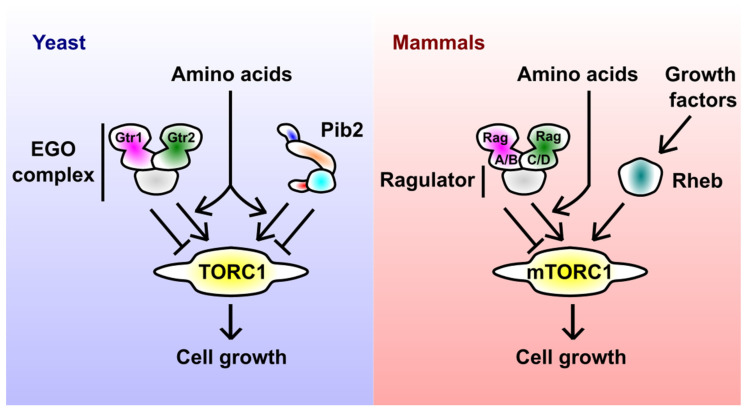
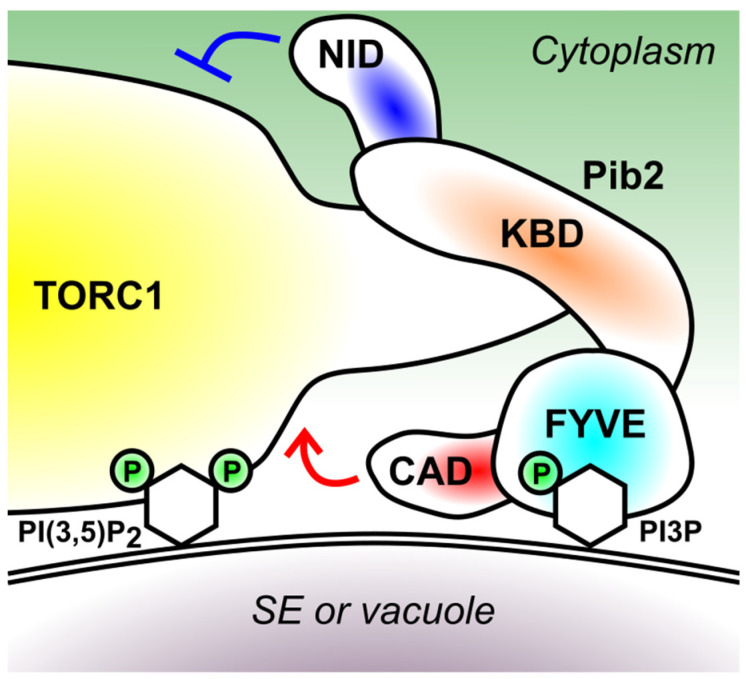
Cell growth is dynamically regulated in response to external cues such as nutrient availability, growth factor signals, and stresses. Central to this adaptation process is the Target of Rapamycin Complex 1 (TORC1), an evolutionarily conserved kinase complex that fine-tunes an enormous number of cellular events. How upstream signals are sensed and transmitted to TORC1 has been intensively studied in major model organisms including the budding yeast . This field recently saw a breakthrough: the identification of yeast phosphatidylInositol(3)-phosphate binding protein 2 (Pib2) protein as a critical regulator of TORC1. Although the study of Pib2 is still in its early days, multiple groups have provided important mechanistic insights on how Pib2 relays nutrient signals to TORC1. There remain, on the other hand, significant gaps in our knowledge and mysteries that warrant further investigations. This is the first dedicated review on Pib2 that summarizes major findings and outstanding questions around this emerging key player in cell growth regulation.
细胞生长是动态调节的,以响应外部线索,如营养物质的可用性、生长因子信号和应激。适应过程的核心是雷帕霉素靶蛋白复合物 1(TORC1),这是一种进化上保守的激酶复合物,精细调节着大量的细胞事件。上游信号如何被感知并传递到 TORC1,在包括 budding yeast 在内的主要模式生物中已经进行了深入研究。这一领域最近取得了突破:鉴定出酵母磷脂酰肌醇(3)-磷酸结合蛋白 2 (Pib2)蛋白是 TORC1 的关键调节因子。尽管对 Pib2 的研究仍处于早期阶段,但多个研究小组已经提供了关于 Pib2 如何将营养信号传递给 TORC1 的重要机制见解。另一方面,我们的知识仍然存在重大空白和未解之谜,需要进一步研究。这是第一篇关于 Pib2 的专门综述,总结了围绕这个细胞生长调节新兴关键因子的主要发现和悬而未决的问题。