Fiorino Fabio, Sicuranza Anna, Ciabattini Annalisa, Santoni Adele, Pastore Gabiria, Simoncelli Martina, Polvere Jacopo, Galimberti Sara, Auddino Stefano, Baratè Claudia, Montagnani Francesca, Sammartano Vincenzo, Bocchia Monica, Medaglini Donata
Laboratory of Molecular Microbiology and Biotechnology, Department of Medical Biotechnologies, University of Siena, 53100 Siena, Italy.
Hematology Unit, Department of Medical Science, Surgery and Neuroscience, Azienda Ospedaliero Universitaria Senese, University of Siena, 53100 Siena, Italy.
Biomedicines. 2021 Oct 15;9(10):1480. doi: 10.3390/biomedicines9101480.
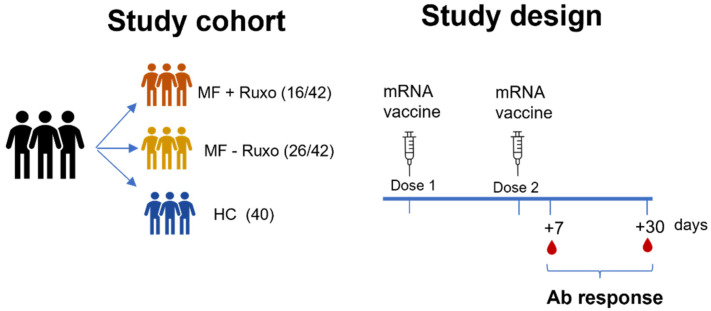
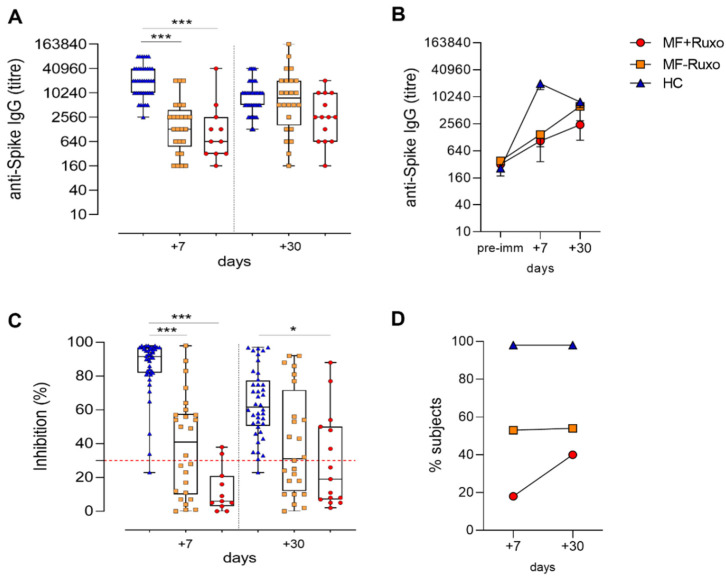
Immunization with mRNA SARS-CoV-2 vaccines has been highly recommended and prioritized in fragile subjects, including patients with myelofibrosis (MF). Available data on the vaccine immune response developed by MF patients and the impact of ruxolitinib treatment are still too fragmented to support an informed decision on a third dose for this category of subjects. Here, we show that 76% of MF patients develop spike-specific IgG after the second mRNA SARS-CoV-2 vaccine dose, but the response has a slower kinetics compared to healthy subjects, suggesting a reduced capability of their immune system to promptly react to vaccination. A reduced ACE2/RBD binding inhibition activity of spike-specific antibodies was also observed, especially in ruxolitinib-treated patients. Our results, showing slow kinetics of antibody responses in MF patients following vaccination with mRNA SARS-CoV-2 vaccines, support the need for a third vaccine dose.
对于包括骨髓纤维化(MF)患者在内的脆弱人群,强烈建议优先接种mRNA新冠病毒疫苗。关于MF患者产生的疫苗免疫反应以及芦可替尼治疗影响的现有数据仍然过于零散,无法为该类人群是否接种第三剂疫苗提供明智的决策依据。在此,我们表明,76%的MF患者在接种第二剂mRNA新冠病毒疫苗后产生了刺突特异性IgG,但与健康受试者相比,其反应动力学较慢,这表明他们的免疫系统对疫苗迅速做出反应的能力降低。还观察到刺突特异性抗体的ACE2/RBD结合抑制活性降低,尤其是在接受芦可替尼治疗的患者中。我们的结果表明,MF患者接种mRNA新冠病毒疫苗后抗体反应动力学缓慢,这支持了接种第三剂疫苗的必要性。