I3S-Institute for Innovation & Health Research, University of Porto, 4200-135 Porto, Portugal.
ICBAS-Institute of Biomedical Sciences Abel Salazar, University of Porto, 4050-313 Porto, Portugal.
Genes (Basel). 2021 Oct 3;12(10):1575. doi: 10.3390/genes12101575.
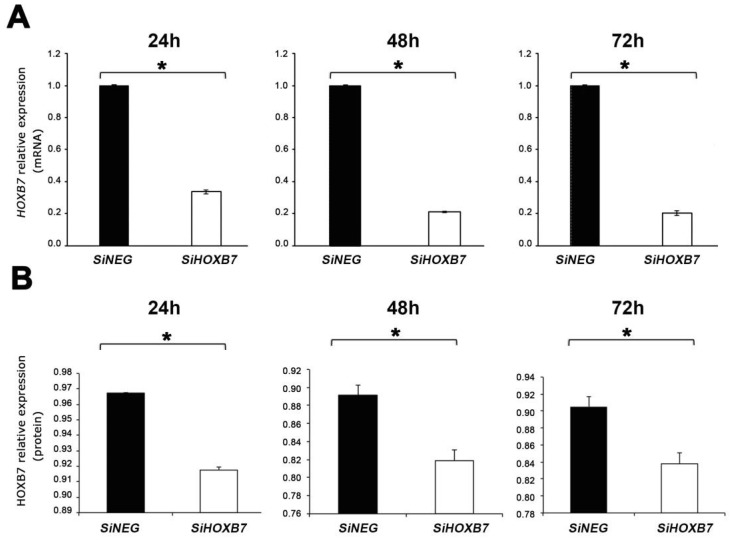
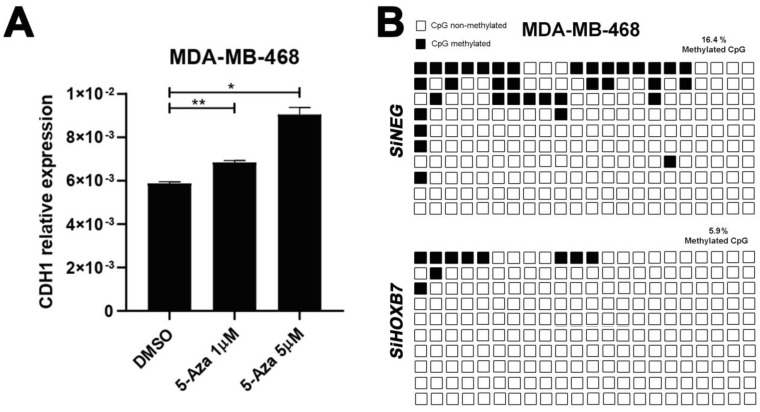
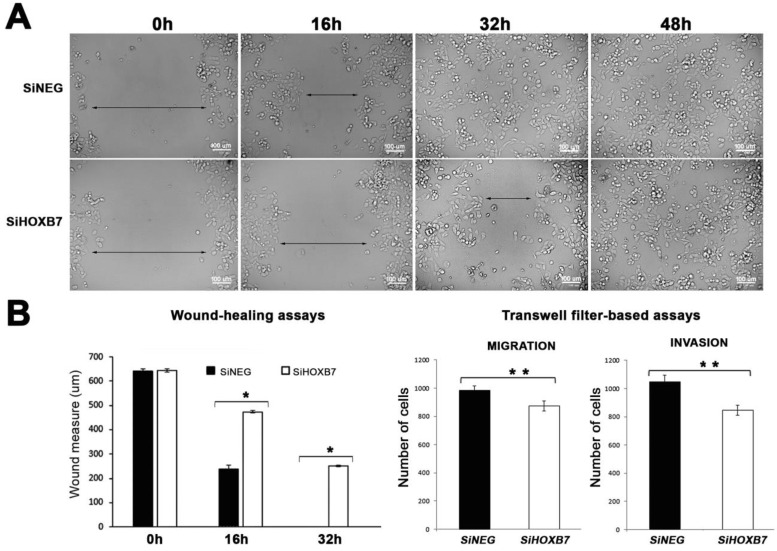
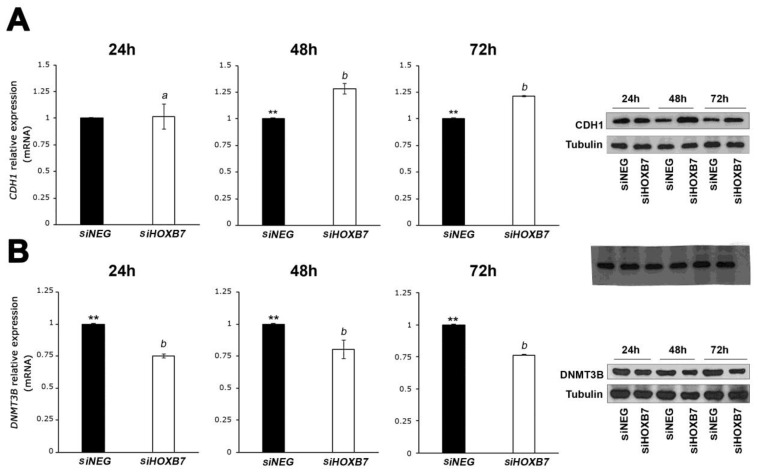
HOXB7 is often overexpressed in breast cancer cells and found to relate to poor prognosis. The search for the HOXB7 targets, as a transcription factor, has led to molecules involved in regulating cell proliferation, migration, invasion, and processes such as angiogenesis and therapy resistance. However, the specific targets affected by the deregulation of HOXB7 in breast cancer remain largely unknown in most molecular sub-types, such as triple-negative breast cancers (TNBC). To unveil the molecular basis behind these aggressive and often untreatable cancers, here we explored the contribution of HOXB7 deregulation for their aggressiveness. To this end, HOXB7 was silenced in TNBC Basal A cells MDA-MB-468, and the phenotype, gene/protein expression, and methylation profile of putative targets were analyzed. Lower migration and invasion rates were detected in HOXB7-silenced cells in comparison with the controls. In addition, these cells expressed more CDH1 and less DNMT3B, and the promoter methylation status of CDH1 diminished. Our data suggest that the HOXB7 transcription factor may act on TNBC Basal A cells by controlling CDH1 epigenetic regulation. This may occur indirectly through the up-regulation of DNMT3B, which then controls DNA methylation of the CDH1 promoter. Thus, future approaches interfering with HOXB7 regulation may be promising therapeutic strategies in TNBC treatment.
HOXB7 在乳腺癌细胞中常常过表达,并与不良预后相关。作为转录因子,对 HOXB7 靶标的研究导致了涉及调节细胞增殖、迁移、侵袭以及血管生成和治疗耐药等过程的分子的发现。然而,在大多数分子亚型(如三阴性乳腺癌 [TNBC])中,HOXB7 失调影响的特定靶标在很大程度上仍然未知。为了揭示这些侵袭性且往往难以治疗的癌症背后的分子基础,我们在这里探索了 HOXB7 失调对其侵袭性的贡献。为此,我们在 TNBC 基底 A 细胞 MDA-MB-468 中沉默 HOXB7,并分析了假定靶标的表型、基因/蛋白质表达和甲基化谱。与对照组相比,沉默 HOXB7 的细胞迁移和侵袭率降低。此外,这些细胞表达更多的 CDH1 和更少的 DNMT3B,并且 CDH1 启动子的甲基化状态减弱。我们的数据表明,HOXB7 转录因子可能通过控制 CDH1 的表观遗传调控来作用于 TNBC 基底 A 细胞。这可能通过上调 DNMT3B 间接发生,后者继而控制 CDH1 启动子的 DNA 甲基化。因此,未来干扰 HOXB7 调节的方法可能是 TNBC 治疗中很有前途的治疗策略。