
锌与NAP型神经保护肽的结合:核磁共振研究与分子模拟
Zinc Binding to NAP-Type Neuroprotective Peptides: Nuclear Magnetic Resonance Studies and Molecular Modeling.
作者信息
Lupaescu Ancuta-Veronica, Mocanu Cosmin Stefan, Drochioiu Gabi, Ciobanu Catalina-Ionica
机构信息
Integrated Center for Research, Development and Innovation in Advanced Materials, Nanotechnologies and Distributed Systems for Fabrication and Control (MANSiD), Stefan cel Mare University of Suceava, 720229 Suceava, Romania.
Faculty of Chemistry, Alexandru Ioan Cuza University, 11 Carol I, 700506 Iasi, Romania.
出版信息
Pharmaceuticals (Basel). 2021 Oct 1;14(10):1011. doi: 10.3390/ph14101011.
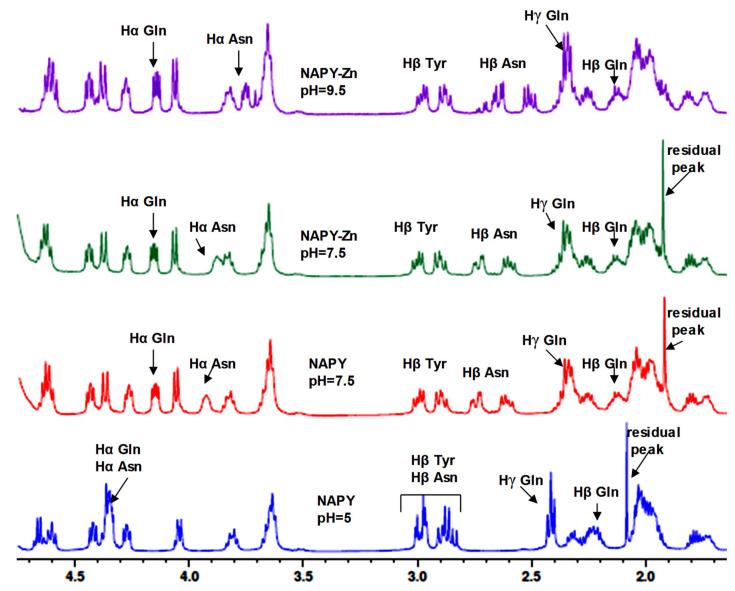
Aggregation of amyloid-β peptides (Aβ) is a hallmark of Alzheimer's disease (AD), which is affecting an increasing number of people. Hence, there is an urgent need to develop new pharmaceutical treatments which could be used to prevent the AD symptomatology. Activity-dependent neuroprotective protein (ADNP) was found to be deficient in AD, whereas NAP, an 8-amino-acid peptide (NAPVSIPQ) derived from ADNP, was shown to enhance cognitive function. The higher tendency of zinc ion to induce Aβ aggregation and formation of amorphous aggregates is also well-known in the scientific literature. Although zinc binding to Aβ peptides was extensively investigated, there is a shortage of knowledge regarding the relationship between NAP peptide and zinc ions. Therefore, here, we investigated the binding of zinc ions to the native NAP peptide and its analog obtained by replacing the serine residue in the NAP sequence with tyrosine (NAPVYIPQ) at various molar ratios and pH values by mass spectrometry (MS) and nuclear magnetic resonancespectroscopy (NMR). Matrix-assisted laser desorption/ionization time-of-flight (MALDI ToF) mass spectrometry confirmed the binding of zinc ions to NAP peptides, while the chemical shift of Asp, observed in H-NMR spectra, provided direct evidence for the coordinating role of zinc in the N-terminal region. In addition, molecular modeling has also contributed largely to our understanding of Zn binding to NAP peptides.
淀粉样β肽(Aβ)的聚集是阿尔茨海默病(AD)的一个标志,而AD影响着越来越多的人。因此,迫切需要开发可用于预防AD症状的新药物治疗方法。发现活性依赖的神经保护蛋白(ADNP)在AD中缺乏,而NAP,一种源自ADNP的8氨基酸肽(NAPVSIPQ),被证明可增强认知功能。锌离子诱导Aβ聚集和形成无定形聚集体的较高倾向在科学文献中也广为人知。尽管对锌与Aβ肽的结合进行了广泛研究,但关于NAP肽与锌离子之间的关系仍缺乏了解。因此,在这里,我们通过质谱(MS)和核磁共振光谱(NMR)研究了在不同摩尔比和pH值下锌离子与天然NAP肽及其通过将NAP序列中的丝氨酸残基替换为酪氨酸而获得的类似物(NAPVYIPQ)的结合。基质辅助激光解吸/电离飞行时间(MALDI ToF)质谱证实了锌离子与NAP肽的结合,而在H-NMR光谱中观察到的Asp化学位移为锌在N端区域的配位作用提供了直接证据。此外,分子建模在很大程度上也有助于我们理解锌与NAP肽的结合。


 Zotero 插件