Feller Franziska Maria, Eilebrecht Sebastian, Nedielkov Ruslan, Yücel Onur, Alvincz Julia, Salinas Gabriela, Ludwig Kevin Christopher, Möller Heiko, Philipp Bodo
Institute for Molecular Microbiology and Biotechnology, University of Münster, Corrensstr. 3, 48149 Münster, Germany.
Fraunhofer Attract Eco'n'OMICs, Fraunhofer Institute for Molecular Biology and Applied Ecology IME, Auf dem Aberg 1, 57392 Schmallenberg, Germany.
Microorganisms. 2021 Oct 14;9(10):2146. doi: 10.3390/microorganisms9102146.
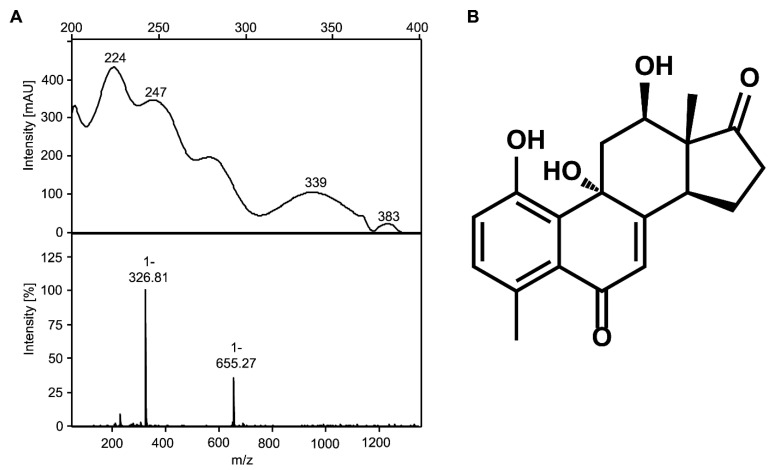
Bile salts such as cholate are steroid compounds from the digestive tracts of vertebrates, which enter the environment upon excretion, e.g., in manure. Environmental bacteria degrade bile salts aerobically via two pathway variants involving intermediates with Δ- or Δ-3-keto-structures of the steroid skeleton. Recent studies indicated that degradation of bile salts via Δ-3-keto intermediates in sp. strain Chol11 proceeds via 9,10 cleavage of the steroid skeleton. For further elucidation, the presumptive product of this cleavage, 3,12β-dihydroxy-9,10--androsta-1,3,5(10),6-tetraene-9,17-dione (DHSATD), was provided to strain Chol11 in a co-culture approach with Chol1 and as purified substrate. Strain Chol11 converted DHSATD to the so far unknown compound 4-methyl-3-deoxy-1,9,12-trihydroxyestra-1,3,5(10)7-tetraene-6,17-dione (MDTETD), presumably in a side reaction involving an unusual ring closure. MDTETD was neither degraded by strains Chol1 and Chol11 nor in enrichment cultures. Functional transcriptome profiling of zebrafish embryos after exposure to MDTETD identified a significant overrepresentation of genes linked to hormone responses. In both pathway variants, steroid degradation intermediates transiently accumulate in supernatants of laboratory cultures. Soil slurry experiments indicated that bacteria using both pathway variants were active and also released their respective intermediates into the environment. This instance could enable the formation of recalcitrant steroid metabolites by interspecies cross-feeding in agricultural soils.
胆盐如胆酸是脊椎动物消化道中的类固醇化合物,排泄后进入环境,例如随粪便排出。环境细菌通过两种途径变体需氧降解胆盐,这两种变体涉及类固醇骨架具有Δ-或Δ-3-酮结构的中间体。最近的研究表明,在菌株Chol11中,通过Δ-3-酮中间体降解胆盐是通过类固醇骨架的9,10裂解进行的。为了进一步阐明,通过与Chol1共培养的方法并作为纯化底物,将这种裂解的推定产物3,12β-二羟基-9,10-雄甾-1,3,5(10),6-四烯-9,17-二酮(DHSATD)提供给菌株Chol11。菌株Chol11将DHSATD转化为迄今未知的化合物4-甲基-3-脱氧-1,9,12-三羟基雌甾-1,3,5(10)7-四烯-6,17-二酮(MDTETD),推测是通过涉及异常环化的副反应。MDTETD既不被菌株Chol1和Chol11降解,也不在富集培养物中降解。斑马鱼胚胎暴露于MDTETD后的功能转录组分析确定了与激素反应相关的基因显著富集。在这两种途径变体中,类固醇降解中间体在实验室培养物的上清液中短暂积累。土壤泥浆实验表明,使用这两种途径变体的细菌都具有活性,并且还将各自的中间体释放到环境中。这种情况可能会通过农业土壤中的种间交叉喂养形成难降解的类固醇代谢物。