Mai Chunliang, Hu Xue, Zhang Lixin, Song Bao, Zheng Xiongfei
College of Mechanical and Electrical Engineering, Shihezi University, Shihezi 832003, China.
College of Mechanical Science and Engineering, Huazhong University of Science and Technology, Wuhan 430074, China.
Materials (Basel). 2021 Oct 11;14(20):5980. doi: 10.3390/ma14205980.
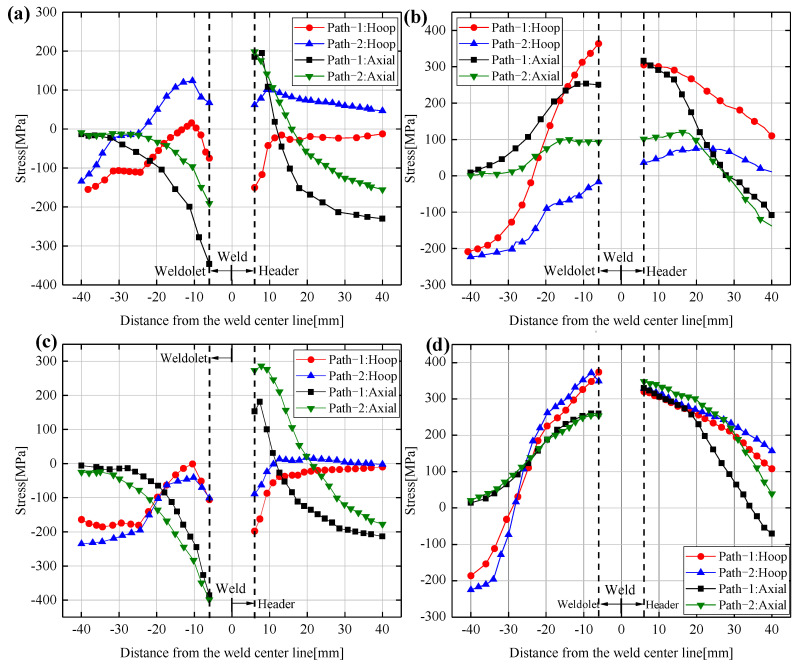
In this paper, based on Simufact Welding finite element analysis software, a numerical simulation of the temperature and residual stress distribution of the weldolet-header multi-layer multi-pass welding process is carried out, and the simulation results are verified through experiments. The experimental results are in good agreement with the numerical simulation results, which proves the validity of the numerical simulation results. Through the results of the numerical simulation, the influence of the welding sequence and interlayer temperature on the temperature and residual stress distribution at different locations of the saddle-shaped weld was studied. The results show that the temperature and residual stress distribution on the header and weldolet are asymmetric, and the high-stress area of the saddle-shaped welded joint always appears at the saddle shoulder or saddle belly position. When the interlayer temperature is 300 °C, the peak residual stress reaches a minimum of 428.35 MPa. Adjusting the welding sequence can change the distribution trend of residual stress. There is no high-stress area on the first welding side of the two-stage welding path-2. The peak values of residual stresses for continuous welding path-1 and two-stage welding path-2 are 428.35 MPa and 434.01 MPa, respectively, which are very close to each other.
本文基于 Simufact Welding 有限元分析软件,对插入式支管 - 主管多层多道焊接过程的温度和残余应力分布进行了数值模拟,并通过实验对模拟结果进行了验证。实验结果与数值模拟结果吻合良好,证明了数值模拟结果的有效性。通过数值模拟结果,研究了焊接顺序和层间温度对鞍形焊缝不同位置温度和残余应力分布的影响。结果表明,主管和插入式支管上的温度和残余应力分布不对称,鞍形焊接接头的高应力区域总是出现在鞍肩或鞍腹位置。当层间温度为300℃时,残余应力峰值最小,为428.35MPa。调整焊接顺序可以改变残余应力的分布趋势。两级焊接路径 -2 的第一焊接侧没有高应力区域。连续焊接路径 -1 和两级焊接路径 -2 的残余应力峰值分别为428.35MPa和434.01MPa,两者非常接近。