
意大利第二波新冠疫情期间炎症性肠病患者抗SARS-CoV-2抗体血清流行率研究
A Seroprevalence Study of Anti-SARS-CoV-2 Antibodies in Patients with Inflammatory Bowel Disease during the Second Wave of the COVID-19 Pandemic in Italy.
作者信息
Di Ruscio Mirko, Lunardi Gianluigi, Buonfrate Dora, Gobbi Federico, Bertoli Giulia, Piccoli Donatella, Conti Antonio, Geccherle Andrea, Variola Angela
机构信息
IBD Unit, IRCCS Sacro Cuore Don Calabria Hospital, 37024 Negrar di Valpolicella (VR), Italy.
Medical Analysis Laboratory, IRCCS Sacro Cuore Don Calabria Hospital, 37024 Negrar di Valpolicella (VR), Italy.
出版信息
Medicina (Kaunas). 2021 Oct 1;57(10):1048. doi: 10.3390/medicina57101048.
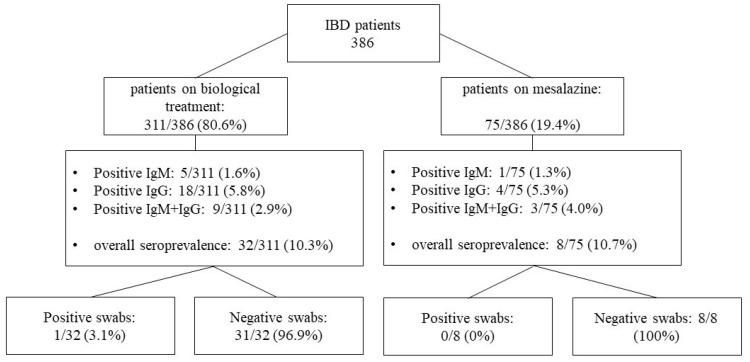
Studies have shown a lower prevalence of anti-SARS-CoV-2 antibodies in patients with inflammatory bowel disease (IBD), including amongst those receiving biological therapy. Aims were to determine the seroprevalence of anti-SARS-CoV-2 antibodies in IBD patients and to assess any association between seropositivity and IBD characteristics. Serum from adult IBD patients was prospectively collected between December 2020 and January 2021 and analyzed for anti-SARS-CoV-2 antibodies. Information about IBD characteristics and SARS-CoV-2 exposure risk factors was collected and analyzed. Serum from non-IBD healthcare workers formed the control group. 311 IBD patients on biologics and 75 on mesalazine were enrolled. Ulcerative colitis (UC) extension ( < 0.001), Crohn's disease (CD) phenotype ( = 0.009) and use of concomitant corticosteroids ( < 0.001) were significantly different between the two IBD groups. Overall seroprevalence among IBD patients was 10.4%. The control group showed a prevalence of 13.0%, not significantly different to that of IBD patients ( = 0.145). Only a close contact with SARS-CoV-2 positive individuals and the use of non-FFP2 masks were independently associated with a higher likelihood of seropositivity amongst IBD patients. In IBD patients, the prevalence of anti-SARS-CoV-2 antibodies is not determined by their ongoing treatment. Disease-related characteristics are not associated with a greater risk of antibody seropositivity.
研究表明,炎症性肠病(IBD)患者中抗SARS-CoV-2抗体的流行率较低,包括接受生物疗法的患者。目的是确定IBD患者中抗SARS-CoV-2抗体的血清流行率,并评估血清阳性与IBD特征之间的任何关联。在2020年12月至2021年1月期间前瞻性收集成年IBD患者的血清,并分析抗SARS-CoV-2抗体。收集并分析有关IBD特征和SARS-CoV-2暴露风险因素的信息。非IBD医护人员的血清构成对照组。纳入了311名接受生物制剂治疗的IBD患者和75名接受美沙拉嗪治疗的患者。两个IBD组之间的溃疡性结肠炎(UC)病变范围(<0.001)、克罗恩病(CD)表型(=0.009)和同时使用皮质类固醇(<0.001)存在显著差异。IBD患者的总体血清流行率为10.4%。对照组的流行率为13.0%,与IBD患者的流行率无显著差异(=0.145)。在IBD患者中,只有与SARS-CoV-2阳性个体密切接触和使用非FFP2口罩与血清阳性的较高可能性独立相关。在IBD患者中,抗SARS-CoV-2抗体的流行率不受其正在进行的治疗的影响。疾病相关特征与抗体血清阳性的更高风险无关。
 Zotero 插件