Société Francophone de Nutrithérapie et de Nutrigénétique Appliquée, Villeurbanne, France.
Department of Chemistry and Pharmacy, University of Sassari, Sassari, Italy.
Clin Immunol. 2021 Mar;224:108651. doi: 10.1016/j.clim.2020.108651. Epub 2020 Dec 14.
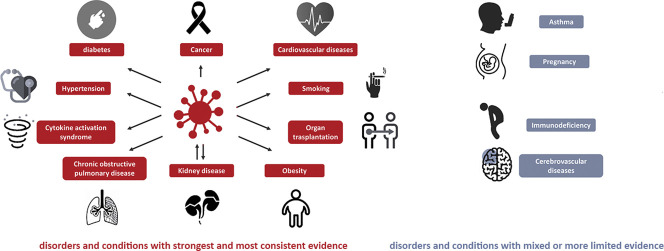
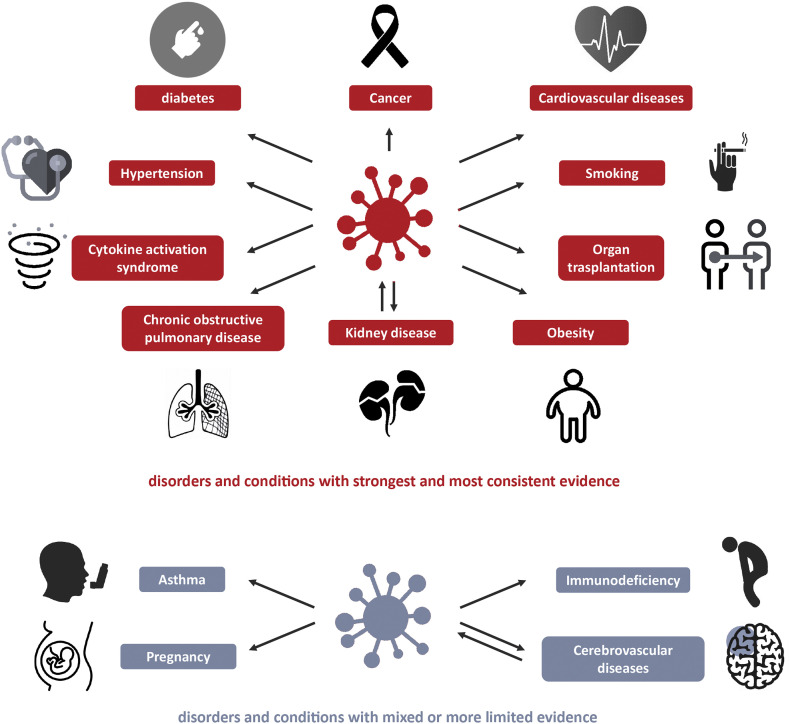
The severe acute respiratory syndrome coronavirus 2 (SARS-CoV-2) is a respiratory tract virus that causes Coronavirus disease (COVID-19). The virus originated in Wuhan, China, in December 2019 and has spread across the globe to-date. The disease ranges from asymptomatic carriers to symptoms such as fever, sore throat, cough, lung infections, and in severe cases, acute respiratory distress syndrome, sepsis, and death. As many as 50% of patients reported having at least one comorbidities with COVID-19 upon hospital admission. Hypertension, diabetes, chronic obstructive pulmonary disease, obesity, and cardiovascular diseases are among the most commonly reported. Comorbidities are contributing to acute disease prognosis and increased risk of severe symptoms. Around 70% of patients who require ICU care have been observed to have comorbidities. This review intends to understand how some of these comorbidities affect the disease's prognosis and how severe the outcome can be expected.
严重急性呼吸综合征冠状病毒 2(SARS-CoV-2)是一种呼吸道病毒,可引起冠状病毒病(COVID-19)。该病毒于 2019 年 12 月在中国武汉起源,并已传播到全球。该疾病的范围从无症状携带者到发热、喉咙痛、咳嗽、肺部感染等症状,在严重情况下,还会出现急性呼吸窘迫综合征、败血症和死亡。多达 50%的住院患者在入院时至少有一种与 COVID-19 相关的合并症。高血压、糖尿病、慢性阻塞性肺疾病、肥胖和心血管疾病是最常报告的合并症。合并症会影响急性疾病的预后,并增加出现严重症状的风险。约 70%需要 ICU 护理的患者被观察到存在合并症。这篇综述旨在了解其中一些合并症如何影响疾病的预后,以及预期的结果会有多严重。