Kua Jeremy, Hernandez Alexandra L, Velasquez Danielle N
Department of Chemistry & Biochemistry, University of San Diego, San Diego, CA 92110, USA.
Life (Basel). 2021 Sep 29;11(10):1025. doi: 10.3390/life11101025.
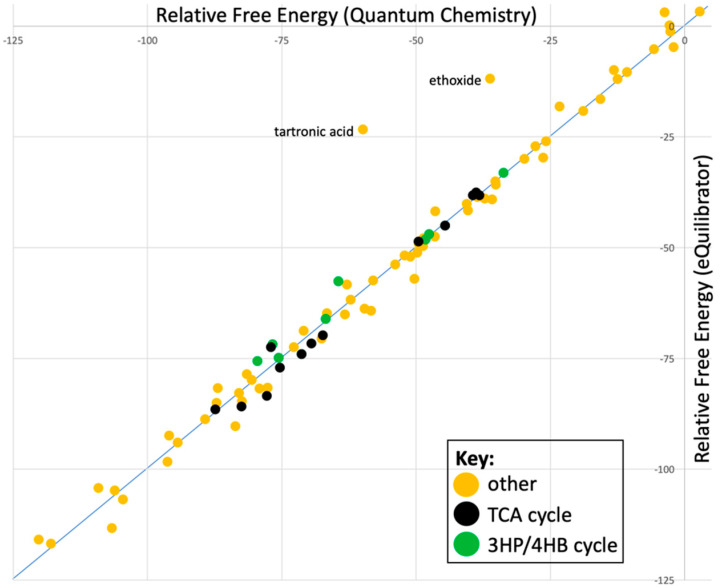
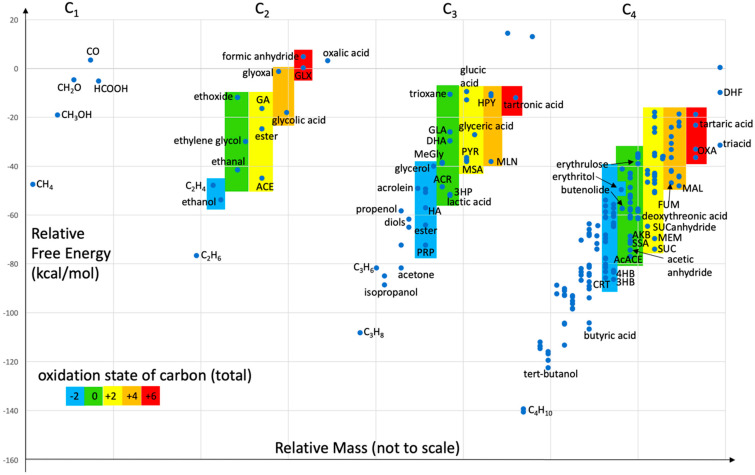
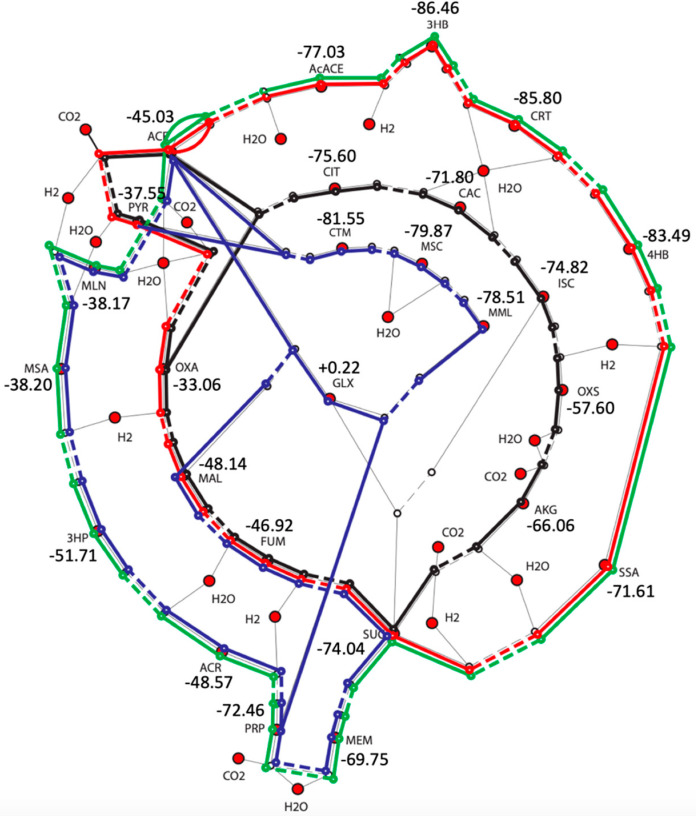
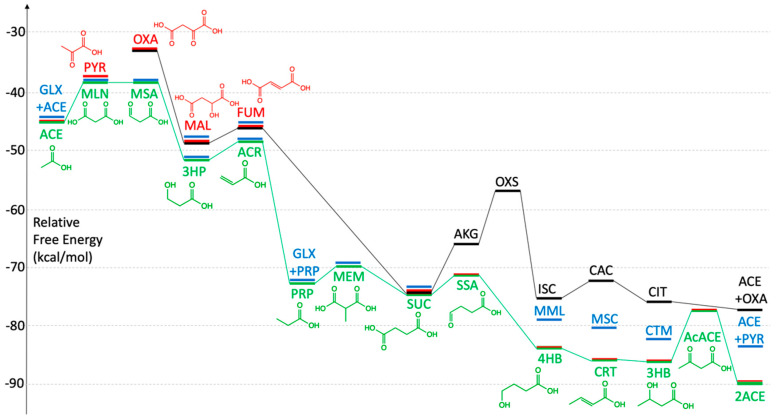
How did metabolism arise and evolve? What chemical compounds might be suitable to support and sustain a proto-metabolism before the advent of more complex co-factors? We explore these questions by using first-principles quantum chemistry to calculate the free energies of CHO compounds in aqueous solution, allowing us to probe the thermodynamics of core extant cycles and their closely related chemical cousins. By framing our analysis in terms of the simplest feasible cycle and its permutations, we analyze potentially favorable thermodynamic cycles for CO fixation with H as a reductant. We find that paying attention to redox states illuminates which reactions are endergonic or exergonic. Our results highlight the role of acetate in proto-metabolic cycles, and its connection to other prebiotic molecules such as glyoxalate, glycolaldehyde, and glycolic acid.
新陈代谢是如何产生和进化的?在更复杂的辅助因子出现之前,哪些化合物可能适合支持和维持原始新陈代谢?我们通过使用第一性原理量子化学来计算水溶液中CHO化合物的自由能,从而探讨这些问题,这使我们能够探究核心现存循环及其密切相关的化学类似物的热力学。通过以最简单可行的循环及其排列方式构建我们的分析,我们分析了以H作为还原剂固定CO的潜在有利热力学循环。我们发现关注氧化还原状态可以阐明哪些反应是吸能的或放能的。我们的结果突出了乙酸盐在原始代谢循环中的作用,以及它与其他益生元分子如乙醛酸、乙醇醛和乙醇酸的联系。