Institute of Neuroimmunology and Multiple Sclerosis (INIMS), University Medical Center Hamburg-Eppendorf (UKE), Martinistrasse 52, 20246, Hamburg, Germany.
Patient representative, Trier, Hamburg, Germany.
BMC Health Serv Res. 2021 Oct 22;21(1):1141. doi: 10.1186/s12913-021-07012-z.
Besides coping with a disease with many uncertainties, people with relapsing-remitting multiple sclerosis face complex decisions concerning disease-modifying therapies (DMTs). In an interview study, we aimed to assess patients' experiences with DMTs.
Problem-centred interviews were conducted with 50 people with relapsing-remitting multiple sclerosis in Germany using maximum variation sampling and covering all licensed DMTs. Data were analysed thematically using deductive and inductive categories.
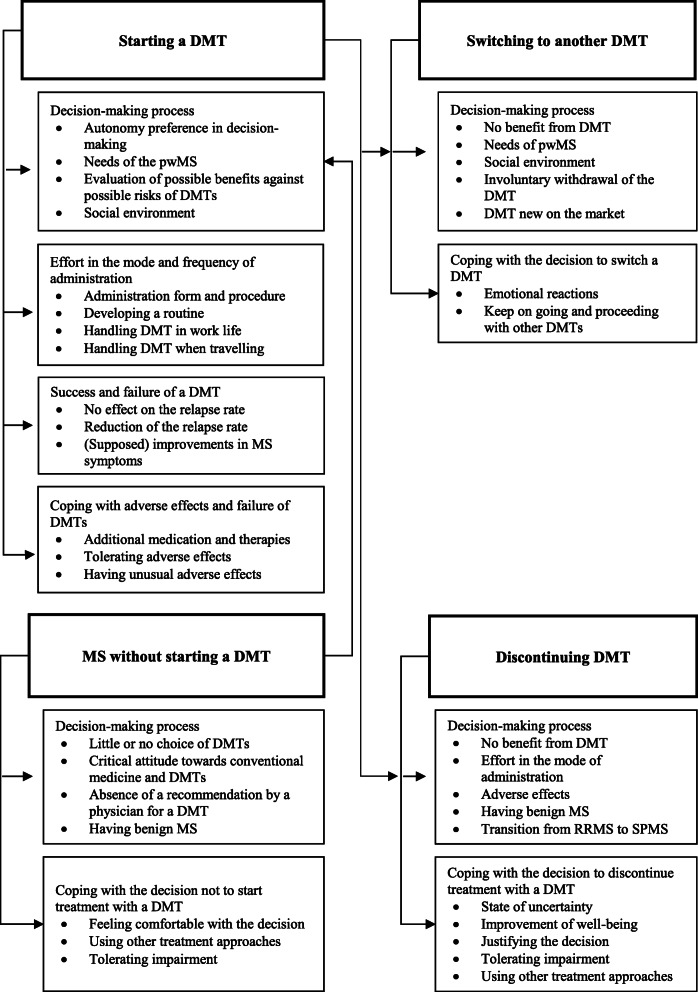
47 of 50 patients had treatment with at least one of the approved DMTs. The main themes were: (1) starting a DMT, (2) switching to another DMT, (3) discontinuing a DMT, and (4) multiple sclerosis without starting a DMT. Different intercorrelated factors influenced the decision-making processes for or against a DMT. Individual experiences with DMTs in daily life contained the effort in administration, success, and failure of DMTs, coping strategies and well-being without DMTs. The decision-making process for or against a DMT and the use of those treatments can be understood as a constant, continually shifting process, complicated by different factors, which change over time. Experiences with DMTs were characterized by attempts to handle uncertainty and to (re)gain control and integrate adaptivity into one's life.
The study provides a rich and nuanced amount of patients' experiences with DMTs. The findings demonstrate the importance for practitioners to look at current life circumstances of patients with multiple sclerosis when recommending a DMT and to promote and enable patients to make informed decisions.
除了应对具有许多不确定性的疾病外,患有复发性缓解型多发性硬化症的人还面临着与疾病修正疗法(DMT)相关的复杂决策。在一项访谈研究中,我们旨在评估患者对 DMT 的体验。
使用最大变异抽样对德国的 50 名复发性缓解型多发性硬化症患者进行了以问题为中心的访谈,涵盖了所有许可的 DMT。使用演绎和归纳类别对数据进行主题分析。
50 名患者中有 47 名至少使用过一种批准的 DMT。主要主题包括:(1)开始使用 DMT;(2)切换到另一种 DMT;(3)停止使用 DMT;(4)未开始使用 DMT 的多发性硬化症。不同的相互关联的因素影响了使用或不使用 DMT 的决策过程。日常生活中使用 DMT 的个人体验包括 DMT 的管理、成功和失败、应对策略以及没有 DMT 的幸福感。使用或不使用 DMT 的决策过程以及这些治疗方法的使用可以被理解为一个不断变化的过程,受到不同因素的影响,这些因素会随着时间的推移而变化。DMT 的体验以试图处理不确定性和(重新)获得控制以及将适应性融入生活为特征。
该研究提供了大量关于患者使用 DMT 的丰富而细致的体验。研究结果表明,从业者在推荐 DMT 时,必须考虑多发性硬化症患者的当前生活情况,并促进和使患者能够做出明智的决策。