Huey Sarah, Kavanagh Michaela, Regan Aine, Dean Moira, McKernan Clare, McCoy Finola, Ryan Eoin G, Caballero-Villalobos Javier, McAloon Catherine I
Institute for Global Food Security, School of Biological Sciences, Queen's University Belfast, Belfast, Northern Ireland.
Section of Herd Health and Animal Husbandry, School of Veterinary Medicine, University College Dublin, Belfield, Dublin 4, Ireland.
Ir Vet J. 2021 Oct 23;74(1):28. doi: 10.1186/s13620-021-00207-0.
Selective dry cow therapy (SDCT) is widely promoted in dairy farming as a method to reduce antimicrobial usage. New legislation introduced by the European Union will restrict and regulate the prophylactic and metaphylactic use of antibiotics from January 2022. Blanket dry cow therapy continues to be a practice engaged in by many farmers in Ireland and for many of these farmers, moving towards SDCT would require a significant infrastructural, behavioural and/or cultural change on their farm. Existing research has reported the important need to understand farmers' motivations to initiate any substantial behaviour change. However, it is currently unknown what farmers know, think and believe about SDCT in Ireland. The aim of this study was to use qualitative methods to explore what barriers and facilitators farmers perceived to exist with SDCT and explore if they had chosen to implement SDCT after voluntarily participating in a funded dry cow consult with a trained veterinarian, with the objective of maximising the dry period udder health performance and moving safely to SDCT.
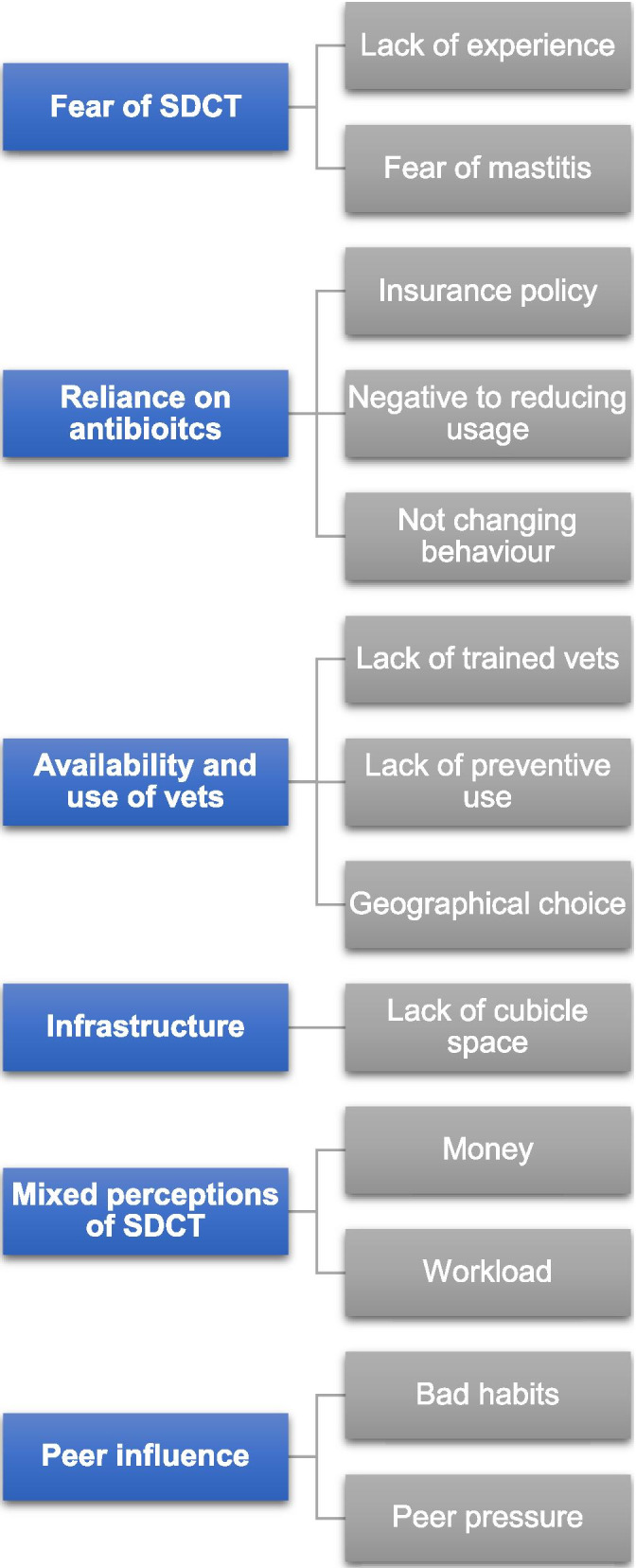
In this study, 19 farmers were contacted, and telephone interviews were conducted regarding farmers' beliefs about the consequences of SDCT. Audio recordings were professionally transcribed verbatim and analysed qualitatively using an inductive thematic analysis. The analysis identified 6 barriers and 6 facilitators to implementing SDCT. A significant fear of increasing mastitis incidence was evident that caused reluctance towards SDCT and reliance on antibiotics. Mixed perceptions on SDCT, infrastructure limitations, a perceived lack of preventive advice as well as peer influence were presented as barriers to SDCT. Farmers can build confidence when a graded approach to SDCT is implemented, which could help overcome the fear of SDCT and reliance on antibiotics. Regulatory pressure, high standards of farm hygiene and use of targeted veterinary consults were found to facilitate SDCT. Education was suggested to motivate farmers in the future uptake of SDCT. Despite cited negative influences, peer influence can be utilised to encourage the farming community.
This study prioritises areas to facilitate the major behaviour change required as a dairy industry in order to move from blanket dry cow therapy to SDCT.
选择性干奶牛疗法(SDCT)作为一种减少抗菌药物使用的方法,在奶牛养殖中得到广泛推广。欧盟出台的新立法将从2022年1月起限制和规范抗生素的预防性和群体预防性使用。在爱尔兰,许多奶农仍在继续采用全面干奶牛疗法,而对其中许多奶农来说,转向选择性干奶牛疗法需要在农场进行重大的基础设施、行为和/或文化变革。现有研究报告称,了解农民发起任何重大行为改变的动机非常重要。然而,目前尚不清楚爱尔兰的奶农对选择性干奶牛疗法了解、思考和相信些什么。本研究的目的是使用定性方法来探讨奶农认为选择性干奶牛疗法存在哪些障碍和促进因素,并探讨他们在自愿参加由训练有素的兽医提供的有偿干奶牛咨询后是否选择实施选择性干奶牛疗法,目标是最大限度地提高干奶期乳房健康水平并安全转向选择性干奶牛疗法。
在本研究中,联系了19位奶农,并就他们对选择性干奶牛疗法后果的看法进行了电话访谈。音频记录被专业逐字转录,并使用归纳主题分析法进行定性分析。分析确定了实施选择性干奶牛疗法的6个障碍和6个促进因素。明显存在对乳腺炎发病率增加的严重担忧,这导致对选择性干奶牛疗法的不情愿和对抗生素的依赖。对选择性干奶牛疗法的看法不一、基础设施限制、认为缺乏预防性建议以及同行影响被认为是选择性干奶牛疗法的障碍。当实施分级的选择性干奶牛疗法时,奶农可以建立信心,这有助于克服对选择性干奶牛疗法的恐惧和对抗生素的依赖。发现监管压力、高标准的农场卫生和使用有针对性的兽医咨询有助于选择性干奶牛疗法的实施。建议开展教育,以促使奶农未来采用选择性干奶牛疗法。尽管提到了负面影响,但可以利用同行影响来鼓励养殖社区。
本研究确定了促进乳制品行业从全面干奶牛疗法转向选择性干奶牛疗法所需的重大行为改变的优先领域。