Bae Jun Hyun, Seo Dae Yun, Lee Sang Ho, Shin Chaeyoung, Jamrasi Parivash, Han Jin, Song Wook
Health and Exercise Science Laboratory, Institute of Sports Science, Seoul National University, Seoul 08826, Korea.
National ResearchLaboratory for Mitochondrial Signaling, Department of Physiology, College of Medicine, Smart Marine Therapeutics Center, Cardiovascular and Metabolic Disease Center, Inje University.
Korean J Physiol Pharmacol. 2021 Nov 1;25(6):585-592. doi: 10.4196/kjpp.2021.25.6.585.
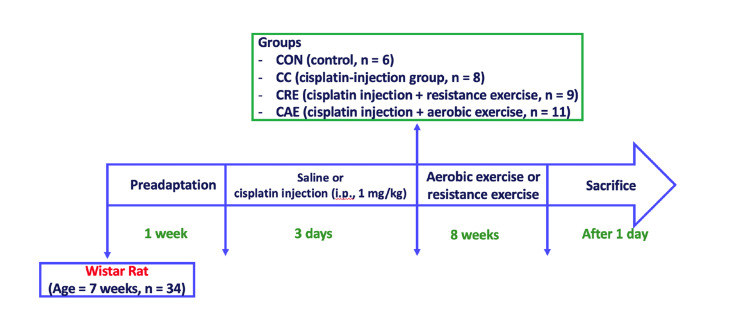
Cisplatin has been reported to cause side effects such as muscle wasting in humans and rodents. The physiological mechanisms involved in preventing muscle wasting, such as the regulation of AKT, PGC1-α, and autophagy-related factor FOXO3a by MuRF 1 and Atrogin-1, remain unclear following different types of exercise and in various skeletal muscle types. Eight-week-old male Wistar rats (n = 34) were assigned to one of four groups: control (CON, n = 6), cisplatin injection (1 mg/kg) without exercise (CC, n = 8), cisplatin (1 mg/kg) + resistance exercise (CRE, n = 9) group, and cisplatin (1 mg/kg) + aerobic exercise (CAE, n = 11). The CRE group performed progressive ladder exercise (starting with 10% of body weight on a 1-m ladder with 2-cm-interval grids, at 85°) for 8 weeks. The CAE group exercised by treadmill running (20 m/min for 60 min daily, 4 times/week) for 8 weeks. Compared with the CC group, the levels of the autophagy-related factors BNIP3, Beclin 1, LC3-II/I ratio, p62, and FOXO3a in the gastrocnemius and soleus muscles were significantly decreased in the CRE and CAE groups. The CRE and CAE groups further showed significantly decreased MuRF 1 and Atrogin-1 levels and increased phosphorylation of AKT, FOXO3a, and PGC1-α. These results suggest that both ladder and aerobic exercise directly affected muscle wasting by modulating the AKT/PGC1-α/FOXO3a signaling pathways regardless of the skeletal muscle type.
据报道,顺铂会在人类和啮齿动物中引起诸如肌肉萎缩等副作用。在不同类型的运动以及各种骨骼肌类型中,参与预防肌肉萎缩的生理机制,如MuRF 1和Atrogin-1对AKT、PGC1-α和自噬相关因子FOXO3a的调节,仍不清楚。将8周龄雄性Wistar大鼠(n = 34)分为四组之一:对照组(CON,n = 6)、不运动的顺铂注射组(1 mg/kg,CC,n = 8)、顺铂(1 mg/kg)+抗阻运动组(CRE,n = 9)和顺铂(1 mg/kg)+有氧运动组(CAE,n = 11)。CRE组进行渐进式阶梯运动(从体重的10%开始,在间隔2厘米网格的1米阶梯上,呈85°角),持续8周。CAE组通过跑步机跑步(每天20米/分钟跑60分钟,每周4次)进行8周运动。与CC组相比,CRE组和CAE组腓肠肌和比目鱼肌中自噬相关因子BNIP3、Beclin 1、LC3-II/I比值、p62和FOXO3a的水平显著降低。CRE组和CAE组还进一步显示MuRF 1和Atrogin-1水平显著降低,AKT、FOXO3a和PGC1-α的磷酸化增加。这些结果表明,无论骨骼肌类型如何,阶梯运动和有氧运动均通过调节AKT/PGC1-α/FOXO3a信号通路直接影响肌肉萎缩。