Mercado-Reyes Marcela, Gilboa Suzanne M, Valencia Diana, Daza Marcela, Tong Van T, Galang Romeo R, Winfield Christina M, Godfred-Cato Shana, Benavides Mónica, Villanueva Julie M, Thomas Jennifer D, Daniels Jonathan, Zaki Sherif, Reagan-Steiner Sarah, Bhatnagar Julu, Schiffer Jarad, Steward-Clark Evelene, Ricaldi Jessica N, Osorio Johana, Sancken Christina L, Pardo Lissethe, Tinker Sarah C, Anderson Kayla N, Rico Angelica, Burkel Veronica K, Hojnacki Jacob, Delahoy Miranda J, González Maritza, Osorio May B, Moore Cynthia A, Honein Margaret A, Ospina Martinez Martha Lucia
Instituto Nacional de Salud, Bogotá 111321, Colombia.
National Center on Birth Defects and Developmental Disabilities, Centers for Disease Control and Prevention, Atlanta, GA 30329, USA.
Trop Med Infect Dis. 2021 Oct 12;6(4):183. doi: 10.3390/tropicalmed6040183.
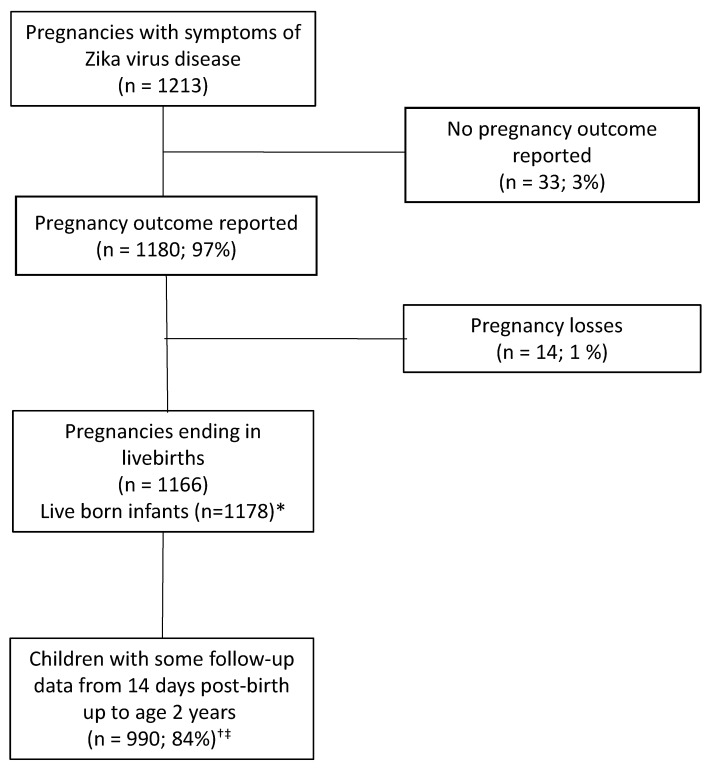
Project (VEZ), an intensified surveillance of pregnant women with symptoms of the Zika virus disease (ZVD) in Colombia, aimed to evaluate the relationship between symptoms of ZVD during pregnancy and adverse pregnancy, birth, and infant outcomes and early childhood neurodevelopmental outcomes. During May-November 2016, pregnant women in three Colombian cities who were reported with symptoms of ZVD to the national surveillance system, or with symptoms of ZVD visiting participating clinics, were enrolled in Project VEZ. Data from maternal and pediatric (up to two years of age) medical records were abstracted. Available maternal specimens were tested for the presence of the Zika virus ribonucleic acid and/or anti-Zika virus immunoglobulin antibodies. Of 1213 enrolled pregnant women with symptoms of ZVD, 1180 had a known pregnancy outcome. Results of the Zika virus laboratory testing were available for 569 (48.2%) pregnancies with a known pregnancy outcome though testing timing varied and was often distal to the timing of symptoms; 254 (21.5% of the whole cohort; 44.6% of those with testing results) were confirmed or presumptive positive for the Zika virus infection. Of pregnancies with a known outcome, 50 (4.2%) fetuses/infants had Zika-associated brain or eye defects, which included microcephaly at birth. Early childhood adverse neurodevelopmental outcomes were more common among those with Zika-associated birth defects than among those without and more common among those with laboratory evidence of a Zika virus infection compared with the full cohort. The proportion of fetuses/infants with any Zika-associated brain or eye defect was consistent with the proportion seen in other studies. Enhancements to Colombia's existing national surveillance enabled the assessment of adverse outcomes associated with ZVD in pregnancy.
“VEZ项目”旨在加强对哥伦比亚出现寨卡病毒病(ZVD)症状的孕妇的监测,以评估孕期ZVD症状与不良妊娠、分娩、婴儿结局以及幼儿神经发育结局之间的关系。2016年5月至11月期间,向国家监测系统报告有ZVD症状或前往参与项目的诊所就诊且有ZVD症状的哥伦比亚三个城市的孕妇被纳入“VEZ项目”。提取了孕产妇和儿科(至两岁)医疗记录中的数据。对可用的孕产妇样本进行寨卡病毒核糖核酸和/或抗寨卡病毒免疫球蛋白抗体检测。在1213名有ZVD症状的登记孕妇中,1180名孕妇有已知的妊娠结局。尽管检测时间各不相同且往往在症状出现时间之后,但569例(48.2%)有已知妊娠结局的孕妇有寨卡病毒实验室检测结果;254例(占整个队列的21.5%;占检测结果阳性者的44.6%)被确诊或疑似为寨卡病毒感染阳性。在有已知结局的妊娠中,50例(4.2%)胎儿/婴儿有与寨卡病毒相关的脑或眼缺陷,其中包括出生时小头畸形。与无寨卡病毒相关出生缺陷的婴儿相比,有寨卡病毒相关出生缺陷的婴儿出现幼儿期不良神经发育结局更为常见;与整个队列相比,有寨卡病毒感染实验室证据的婴儿出现幼儿期不良神经发育结局更为常见。有任何与寨卡病毒相关的脑或眼缺陷的胎儿/婴儿比例与其他研究中观察到的比例一致。哥伦比亚现有国家监测系统的强化措施使得能够评估与孕期ZVD相关的不良结局。