Department of Metabolic Diseases, Faculty of Medicine, Jagiellonian University Medical College, Krakow, Poland.
Department of Metabolic Diseases, University Hospital, Krakow, Poland.
Sci Rep. 2021 Oct 26;11(1):21003. doi: 10.1038/s41598-021-00411-6.
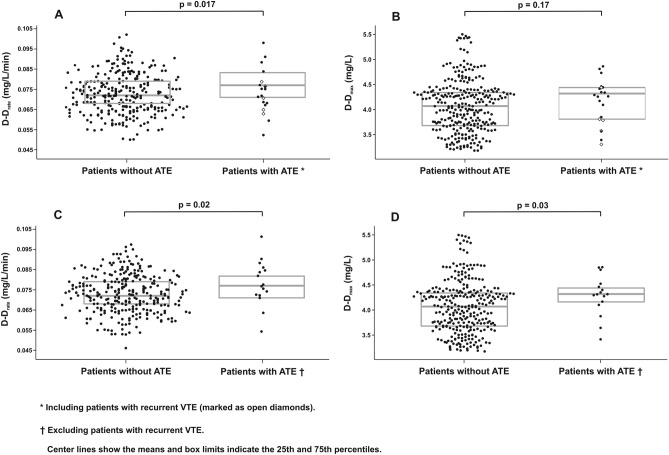
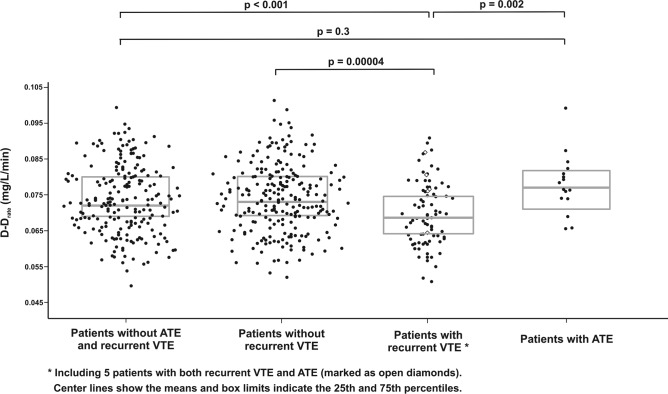
Several lines of evidence have suggested that patients following venous thromboembolism (VTE) are at higher risk of arterial thromboembolism (ATE). Prothrombotic fibrin clot characteristics were reported in individuals with cardiovascular risk factors. We investigated whether specific fibrin clot properties measured after 3-4 months of anticoagulation characterize VTE patients with subsequent ATE. We enrolled 320 patients following VTE aged below 70 years (median age, 46). Ten patients were lost to follow-up. ATE occurred in 21 individuals after a median 54 (31-68) months during a follow-up of 87.5 months (incidence 0.94%; 95% confidence interval [CI], 0.59-1.4 per patient-year). Patients with ATE had faster fibrin clot degradation, reflected by maximum rate of D-dimer increase during plasma clot lysis induced by tissue-type plasminogen activator (D-D) at baseline. Clot permeability, turbidimetric variables, clot lysis time, and thrombin generation were unrelated to ATE. Univariable Cox proportional hazards analysis showed that age, diabetes, and D-D were risk factors for subsequent ATE. Increased D-D (by 0.001 mg/L/min; hazard ratio, 1.08; 95% CI 1.02-1.14) was an independent predictor of ATE after adjustment for potential confounders. Faster fibrin clot degradation at 3 months since VTE may increase the risk of ATE among VTE patients during follow-up.
有几项证据表明,静脉血栓栓塞症(VTE)患者发生动脉血栓栓塞症(ATE)的风险更高。心血管危险因素患者存在促血栓纤维蛋白凝块特征。我们研究了抗凝治疗 3-4 个月后测量的特定纤维蛋白凝块特性是否可以表征随后发生 ATE 的 VTE 患者。我们纳入了 320 名年龄在 70 岁以下的 VTE 患者(中位数年龄 46 岁)。10 名患者失访。在 87.5 个月的随访中,21 名患者在中位数 54 个月(31-68 个月)后发生 ATE(发生率为 0.94%;95%置信区间 [CI],每患者年 0.59-1.4)。ATE 患者的纤维蛋白凝块降解速度更快,反映为组织型纤溶酶原激活物(t-PA)诱导血浆凝块溶解时 D-二聚体增加的最大速率(D-D)。在基线时,纤维蛋白凝块通透性、比浊变量、凝块溶解时间和凝血酶生成与 ATE 无关。单变量 Cox 比例风险分析显示,年龄、糖尿病和 D-D 是 ATE 的危险因素。在校正潜在混杂因素后,D-D 增加(增加 0.001mg/L/min;风险比 1.08;95%CI 1.02-1.14)是 ATE 的独立预测因子。VTE 发生后 3 个月纤维蛋白凝块降解速度加快可能会增加 VTE 患者在随访期间发生 ATE 的风险。