Zhao Xiaoxiao, Song Li, Wang Ying, Li Jiannan, Zhou Jinying, Chen Runzhen, Liu Chen, Zhou Peng, Sheng Zhaoxue, Chen Yi, Zhao Hanjun, Yan Hongbing
Department of Cardiology, Fuwai Hospital, National Center for Cardiovascular Diseases, Peking Union Medical College & Chinese Academy of Medical Sciences, BeiJing, People's Republic of China.
Department of Cardiology, Fuwai Hospital Chinese Academy of Medical Sciences, ShenZhen, People's Republic of China.
J Inflamm Res. 2021 Oct 14;14:5319-5335. doi: 10.2147/JIR.S334246. eCollection 2021.
The aim of prospective study was to determine the prognostic value of combined measures of plasma proprotein convertase subtilisin/kexin type 9 (PCSK9) and pentraxin 3 (PTX3) according to the culprit-plaque morphology (plaque rupture versus plaque erosion) in relation to the in patients with acute ST-elevated myocardial infarction (STEMI) who underwent primary percutaneous coronary intervention.
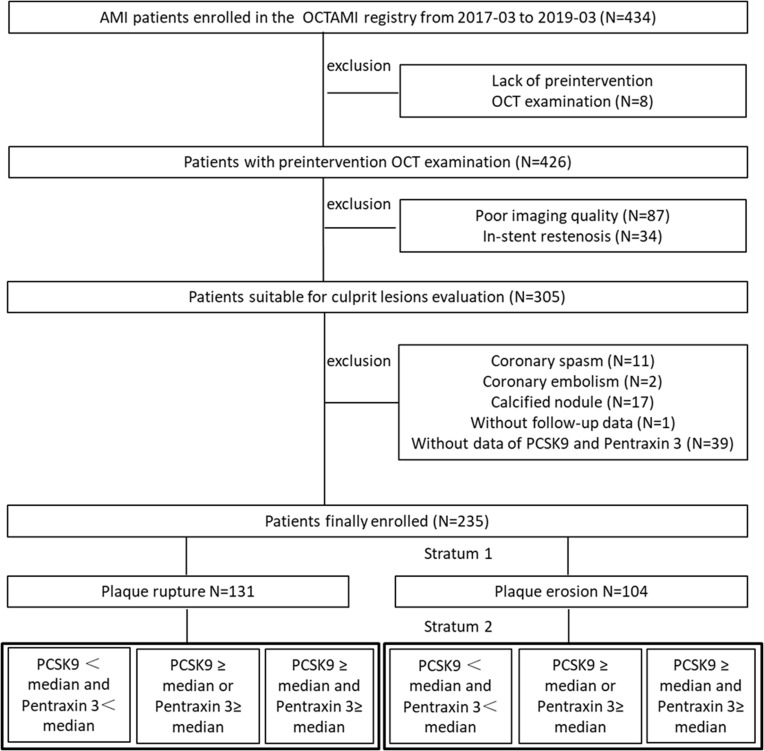
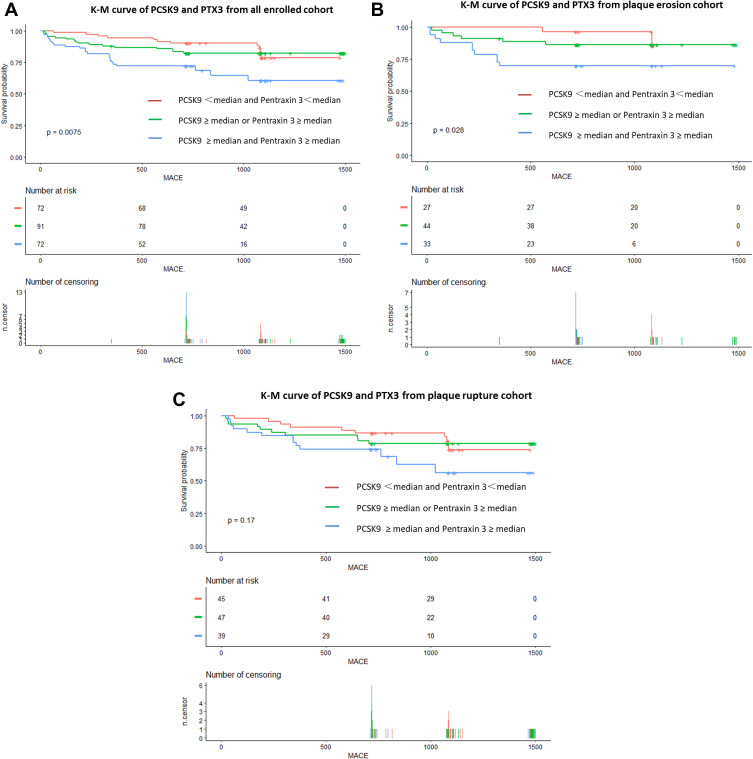
A total of 434 patients with STEMI aged ≥18 years who underwent pre-intervention OCT imaging of culprit lesions between March 2017 and March 2019 were enrolled. Finally, 235 patients who meet the inclusion criteria were enrolled and the cohort was divided into 3 groups according to PCSK9 and PTX3 levels: group A: PCSK9 < median and Pentraxin 3 (N = 72/30.6%); group B: PCSK9 ≥ median or Pentraxin 3≥ median (N = 91/38.7%); group C: PCSK9 ≥ median and Pentraxin 3≥ median (N = 72/30.6%). MACEs were defined as a composite of all-cause death, myocardial infarction (MI) recurrence, and ischemic stroke, revascularization and heart failure.
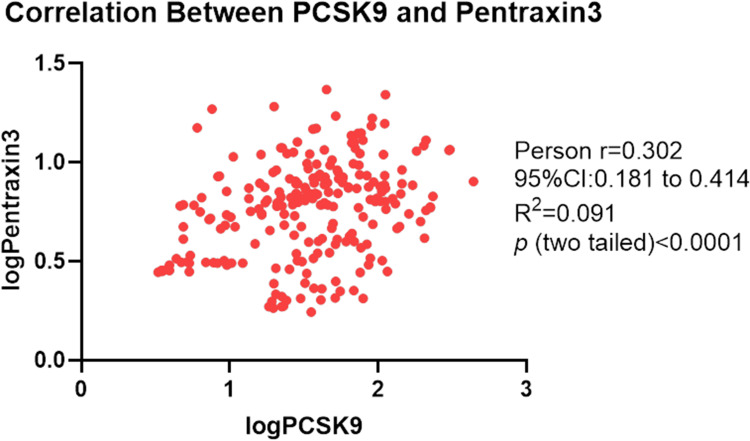
During a median follow-up of 2.01 years, 50 patients has occurred MACE. Two-year MACE was higher in group C (23/31.9%) than in group B (16/17.6%) and group A (11/15.3%) (p = 0.028). There was a correlation between PCSK9 and PTX3 (r = 0.302, p < 0.003). In multivariable analysis adjusted for age, gender, risk factors, and serum indexes, being in group C remained independently associated with an increased risk of MACE (hazard ratio [HR]: 2.90; p = 0.010), and group B tended to have higher MACE (HR: 1.76; p = 0.172) compared with group A. Among patients with plaque erosion by OCT, group C was independently associated with an increased risk of MACE (HR: 9.04; p = 0.048) after fully adjustment. However, the significant association was absence among patients with plaque rupture.
This study demonstrated the usefulness of combined measures of PCSK9 and PTX3 to enhance risk stratification in patients with STEMI especially among patients with plaque erosion. Patients with elevation of both PCSK9 and PTX3 had a markedly increased risk of MACE.
本前瞻性研究的目的是,针对接受直接经皮冠状动脉介入治疗的急性ST段抬高型心肌梗死(STEMI)患者,根据罪犯斑块形态(斑块破裂与斑块侵蚀)确定血浆前蛋白转化酶枯草溶菌素/kexin 9型(PCSK9)和五聚素3(PTX3)联合检测指标的预后价值。
纳入2017年3月至2019年3月期间,434例年龄≥18岁、在干预前对罪犯病变进行光学相干断层扫描(OCT)成像的STEMI患者。最终,235例符合纳入标准的患者入组,根据PCSK9和PTX3水平将队列分为3组:A组:PCSK9<中位数且五聚素3(N = 72/30.6%);B组:PCSK9≥中位数或五聚素3≥中位数(N = 91/38.7%);C组:PCSK9≥中位数且五聚素3≥中位数(N = 72/30.6%)。主要不良心血管事件(MACE)定义为全因死亡、心肌梗死(MI)复发、缺血性卒中、血运重建和心力衰竭的复合事件。
在中位随访2.01年期间,50例患者发生了MACE。C组的两年MACE发生率(23/31.9%)高于B组(16/17.6%)和A组(11/15.3%)(p = 0.028)。PCSK9与PTX3之间存在相关性(r = 0.302,p < 0.003)。在对年龄、性别、危险因素和血清指标进行校正的多变量分析中,C组仍与MACE风险增加独立相关(风险比[HR]:2.90;p = 0.010),与A组相比,B组的MACE风险有升高趋势(HR:1.76;p = 0.172)。在OCT显示为斑块侵蚀的患者中,完全校正后C组与MACE风险增加独立相关(HR:9.04;p = 0.048)。然而,在斑块破裂的患者中未发现显著相关性。
本研究表明,PCSK9和PTX3联合检测指标有助于改善STEMI患者尤其是斑块侵蚀患者的风险分层。PCSK9和PTX3均升高的患者发生MACE的风险显著增加。