• 文献检索
  • 文档翻译
  • 深度研究
  • 学术资讯
  • Suppr Zotero 插件Zotero 插件
  • 邀请有礼
  • 套餐&价格
  • 历史记录
应用&插件
Suppr Zotero 插件Zotero 插件浏览器插件Mac 客户端Windows 客户端微信小程序
定价
高级版会员购买积分包购买API积分包
服务
文献检索文档翻译深度研究API 文档MCP 服务
关于我们
关于 Suppr公司介绍联系我们用户协议隐私条款
关注我们

Suppr 超能文献

核心技术专利:CN118964589B侵权必究
粤ICP备2023148730 号-1Suppr @ 2026

文献检索

告别复杂PubMed语法,用中文像聊天一样搜索,搜遍4000万医学文献。AI智能推荐,让科研检索更轻松。

立即免费搜索

文件翻译

保留排版,准确专业,支持PDF/Word/PPT等文件格式,支持 12+语言互译。

免费翻译文档

深度研究

AI帮你快速写综述,25分钟生成高质量综述,智能提取关键信息,辅助科研写作。

立即免费体验

新冠疫情期间同伴手机冷落行为与中国大学生手机成瘾:无聊倾向的中介作用与拒绝自我效能感的调节作用

Peer Phubbing and Chinese College Students' Smartphone Addiction During COVID-19 Pandemic: The Mediating Role of Boredom Proneness and the Moderating Role of Refusal Self-Efficacy.

作者信息

Zhao Jun, Ye Baojuan, Yu Li

机构信息

Center of Mental Health Education and Research, School of Psychology, Jiangxi Normal University, Nanchang, 330022, People's Republic of China.

Mental Health Education and Counseling Center, Nanchang Hangkong University, Nanchang, 330063, People's Republic of China.

出版信息

Psychol Res Behav Manag. 2021 Oct 18;14:1725-1736. doi: 10.2147/PRBM.S335407. eCollection 2021.

DOI:10.2147/PRBM.S335407
PMID:34703335
原文链接:https://pmc.ncbi.nlm.nih.gov/articles/PMC8536884/
Abstract

PURPOSE

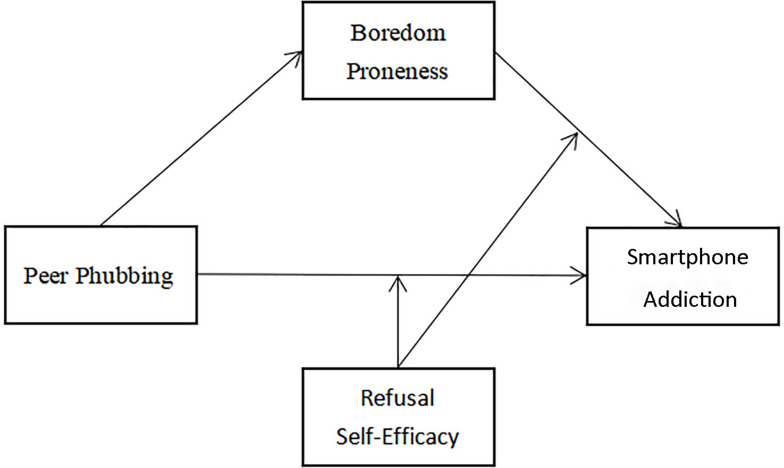
COVID-19 has had a huge impact on the physical behavior and mental health of people. Long-term and strict isolation policies are widely used to ensure social distancing, which may cause excessive smartphone use and increase the risk of smartphone addiction. Previous researchers have identified that some factors that affect smartphone addiction, but there was little research conducted during COVID-19 pandemic. The present study aims to examine the effect of peer phubbing on smartphone addiction, how boredom proneness may mediate this effect, and lastly how refusal self-efficacy may moderate the indirect and direct pathways during COVID-19 pandemic.

METHODS

A total of 1396 college students (mean age=20.48, SD=1.08) were surveyed and completed four scales (Peer Phubbing Scale, Refusal Self-efficacy Scale, Smartphone Addiction Index Scale, Boredom Proneness Scale). The statistical analyses were conducted by SPSS 22.0 and SPSS PROCESS macro.

RESULTS

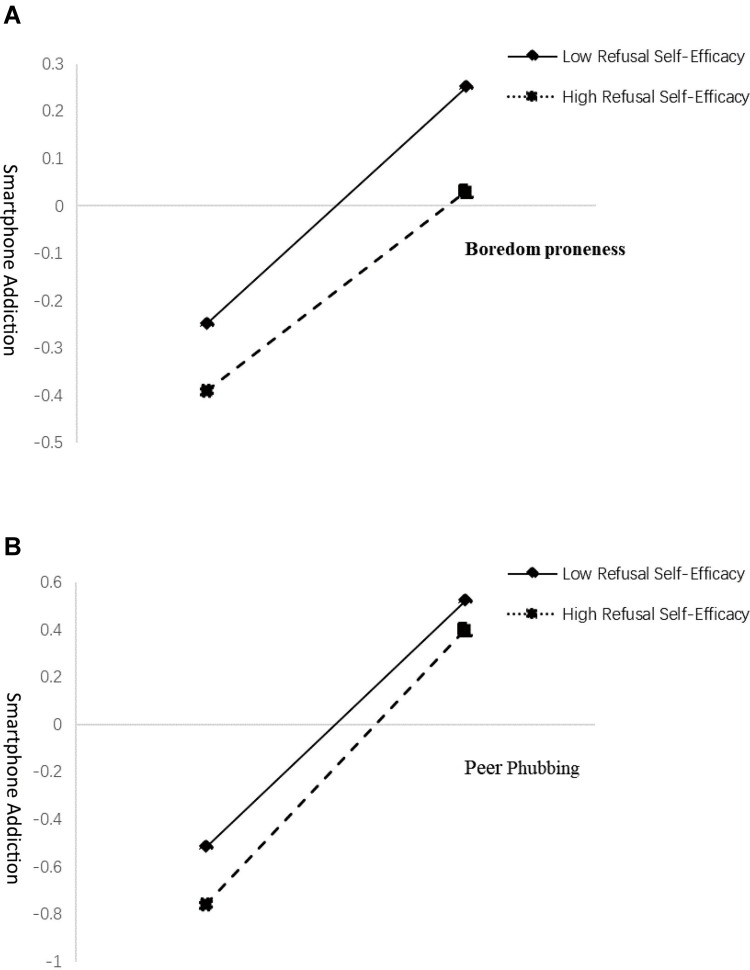
This study found that peer phubbing was positively associated with smartphone addiction. Boredom proneness mediated the effect of peer phubbing and smartphone addiction. Furthermore, refusal self-efficacy moderated the relationship between peer phubbing and smartphone addiction as well as boredom proneness and smartphone addiction. Specifically, peer phubbing had a greater impact on smartphone addiction for college students with higher levels of refusal self-efficacy, and the boredom proneness on smartphone addiction was stronger for college students with low levels of refusal self-efficacy.

CONCLUSION

This study is important in investigating how peer phubbing is related to the smartphone addiction of Chinese college students during COVID-19 pandemic. The results suggest that college students' boredom proneness and refusal self-efficacy may be prime targets for prevention and intervention programs. Thus, this study explored "how" and "when" peer phubbing may enhance college students' smartphone addiction during COVID-19 pandemic.

摘要

目的

新冠疫情对人们的身体行为和心理健康产生了巨大影响。长期严格的隔离政策被广泛用于确保社交距离,这可能导致智能手机使用过度,并增加智能手机成瘾的风险。先前的研究已经确定了一些影响智能手机成瘾的因素,但在新冠疫情期间进行的相关研究较少。本研究旨在探讨同伴冷落对智能手机成瘾的影响、无聊倾向如何介导这种影响,以及最后拒绝自我效能如何在新冠疫情期间调节间接和直接路径。

方法

共对1396名大学生(平均年龄=20.48,标准差=1.08)进行了调查,并完成了四个量表(同伴冷落量表、拒绝自我效能量表、智能手机成瘾指数量表、无聊倾向量表)。统计分析采用SPSS 22.0和SPSS PROCESS宏程序进行。

结果

本研究发现同伴冷落与智能手机成瘾呈正相关。无聊倾向介导了同伴冷落与智能手机成瘾之间的关系。此外,拒绝自我效能调节了同伴冷落与智能手机成瘾以及无聊倾向与智能手机成瘾之间的关系。具体而言,同伴冷落对拒绝自我效能水平较高的大学生的智能手机成瘾影响更大,而拒绝自我效能水平较低的大学生中,无聊倾向对智能手机成瘾的影响更强。

结论

本研究对于调查新冠疫情期间同伴冷落如何与中国大学生的智能手机成瘾相关具有重要意义。结果表明,大学生的无聊倾向和拒绝自我效能可能是预防和干预项目的主要目标。因此,本研究探讨了在新冠疫情期间同伴冷落“如何”以及“何时”可能增强大学生的智能手机成瘾。
https://cdn.ncbi.nlm.nih.gov/pmc/blobs/e907/8536884/651012c36473/PRBM-14-1725-g0002.jpg
https://cdn.ncbi.nlm.nih.gov/pmc/blobs/e907/8536884/f02795269625/PRBM-14-1725-g0001.jpg
https://cdn.ncbi.nlm.nih.gov/pmc/blobs/e907/8536884/651012c36473/PRBM-14-1725-g0002.jpg
https://cdn.ncbi.nlm.nih.gov/pmc/blobs/e907/8536884/f02795269625/PRBM-14-1725-g0001.jpg
https://cdn.ncbi.nlm.nih.gov/pmc/blobs/e907/8536884/651012c36473/PRBM-14-1725-g0002.jpg

相似文献

1
Peer Phubbing and Chinese College Students' Smartphone Addiction During COVID-19 Pandemic: The Mediating Role of Boredom Proneness and the Moderating Role of Refusal Self-Efficacy.新冠疫情期间同伴手机冷落行为与中国大学生手机成瘾:无聊倾向的中介作用与拒绝自我效能感的调节作用
Psychol Res Behav Manag. 2021 Oct 18;14:1725-1736. doi: 10.2147/PRBM.S335407. eCollection 2021.
2
The Effect of Parent Phubbing on Chinese Adolescents' Smartphone Addiction During COVID-19 Pandemic: Testing a Moderated Mediation Model.疫情期间父母低头玩手机对中国青少年智能手机成瘾的影响:检验一个有调节的中介模型。
Psychol Res Behav Manag. 2022 Mar 5;15:569-579. doi: 10.2147/PRBM.S349105. eCollection 2022.
3
Boredom Proneness on Chinese College Students' Phubbing during the COVID-19 Outbreak: The Mediating Effects of Self-Control and Bedtime Procrastination.新冠疫情期间中国大学生手机成瘾倾向与无聊倾向性:自我控制和就寝拖延的中介作用
J Healthc Eng. 2023 Feb 8;2023:4134283. doi: 10.1155/2023/4134283. eCollection 2023.
4
Why Cannot I Stop Phubbing? Boredom Proneness and Phubbing: A Multiple Mediation Model.为什么我无法停止低头族行为?易 boredom 倾向与低头族行为:一个多重中介模型。 (注:“boredom”常见释义为“无聊”,这里“boredom proneness”直译为“易无聊倾向”,可能在特定语境中有更合适的意译,比如“易产生无聊情绪倾向”等,但按照要求直接翻译了。 )
Psychol Res Behav Manag. 2023 Sep 8;16:3727-3738. doi: 10.2147/PRBM.S423371. eCollection 2023.
5
The role of boredom proneness and self-control in the association between anxiety and smartphone addiction among college students: a multiple mediation model.易厌倦倾向和自我控制在大学生焦虑与智能手机成瘾关系中的作用:一个多重中介模型。
Front Public Health. 2023 Jul 26;11:1201079. doi: 10.3389/fpubh.2023.1201079. eCollection 2023.
6
Loneliness and Mobile Phone Addiction Among Chinese College Students: The Mediating Roles of Boredom Proneness and Self-Control.中国大学生的孤独感与手机成瘾:无聊倾向和自我控制的中介作用
Psychol Res Behav Manag. 2021 Jun 11;14:687-694. doi: 10.2147/PRBM.S315879. eCollection 2021.
7
The Effect of Future Time Perspective on Internet Dependence Among College Students in Pandemic Time: A Moderated Mediation Analysis.疫情期间未来时间洞察力对大学生网络依赖的影响:一项有调节的中介分析
Psychol Res Behav Manag. 2023 Feb 22;16:509-520. doi: 10.2147/PRBM.S396622. eCollection 2023.
8
Examining the Association Between Boredom Proneness and Bedtime Procrastination Among Chinese College Students: A Sequential Mediation Model with Mobile Phone Addiction and Negative Emotions.探究中国大学生无聊倾向与就寝拖延之间的关联:一个以手机成瘾和负面情绪为中介变量的序列中介模型
Psychol Res Behav Manag. 2023 Oct 25;16:4329-4340. doi: 10.2147/PRBM.S431615. eCollection 2023.
9
Risk and Protective Factors Associated With Smartphone Addiction and Phubbing Behavior Among College Students in China.中国大学生智能手机成瘾和低头行为相关的风险和保护因素。
Psychol Rep. 2023 Oct;126(5):2172-2190. doi: 10.1177/00332941221084905. Epub 2022 Apr 12.
10
Social Exclusion and Short Video Addiction: The Mediating Role of Boredom and Self-Control.社会排斥与短视频成瘾:无聊和自我控制的中介作用
Psychol Res Behav Manag. 2024 May 30;17:2195-2203. doi: 10.2147/PRBM.S463240. eCollection 2024.

引用本文的文献

1
Decisional procrastination and problematic mobile phone use: the mediation of anxiety and the moderation of 2019-nCoV traumatic experience.决策拖延与问题性手机使用:焦虑的中介作用以及2019新型冠状病毒创伤经历的调节作用
BMC Psychol. 2025 Aug 4;13(1):863. doi: 10.1186/s40359-025-03193-y.
2
Inconsistent Bodily Feedback? Interoceptive Sensibility Affects Internet Gaming Disorder in Emerging Adults.身体反馈不一致?内感受敏感性影响青少年的网络成瘾障碍。
Behav Sci (Basel). 2025 Jun 30;15(7):896. doi: 10.3390/bs15070896.
3
Peer pressure, anxiety, and smartphone addiction among Chinese college students: a mediation analysis.

本文引用的文献

1
Cellphone addiction during the Covid-19 outbreak: How online social anxiety and cyber danger belief mediate the influence of personality.新冠疫情期间的手机成瘾:网络社交焦虑和网络危险信念如何介导人格的影响。
Comput Human Behav. 2021 Aug;121:106790. doi: 10.1016/j.chb.2021.106790. Epub 2021 Mar 22.
2
Positive Information of COVID-19 and Anxiety: A Moderated Mediation Model of Risk Perception and Intolerance of Uncertainty.新冠疫情的积极信息与焦虑:风险认知和不确定性不耐受的有调节的中介模型
Front Psychiatry. 2021 Aug 3;12:715929. doi: 10.3389/fpsyt.2021.715929. eCollection 2021.
3
Association Between Anxiety Symptoms and Problematic Smartphone Use Among Chinese University Students: The Mediating/Moderating Role of Self-Efficacy.
中国大学生中的同伴压力、焦虑与智能手机成瘾:一项中介效应分析
BMC Psychol. 2025 Jul 10;13(1):772. doi: 10.1186/s40359-025-03107-y.
4
A manual three-step latent profile analysis to discover phubbing risk profiles among university students.一项用于发现大学生中低头族风险特征的手动三步潜在剖面分析。
Front Psychol. 2025 Jun 25;16:1510585. doi: 10.3389/fpsyg.2025.1510585. eCollection 2025.
5
Phubbing Behaviour: A Bibliometric Analysis of Scientific Production.低头族行为:科学产出的文献计量分析
Behav Sci (Basel). 2025 May 28;15(6):745. doi: 10.3390/bs15060745.
6
Boss, Can't You Hear Me? The Impact Mechanism of Supervisor Phone Snubbing (Phubbing) on Employee Psychological Withdrawal Behavior.老板,你听不到我说话吗?上司电话冷落(低头族行为)对员工心理退缩行为的影响机制
Healthcare (Basel). 2023 Dec 14;11(24):3167. doi: 10.3390/healthcare11243167.
7
Smartphone Addiction Among University Students' During the Post-COVID-19 Era: The Role of Emotional Intelligence and Future Anxiety.新冠疫情后时代大学生的智能手机成瘾:情商与未来焦虑的作用
Psychiatry Investig. 2023 Oct;20(10):951-961. doi: 10.30773/pi.2023.0021. Epub 2023 Oct 24.
8
Why Cannot I Stop Phubbing? Boredom Proneness and Phubbing: A Multiple Mediation Model.为什么我无法停止低头族行为?易 boredom 倾向与低头族行为:一个多重中介模型。 (注:“boredom”常见释义为“无聊”,这里“boredom proneness”直译为“易无聊倾向”,可能在特定语境中有更合适的意译,比如“易产生无聊情绪倾向”等,但按照要求直接翻译了。 )
Psychol Res Behav Manag. 2023 Sep 8;16:3727-3738. doi: 10.2147/PRBM.S423371. eCollection 2023.
9
Boredom Proneness on Chinese College Students' Phubbing during the COVID-19 Outbreak: The Mediating Effects of Self-Control and Bedtime Procrastination.新冠疫情期间中国大学生手机成瘾倾向与无聊倾向性:自我控制和就寝拖延的中介作用
J Healthc Eng. 2023 Feb 8;2023:4134283. doi: 10.1155/2023/4134283. eCollection 2023.
10
Smartphone addiction and phubbing behavior among university students: A moderated mediation model by fear of missing out, social comparison, and loneliness.大学生中的智能手机成瘾与低头族行为:一个由错失恐惧、社会比较和孤独感调节的中介模型。
Front Psychol. 2023 Jan 6;13:1072551. doi: 10.3389/fpsyg.2022.1072551. eCollection 2022.
中国大学生焦虑症状与问题性智能手机使用之间的关联:自我效能感的中介/调节作用
Front Psychiatry. 2021 Feb 24;12:581367. doi: 10.3389/fpsyt.2021.581367. eCollection 2021.
4
Health anxiety related to problematic smartphone use and gaming disorder severity during COVID-19: Fear of missing out as a mediator.新冠疫情期间,与问题性智能手机使用相关的健康焦虑和游戏障碍严重程度:错失恐惧作为中介因素
Hum Behav Emerg Technol. 2021 Jan;3(1):137-146. doi: 10.1002/hbe2.227. Epub 2020 Nov 23.
5
Exploring the associations between gambling cravings, self-efficacy, and gambling episodes: An Ecological Momentary Assessment study.探究赌博渴望、自我效能感与赌博发作之间的关联:一项生态瞬时评估研究。
Addict Behav. 2021 Jan;112:106574. doi: 10.1016/j.addbeh.2020.106574. Epub 2020 Jul 24.
6
COVID-19 anxiety symptoms associated with problematic smartphone use severity in Chinese adults.新冠疫情相关焦虑症状与中国成年人智能手机使用问题严重程度相关。
J Affect Disord. 2020 Sep 1;274:576-582. doi: 10.1016/j.jad.2020.05.080. Epub 2020 May 27.
7
Learning from drinking experiences in college: A test of reciprocal determinism with drinking refusal self-efficacy.从大学饮酒经历中学习:用拒绝饮酒自我效能感检验交互决定论。
Psychol Addict Behav. 2021 Feb;35(1):85-92. doi: 10.1037/adb0000675. Epub 2020 Jul 13.
8
COVID-19 and addiction.新型冠状病毒肺炎与成瘾
Diabetes Metab Syndr. 2020 Sep-Oct;14(5):817-823. doi: 10.1016/j.dsx.2020.06.008. Epub 2020 Jun 9.
9
Are bored minds more likely to be addicted? The relationship between boredom proneness and problematic mobile phone use.无聊的头脑更容易上瘾吗?无聊倾向与问题手机使用之间的关系。
Addict Behav. 2020 Sep;108:106426. doi: 10.1016/j.addbeh.2020.106426. Epub 2020 May 5.
10
Problematic online gaming and the COVID-19 pandemic.问题性网络游戏与新冠疫情。
J Behav Addict. 2020 Apr 29;9(2):184-186. doi: 10.1556/2006.2020.00016. Print 2020 Jun.