Knight Cancer Institute, Oregon Health & Science University, 3181 SW Sam Jackson Road, OC14HO, Portland, OR, 97239, USA.
School of Medicine, Oregon Health & Science University, Portland, OR, USA.
BMC Cancer. 2021 Oct 27;21(1):1150. doi: 10.1186/s12885-021-08894-2.
Docetaxel in combination with two HER2-directed therapies, trastuzumab and pertuzumab, is the current standard frontline therapy for patients with metastatic HER2-positive breast cancer. Ado-trastuzumab (T-DM1), an antibody-drug conjugate of trastuzumab and a cytotoxic microtubule-inhibitory agent, emtansine, is approved in patients that have progressed with prior trastuzumab-based therapy. However, the benefit of T-DM1 in patients previously treated with pertuzumab therapy for metastatic breast cancer remains unclear.
We identified thirty-three adults with metastatic HER2-positive breast cancer treated between March 2013 and July 2018 with T-DM1 either as subsequent therapy after progression on a pertuzumab-based regimen (i.e., "pertuzumab-pretreated") or without prior exposure to pertuzumab (i.e., "pertuzumab-naïve"). Collected data included patient demographics, treatment history, adverse events, and clinical outcomes. For both cohorts receiving T-DM1, the primary endpoint was PFS and secondary endpoints were overall survival (OS), overall response rate (ORR), clinical benefit rate (CBR), and T-DM1-related toxicity rate.
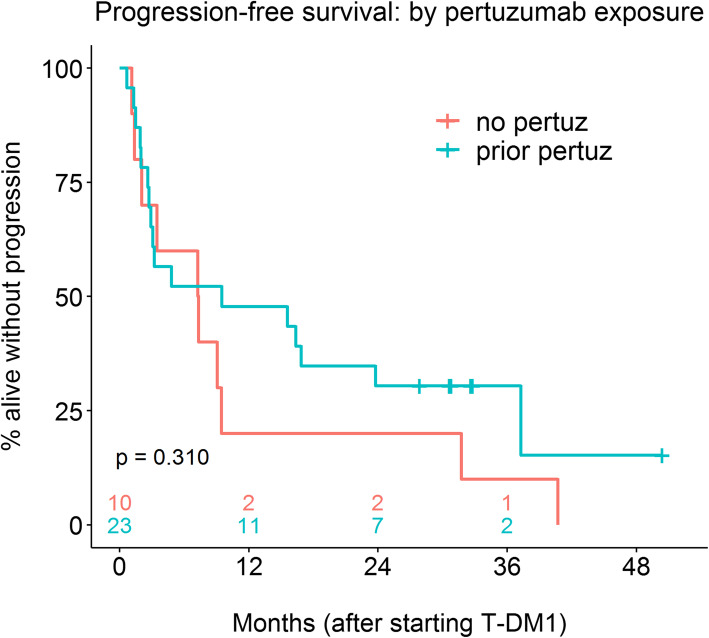
Pertuzumab-pretreated patients (n = 23, with 21 evaluable for T-DM1 efficacy) had a median PFS of 9.5 months (95% CI: 2.9-NA), 1-year OS rate of 67.4% (95% CI: 50.0-90.9%) with an unreached median, ORR of 14.3% (95% CI: 3.0-36.3%), and CBR of 52.4% (95% CI: 29.8-74.3%), with none of these measures being statistically different than those estimated for the pertuzumab-naïve group (n = 10). Treatment with T-DM1 after prior pertuzumab exposure (median T-DM1 duration 2.9 months) resulted in no grade ≥ 3 adverse events.
In our cohort, prior exposure to pertuzumab did not significantly impact T-DM1's clinical efficacy or safety profile as second- or later-line therapy in patients with metastatic HER2-positive breast cancer.
多西他赛联合两种曲妥珠单抗靶向治疗药物,即曲妥珠单抗和帕妥珠单抗,是转移性人表皮生长因子受体 2(HER2)阳性乳腺癌患者的当前标准一线治疗药物。曲妥珠单抗-美坦辛(T-DM1)是曲妥珠单抗与细胞毒微管抑制剂美坦辛的抗体药物偶联物,批准用于先前接受曲妥珠单抗为基础的治疗后进展的患者。然而,对于先前接受曲妥珠单抗治疗转移性乳腺癌的患者,T-DM1 的获益尚不清楚。
我们确定了 33 名患有转移性 HER2 阳性乳腺癌的成年人,他们于 2013 年 3 月至 2018 年 7 月期间接受了 T-DM1 治疗,这些患者接受 T-DM1 治疗的依据为:先前接受过曲妥珠单抗为基础的治疗后进展(即“曲妥珠单抗预处理”)或未接受过曲妥珠单抗治疗(即“曲妥珠单抗初治”)。收集的数据包括患者的人口统计学特征、治疗史、不良事件和临床结局。对于接受 T-DM1 治疗的两个队列,主要终点是无进展生存期(PFS),次要终点是总生存期(OS)、总缓解率(ORR)、临床获益率(CBR)和 T-DM1 相关毒性发生率。
曲妥珠单抗预处理患者(n=23,其中 21 例可评估 T-DM1 的疗效)的中位 PFS 为 9.5 个月(95%CI:2.9-N/A),1 年 OS 率为 67.4%(95%CI:50.0-90.9%),中位 OS 尚未达到,ORR 为 14.3%(95%CI:3.0-36.3%),CBR 为 52.4%(95%CI:29.8-74.3%),这些指标均与曲妥珠单抗初治组(n=10)估计的指标无统计学差异。先前接受过曲妥珠单抗治疗后(中位 T-DM1 治疗持续时间为 2.9 个月)接受 T-DM1 治疗无≥3 级不良事件。
在我们的队列中,先前接受过曲妥珠单抗治疗并不会显著影响转移性 HER2 阳性乳腺癌患者二线或后续治疗中 T-DM1 的临床疗效或安全性特征。