McConnell Brain Imaging Centre, Montréal Neurological Institute, McGill University, Montréal, QC, Canada.
Department of Psychiatry, Psychotherapy and Psychosomatics, Psychiatric Hospital, University of Zurich, Zurich, Switzerland.
Mol Psychiatry. 2022 Feb;27(2):1167-1176. doi: 10.1038/s41380-021-01359-9. Epub 2021 Oct 27.
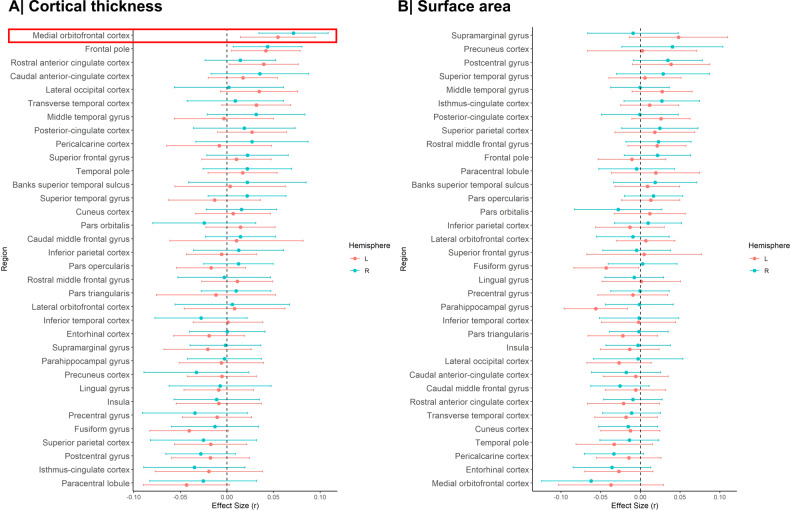
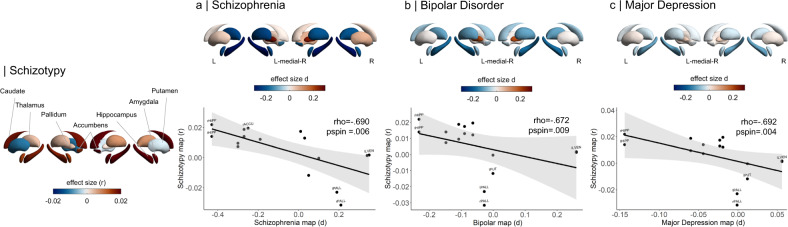
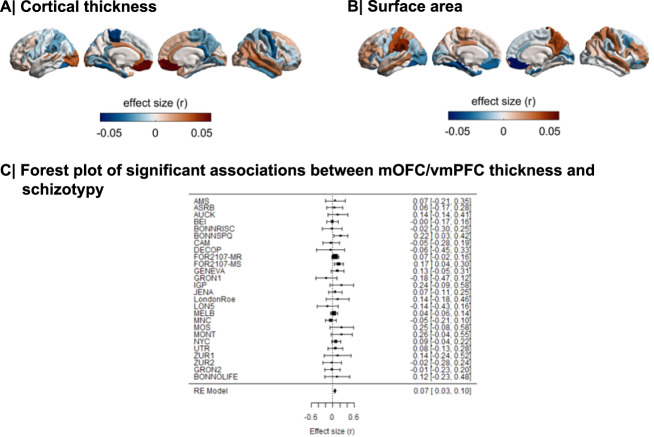
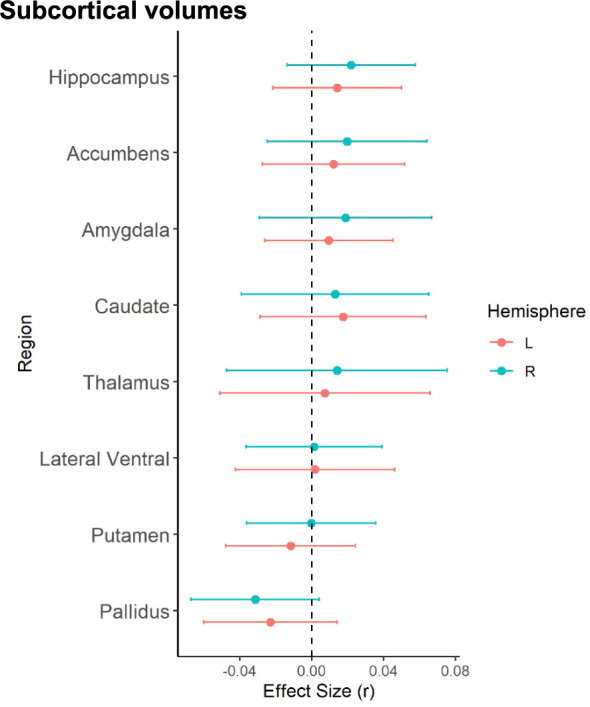
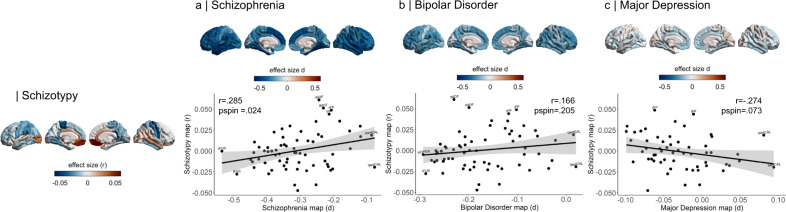
Neuroanatomical abnormalities have been reported along a continuum from at-risk stages, including high schizotypy, to early and chronic psychosis. However, a comprehensive neuroanatomical mapping of schizotypy remains to be established. The authors conducted the first large-scale meta-analyses of cortical and subcortical morphometric patterns of schizotypy in healthy individuals, and compared these patterns with neuroanatomical abnormalities observed in major psychiatric disorders. The sample comprised 3004 unmedicated healthy individuals (12-68 years, 46.5% male) from 29 cohorts of the worldwide ENIGMA Schizotypy working group. Cortical and subcortical effect size maps with schizotypy scores were generated using standardized methods. Pattern similarities were assessed between the schizotypy-related cortical and subcortical maps and effect size maps from comparisons of schizophrenia (SZ), bipolar disorder (BD) and major depression (MDD) patients with controls. Thicker right medial orbitofrontal/ventromedial prefrontal cortex (mOFC/vmPFC) was associated with higher schizotypy scores (r = 0.067, p = 0.02). The cortical thickness profile in schizotypy was positively correlated with cortical abnormalities in SZ (r = 0.285, p = 0.024), but not BD (r = 0.166, p = 0.205) or MDD (r = -0.274, p = 0.073). The schizotypy-related subcortical volume pattern was negatively correlated with subcortical abnormalities in SZ (rho = -0.690, p = 0.006), BD (rho = -0.672, p = 0.009), and MDD (rho = -0.692, p = 0.004). Comprehensive mapping of schizotypy-related brain morphometry in the general population revealed a significant relationship between higher schizotypy and thicker mOFC/vmPFC, in the absence of confounding effects due to antipsychotic medication or disease chronicity. The cortical pattern similarity between schizotypy and schizophrenia yields new insights into a dimensional neurobiological continuity across the extended psychosis phenotype.
神经解剖学异常已在从高危阶段(包括高精神分裂症倾向)到早期和慢性精神病的连续体中得到报道。然而,精神分裂症倾向的全面神经解剖学图谱尚未建立。作者对健康个体的精神分裂症倾向的皮质和皮质下形态计量模式进行了首次大规模的荟萃分析,并将这些模式与主要精神障碍中观察到的神经解剖学异常进行了比较。该样本包括来自全球 ENIGMA 精神分裂症倾向工作组的 29 个队列中的 3004 名未接受药物治疗的健康个体(12-68 岁,46.5%为男性)。使用标准化方法生成了与精神分裂症倾向评分相关的皮质和皮质下效应量图谱。通过比较精神分裂症(SZ)、双相障碍(BD)和重度抑郁症(MDD)患者与对照组,评估了精神分裂症倾向相关皮质和皮质下图谱与效应量图谱之间的模式相似性。右侧内侧眶额/腹内侧前额皮质(mOFC/vmPFC)较厚与较高的精神分裂症倾向评分相关(r=0.067,p=0.02)。精神分裂症倾向的皮质厚度谱与 SZ 的皮质异常呈正相关(r=0.285,p=0.024),但与 BD(r=0.166,p=0.205)或 MDD(r=0.274,p=0.073)无关。精神分裂症倾向的皮质下体积模式与 SZ(rho=-0.690,p=0.006)、BD(rho=-0.672,p=0.009)和 MDD(rho=-0.692,p=0.004)的皮质下异常呈负相关。在普通人群中对精神分裂症倾向相关脑形态计量学进行全面映射显示,较高的精神分裂症倾向与 mOFC/vmPFC 增厚之间存在显著关系,且不存在抗精神病药物或疾病慢性化引起的混杂效应。精神分裂症倾向与精神分裂症之间的皮质模式相似性为扩展精神病表型的维度神经生物学连续性提供了新的见解。