Yin Jiangtao, Mao Wenjian, Xiao Xiaojia, Yu Xianqiang, Li Baiqiang, Chen Faxi, Lin Jiajia, Zhou Jing, Zhou Jing, Tong Zhihui, Ke Lu, Li Weiqin
Department of Critical Care Medicine, Jinling Hospital, Nanjing Medical University, Nanjing, People's Republic of China.
Department of Intensive Care Unit, Affiliated Hospital of Jiangsu University, Zhenjiang, People's Republic of China.
J Inflamm Res. 2021 Oct 20;14:5433-5442. doi: 10.2147/JIR.S321507. eCollection 2021.
Immunosuppression is common in patients with infected pancreatic necrosis (IPN) and associated with morbidity and mortality. This study aimed to investigate the impact of immune status on mortality and readmission after hospital discharge in patients with IPN-related sepsis.
In this prospective observational study, eligible adult patients with IPN-related sepsis requiring ICU admission were included. Monocytic human leukocyte antigen DR (mHLA-DR), expression of regulatory T cells (Treg), and neutrophil CD88 (nCD88) were measured on the diagnosis of sepsis, ICU discharge, hospital discharge, and 15, 30, 60 days after hospital discharge. Logistic regression model was used to assess potential risk factors for readmission 60-days within the index discharge.
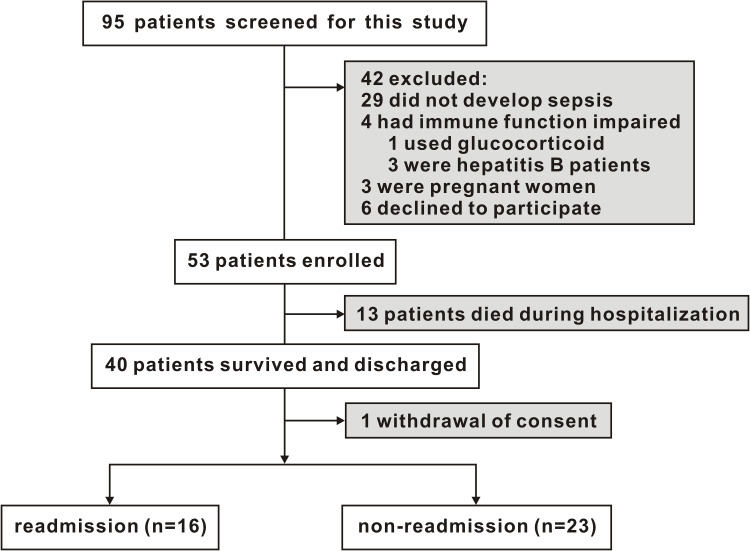
A total of 53 patients were included, 13 died during hospitalization and one withdrew the consent soon after discharge. Among the survivors, a tendency of immune recovery was observed during the consecutive follow-ups, evidenced by the increased expression of mHLA-DR. Sixteen patients (41.03%) were readmitted within 60 days after the index discharge. In the multivariable regression model, APACHE II score when sepsis was diagnosed >9 and mHLA-DR at discharged <14,591 AB/C were found to be independent risk factors affecting readmission.
Immunosuppression is common in patients with IPN-related sepsis and can persist until two months after discharge. The compromised mHLA-DR level at discharge was associated with readmission within two months after discharge.
免疫抑制在感染性胰腺坏死(IPN)患者中很常见,且与发病率和死亡率相关。本研究旨在探讨免疫状态对IPN相关脓毒症患者出院后死亡率和再入院率的影响。
在这项前瞻性观察研究中,纳入了符合条件的需要入住重症监护病房(ICU)的IPN相关脓毒症成年患者。在脓毒症诊断时、ICU出院时、医院出院时以及出院后15、30、60天测量单核细胞人类白细胞抗原DR(mHLA-DR)、调节性T细胞(Treg)的表达以及中性粒细胞CD88(nCD88)。采用逻辑回归模型评估指数出院后60天内再入院的潜在风险因素。
共纳入53例患者,13例在住院期间死亡,1例在出院后不久撤回同意书。在幸存者中,连续随访期间观察到免疫恢复的趋势,mHLA-DR表达增加证明了这一点。16例患者(41.03%)在指数出院后60天内再次入院。在多变量回归模型中,诊断脓毒症时APACHE II评分>9以及出院时mHLA-DR<14,591 AB/C被发现是影响再入院的独立风险因素。
免疫抑制在IPN相关脓毒症患者中很常见,并且可持续到出院后两个月。出院时mHLA-DR水平受损与出院后两个月内再入院有关。