Lehmann Rebecca J, Jolly Lachlan A, Johnson Brett V, Lord Megan S, Kim Ha Na, Saville Jennifer T, Fuller Maria, Byers Sharon, Derrick-Roberts Ainslie L K
Genetics and Molecular Pathology, SA Pathology (at the Women's and Children's Hospital), 72 King William Rd, North Adelaide, SA 5006, Australia.
Department of Molecular and Cellular Biology, University of Adelaide, Adelaide, SA 5005, Australia.
Mol Genet Metab Rep. 2021 Oct 19;29:100811. doi: 10.1016/j.ymgmr.2021.100811. eCollection 2021 Dec.
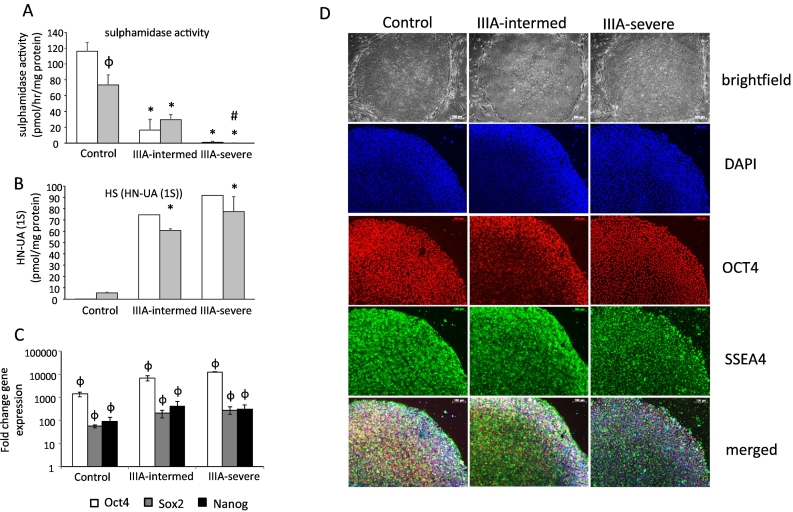
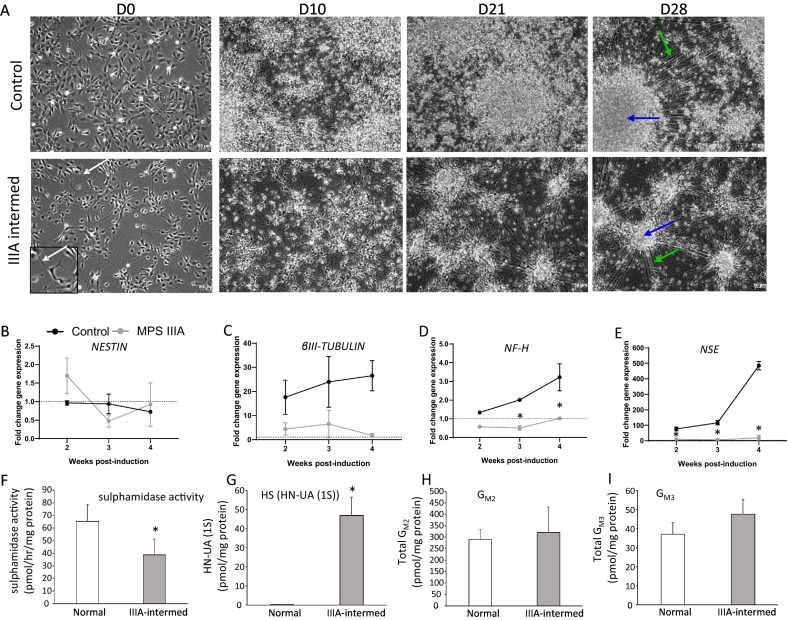
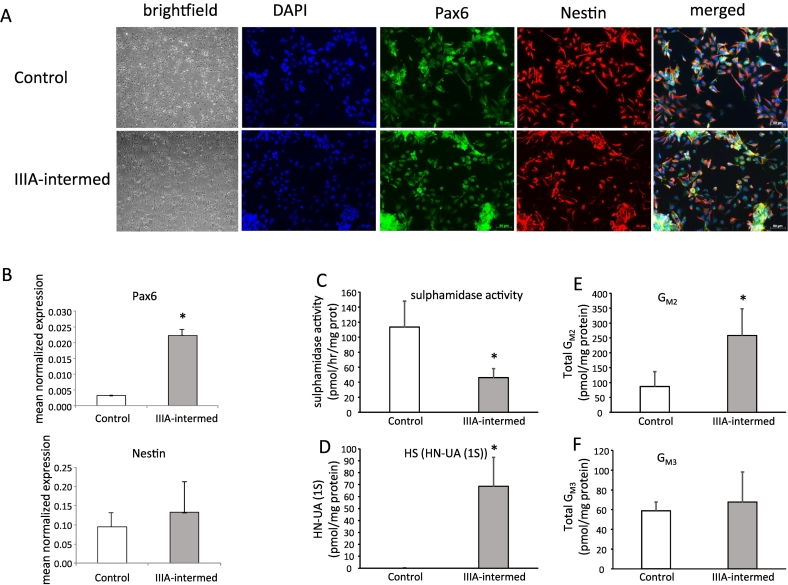
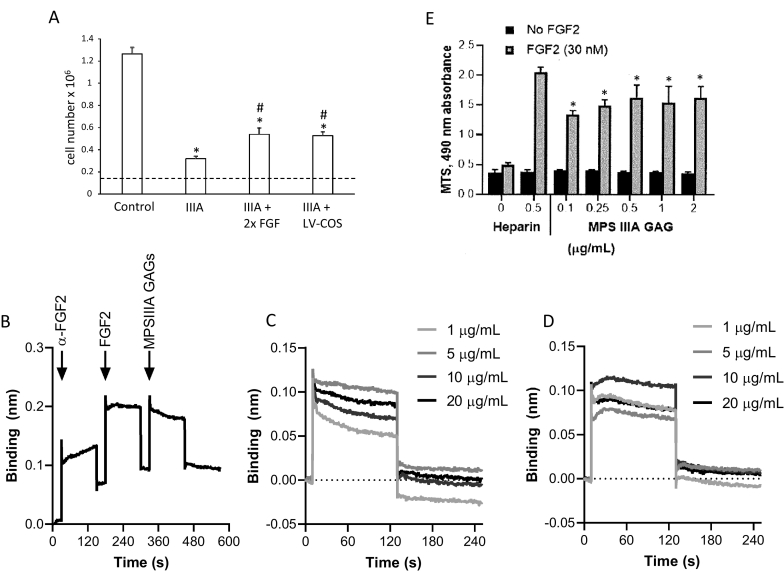
Mucopolysaccharidosis type IIIA (MPS IIIA) is characterised by a progressive neurological decline leading to early death. It is caused by bi-allelic loss-of-function mutations in encoding sulphamidase, a lysosomal enzyme required for heparan sulphate glycosaminoglycan (HS GAG) degradation, that results in the progressive build-up of HS GAGs in multiple tissues most notably the central nervous system (CNS). Skin fibroblasts from two MPS IIIA patients who presented with an intermediate and a severe clinical phenotype, respectively, were reprogrammed into induced pluripotent stem cells (iPSCs). The intermediate MPS IIIA iPSCs were then differentiated into neural progenitor cells (NPCs) and subsequently neurons. The patient derived fibroblasts, iPSCs, NPCs and neurons all displayed hallmark biochemical characteristics of MPS IIIA including reduced sulphamidase activity and increased accumulation of an MPS IIIA HS GAG biomarker. Proliferation of MPS IIIA iPSC-derived NPCs was reduced compared to control, but could be partially rescued by reintroducing functional sulphamidase enzyme, or by doubling the concentration of the mitogen fibroblast growth factor 2 (FGF2). Whilst both control heparin, and MPS IIIA HS GAGs had a similar binding affinity for FGF2, only the latter inhibited FGF signalling, suggesting accumulated MPS IIIA HS GAGs disrupt the FGF2:FGF2 receptor:HS signalling complex. Neuronal differentiation of MPS IIIA iPSC-derived NPCs was associated with a reduction in the expression of neuronal cell marker genes revealing reduced neurogenesis compared to control. A similar result was achieved by adding MPS IIIA HS GAGs to the culture medium during neuronal differentiation of control iPSC-derived NPCs. This study demonstrates the generation of MPS IIIA iPSCs, and NPCs, the latter of which display reduced proliferation and neurogenic capacity. Reduced NPC proliferation can be explained by a model in which soluble MPS IIIA HS GAGs compete with cell surface HS for FGF2 binding. The mechanism driving reduced neurogenesis remains to be determined but appears downstream of MPS IIIA HS GAG accumulation.
ⅢA型黏多糖贮积症(MPS IIIA)的特征是进行性神经功能衰退,最终导致过早死亡。它是由编码硫酸酰胺酶的双等位基因功能丧失突变引起的,硫酸酰胺酶是一种溶酶体酶,参与硫酸乙酰肝素糖胺聚糖(HS GAG)的降解,该突变导致HS GAG在多个组织中进行性蓄积,最显著的是在中枢神经系统(CNS)。分别具有中度和重度临床表型的两名MPS IIIA患者的皮肤成纤维细胞被重编程为诱导多能干细胞(iPSC)。然后将中度MPS IIIA iPSC分化为神经祖细胞(NPC),随后分化为神经元。患者来源的成纤维细胞、iPSC、NPC和神经元均表现出MPS IIIA的典型生化特征,包括硫酸酰胺酶活性降低和MPS IIIA HS GAG生物标志物的积累增加。与对照相比,MPS IIIA iPSC来源的NPC的增殖减少,但通过重新引入功能性硫酸酰胺酶或使有丝分裂原成纤维细胞生长因子2(FGF2)的浓度加倍,可以部分挽救这种情况。虽然对照肝素和MPS IIIA HS GAG对FGF2具有相似的结合亲和力,但只有后者抑制FGF信号传导,这表明积累的MPS IIIA HS GAG破坏了FGF2:FGF2受体:HS信号复合物。MPS IIIA iPSC来源的NPC的神经元分化与神经元细胞标记基因的表达减少有关,与对照相比,神经发生减少。在对照iPSC来源的NPC的神经元分化过程中,向培养基中添加MPS IIIA HS GAG也得到了类似的结果。这项研究证明了MPS IIIA iPSC和NPC的产生,后者表现出增殖和神经发生能力降低。NPC增殖减少可以用一种模型来解释,即可溶性MPS IIIA HS GAG与细胞表面HS竞争FGF2结合。驱动神经发生减少的机制仍有待确定,但似乎在MPS IIIA HS GAG积累的下游。