Cable Brian M, Farooqi Ali S, Tsai Steven, Plyler Ryan, Lee Alex, Parisien Robert L, Kelly John D
Department of Orthopaedic Surgery, University of Pennsylvania, Philadelphia, Pennsylvania, U.S.A.
Arthrosc Sports Med Rehabil. 2021 Aug 14;3(5):e1421-e1429. doi: 10.1016/j.asmr.2021.07.004. eCollection 2021 Oct.
To determine short- to midterm patient-reported outcomes of arthroscopic soft-tissue interposition arthroplasty using acellular dermal allograft with a minimum follow-up of 1 year and to assess outcomes in patients with and without flattening of the humeral head.
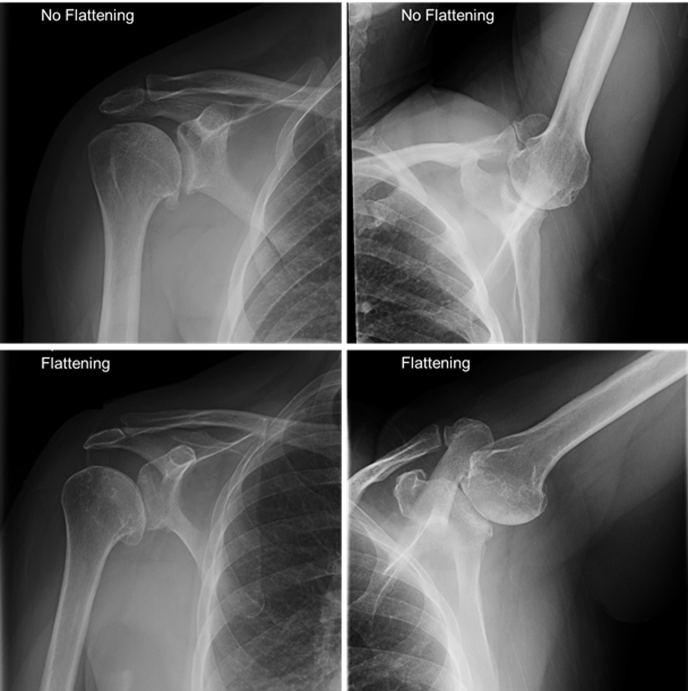
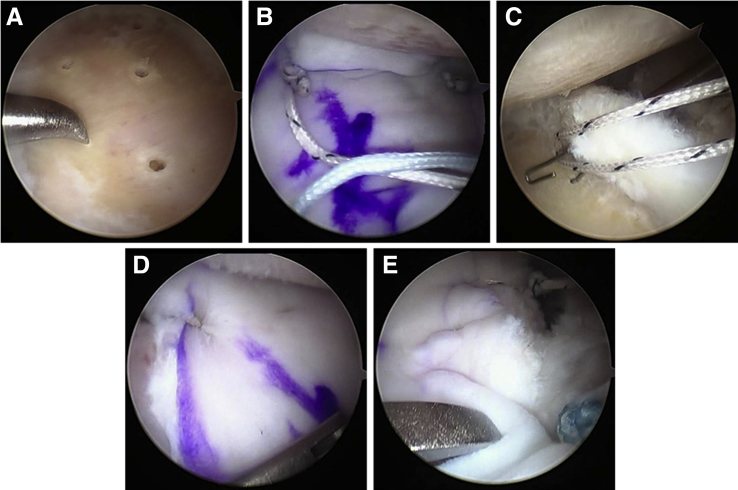
Patients with a diagnosis of primary glenohumeral arthritis who underwent arthroscopic soft-tissue interposition arthroplasty with an acellular dermal allograft from July 2010 to November 2019 were retrospectively enrolled. Inclusion criteria were a primary diagnosis of glenohumeral arthritis and Outerbridge 4 full-thickness cartilage loss of ≥50% of the glenoid articular surface. Patients underwent arthroscopic debridement, microfracture, and biological arthroscopic soft-tissue interposition arthroplasty with an acellular dermal matrix. Postoperative outcomes included American Shoulder and Elbow Surgeon (ASES) score, Single Assessment Numeric Evaluation (SANE) score, Penn Shoulder Score (PSS), numeric rating scale (NRS) pain score, analgesic use, and conversion to total shoulder arthroplasty (TSA). Results were stratified according to humeral head morphology on preoperative radiographs.
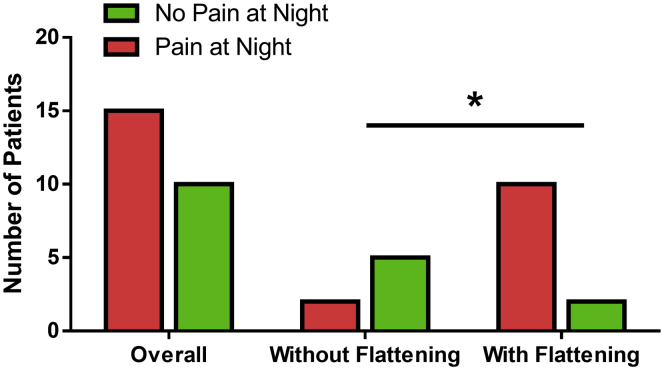
A total of 25 patients were included, with a mean age of 56.0 years (range 19.2 to 74.8) and a mean follow-up of 3.36 years (range 1.03 to 8.98). The mean postoperative ASES score was 64.1 (range 11.7 to 100.0), SANE score was 62% (range 5% to 100%), and PSS was 61.2 (range 10.6 to 97.9). Additionally, 56% of patients rated their shoulder function as improved or much improved, and 36% of patients converted to TSA at a mean of 2.35 years. Patients with and without humeral flattening had similar postoperative ASES scores ( = .44), SANE scores ( = .90), PSS ( = .73), and conversions to TSA ( = .83). Patients with humeral flattening were more likely to have shoulder pain at night (83.3% versus 28.6%, = .02).
Arthroscopic soft-tissue interposition arthroplasty with an acellular dermal allograft resulted in satisfactory short- to mid-term postoperative outcomes for younger patients with glenohumeral arthritis but demonstrated a TSA conversion rate of 36%. Patients with humeral head flattening also had satisfactory shoulder function but were more likely to experience shoulder pain at night.
Level IV, therapeutic case series.
确定使用脱细胞真皮同种异体移植物进行关节镜下软组织间置关节成形术的短期至中期患者报告结局,随访时间至少为1年,并评估肱骨头有无扁平的患者的结局。
回顾性纳入2010年7月至2019年11月接受关节镜下软组织间置关节成形术并使用脱细胞真皮同种异体移植物的原发性盂肱关节炎患者。纳入标准为原发性盂肱关节炎诊断以及肩胛骨关节面≥50%的Outerbridge 4级全层软骨损伤。患者接受关节镜下清创、微骨折以及使用脱细胞真皮基质进行生物性关节镜下软组织间置关节成形术。术后结局包括美国肩肘外科医师(ASES)评分、单项评估数字评定(SANE)评分、宾夕法尼亚肩部评分(PSS)、数字评定量表(NRS)疼痛评分、镇痛药物使用情况以及转为全肩关节置换术(TSA)的情况。根据术前X线片上的肱骨头形态对结果进行分层。
共纳入25例患者,平均年龄56.0岁(范围19.2至74.8岁),平均随访3.36年(范围1.03至8.98年)。术后ASES评分平均为64.1(范围11.7至100.0),SANE评分为62%(范围5%至100%),PSS为61.2(范围10.6至97.9)。此外,56%的患者将其肩部功能评为改善或明显改善,36%的患者平均在2.35年时转为TSA。肱骨头有无扁平的患者术后ASES评分(P = 0.44)、SANE评分(P = 0.90)、PSS(P = 0.73)以及转为TSA的情况(P = 0.83)相似。肱骨头扁平的患者夜间肩部疼痛的可能性更大(83.3%对28.6%,P = 0.02)。
对于较年轻的盂肱关节炎患者,使用脱细胞真皮同种异体移植物进行关节镜下软组织间置关节成形术可获得满意的术后短期至中期结局,但TSA转化率为36%。肱骨头扁平的患者肩部功能也令人满意,但夜间肩部疼痛的可能性更大。
IV级,治疗性病例系列。