Cheng Wei, Marsac Rémi, Hanna Khalil, Boily Jean-François
College of Resources and Environmental Science, South-Central University for Nationalities, Wuhan 430074, P.R. China.
Université Rennes, CNRS, Géosciences Rennes-UMR 6118, Rennes F-35000, France.
Langmuir. 2021 Nov 9;37(44):13107-13115. doi: 10.1021/acs.langmuir.1c02261. Epub 2021 Oct 29.
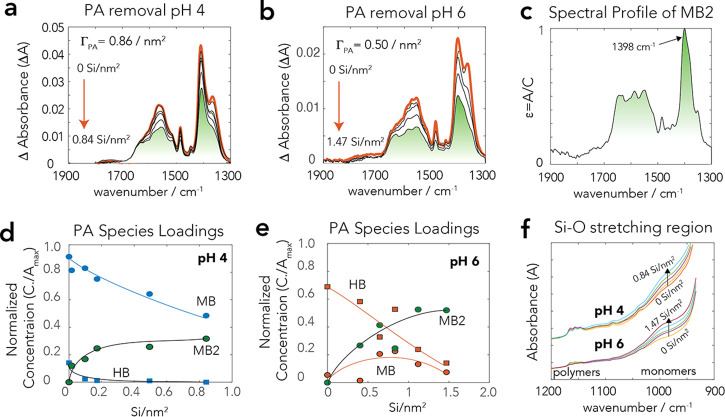
Dissolved silicate ions in wet and dry soils can determine the fate of organic contaminants via competitive binding. While fundamental surface science studies have advanced knowledge of binding in competitive systems, little is still known about the ranges of solution conditions, the time dependence, and the molecular processes controlling competitive silicate-organic binding on minerals. Here we address these issues by describing the competitive adsorption of dissolved silicate and of phthalic acid (PA), a model carboxylate-bearing organic contaminant, onto goethite, a representative natural iron oxyhydroxide nanomineral. Using surface complexation thermodynamic modeling of batch adsorption data and chemometric analyses of vibrational spectra, we find that silicate concentrations representative of natural waters (50-1000 μM) can displace PA bound at goethite surfaces. Below pH ∼8, where PA binds, every bound Si atom removes ∼0.3 PA molecule by competing with reactive singly coordinated hydroxo groups (-OH) on goethite. Long-term (30 days) reaction time and a high silicate concentration (1000 μM) favored silicate polymer formation, and increased silicate while decreasing PA loadings. The multisite complexation model predicted PA and silicate binding in terms of the competition for -OH groups without involving PA/silicate interactions, and in terms of a lowering of outer-Helmholtz potentials of the goethite surface by these anions. The model predicted that silicate binding lowered loadings of PA species, and whose two carboxylate groups are hydrogen- (HB) and metal-bonded (MB) with goethite. Vibrational spectra of dried samples revealed that the loss of water favored greater proportions of MB over HB species, and these coexisted with predominantly monomeric silicate species. These findings underscored the need to develop models for a wider range of organic contaminants in soils exposed to silicate species and undergoing wet-dry cycles.
湿土和干土中的溶解硅酸盐离子可通过竞争结合来决定有机污染物的归宿。虽然基础表面科学研究增进了我们对竞争体系中结合作用的认识,但对于溶液条件范围、时间依赖性以及控制矿物上硅酸盐 - 有机物竞争结合的分子过程,我们仍知之甚少。在此,我们通过描述溶解硅酸盐与邻苯二甲酸(PA,一种含羧基的模型有机污染物)在针铁矿(一种代表性的天然羟基氧化铁纳米矿物)上的竞争吸附来解决这些问题。利用批量吸附数据的表面络合热力学模型和振动光谱的化学计量分析,我们发现代表天然水体的硅酸盐浓度(50 - 1000 μM)能够取代结合在针铁矿表面的PA。在PA发生结合的pH ∼8以下,每个结合的Si原子通过与针铁矿上的反应性单配位羟基(-OH)竞争,可去除约0.3个PA分子。长期(30天)反应时间和高硅酸盐浓度(1000 μM)有利于硅酸盐聚合物的形成,硅酸盐增加而PA负载量降低。多位点络合模型根据对 -OH基团的竞争(不涉及PA/硅酸盐相互作用)以及这些阴离子降低针铁矿表面外亥姆霍兹电位的情况,预测了PA和硅酸盐的结合。该模型预测硅酸盐结合降低了PA物种的负载量,PA的两个羧基与针铁矿形成氢键(HB)和金属键(MB)。干燥样品的振动光谱表明,失水有利于MB物种比例高于HB物种,且它们与主要的单体硅酸盐物种共存。这些发现强调了需要为暴露于硅酸盐物种并经历干湿循环的土壤中更广泛的有机污染物开发模型。