Division of Infectious Diseases and HIV Medicine, Department of Medicine, University of Cape Town, Cape Town, South Africa.
School of Global Public Health, New York University, New York, USA.
BMC Infect Dis. 2021 Oct 29;21(1):1116. doi: 10.1186/s12879-021-06792-3.
Infections due to resistant bacteria are associated with severe illness, increased risk for complications, hospital admissions, and higher mortality. Inappropriate use of antibiotics, which contributes to increased antibiotic resistance (ABR), is common in healthcare settings across the globe. In Cameroon, antibiotics have been reported as high as 45-70% of prescriptions. We sought to investigate the knowledge, attitudes, and perceptions regarding appropriate antibiotic use and ABR of medical doctors practicing in tertiary hospitals in Yaoundé, Cameroon.
We conducted a cross-sectional survey using a 54-item self-administered questionnaire sent via email to medical doctors working in the four major tertiary hospitals of Yaoundé. The questionnaire recorded socio-demographics, perceptions on antibiotic use and ABR, sources and usefulness of education on ABR, and clinical scenarios to appraise knowledge.
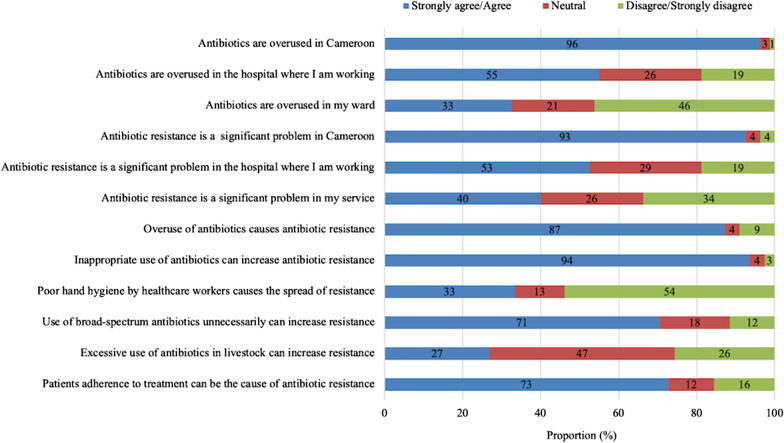
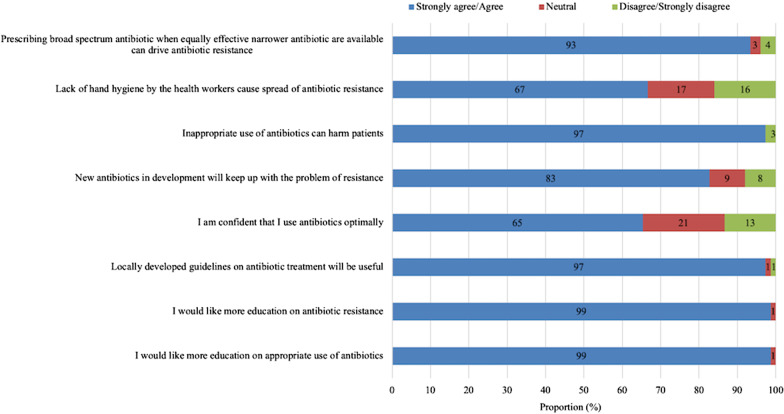
A total of 98/206 (48%) doctors responded. Years of experience ranged between 1 and 17 years. Most participants agreed that ABR is a problem nationwide (93%) and antibiotics are overused (96%), but only one third (32%) thought that ABR was a problem in their wards. Most respondents (65%) were confident that they use antibiotics appropriately. We found a mean knowledge score of 56% (± 14), with prescribers not influenced by patient-exerted pressure for antibiotic prescribing scoring better compared to those influenced by patients (67% vs 53%, p = 0.01). Overall, most participants (99%) expressed interest for further education on both appropriate antibiotic use and ABR.
Confidence of prescribers in their ability to appropriately use antibiotics conflicts with the low level of knowledge on antibiotic use in this group of doctors. Moreover, the opinion of the majority, that ABR is not a problem in their own backyard is in keeping with similar studies in other countries and is of significant concern. Introduction of formal antibiotic stewardship programmes in Cameroon may be a useful intervention.
耐药菌引起的感染与严重疾病、并发症风险增加、住院和死亡率升高有关。在全球范围内的医疗保健环境中,抗生素的不合理使用(导致抗生素耐药性增加)很常见。在喀麦隆,抗生素的处方率高达 45-70%。我们试图调查在雅温得的三级医院工作的医生对适当使用抗生素和抗生素耐药性的知识、态度和看法。
我们使用一份 54 项的自我管理问卷进行了一项横断面调查,该问卷通过电子邮件发送给在雅温得的四家主要三级医院工作的医生。该问卷记录了社会人口统计学数据、对抗生素使用和抗生素耐药性的看法、抗生素耐药性教育的来源和有用性,以及评估知识的临床情况。
共有 98/206(48%)名医生做出了回应。工作年限在 1 至 17 年之间。大多数参与者认为全国范围内存在抗生素耐药性问题(93%)和抗生素过度使用(96%),但只有三分之一(32%)的人认为抗生素耐药性问题在他们的病房中存在。大多数受访者(65%)有信心自己能恰当地使用抗生素。我们发现平均知识得分为 56%(±14),与受到患者压力影响而开具抗生素的医生相比,不受患者影响的医生得分更高(67%比 53%,p=0.01)。总的来说,大多数参与者(99%)表示对适当使用抗生素和抗生素耐药性的进一步教育都感兴趣。
医生对自己适当使用抗生素的能力的信心与该组医生对抗生素使用知识水平低之间存在冲突。此外,大多数人认为抗生素耐药性不是他们自己后院的问题,这与其他国家的类似研究一致,令人严重关切。在喀麦隆引入正式的抗生素管理计划可能是一个有用的干预措施。