Jiangsu Key Laboratory for the Research and Utilization of Plant Resources, Institute of Botany, Jiangsu Province and Chinese Academy of Sciences (Nanjing Botanical Garden Mem. Sun Yat-Sen), Nanjing, 210014, China.
College of Horticulture, Jinling Institute of Technology, Nanjing City, Jiangsu Province, 210038, P.R. China.
BMC Plant Biol. 2021 Oct 30;21(1):503. doi: 10.1186/s12870-021-03227-8.
In angiosperms, phenotypic variation of floral organs is often considered as the traditional basis for the evolutionary relationship of different taxonomic groups above the species level. However, little is known about that at or below the species level. Here, we experimentally tested the phenotypic variation of Malus floral organs using combined methods of intraspecific uniformity test, interspecific distinctness analysis, principal component analysis, Pearson correlation analysis, and Q-type cluster analysis. The ancestor-inclined distribution characteristic analysis of Malus species and cultivars floral attributes was also carried out, so as to explore its taxonomic significance.
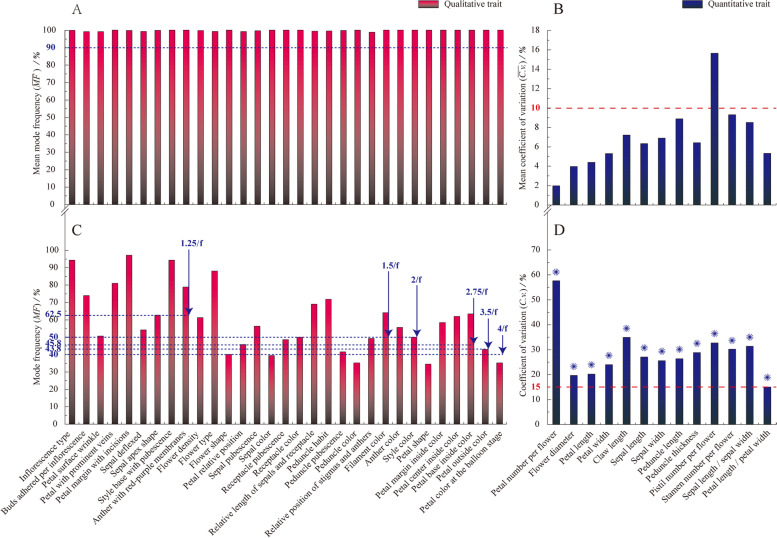
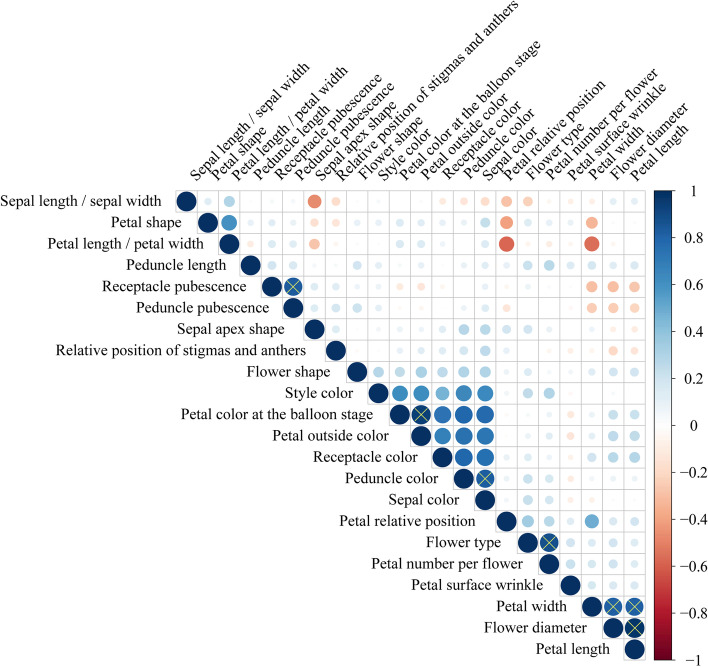
15/44 phenotypic traits (e.g., flower shape, flower type, flower diameter, ...) were highly consistent, distinguishable, and independent and could be used as the basis for Malus germplasm taxonomy. The studied 142 taxa were divided into two groups (A, B) and five sub-groups (A, A, B, B, B), with significantly variable floral phenotypic attributes between groups and within sub-groups. Malus natural species were relatively clustered in the same section (series) while homologous cultivars showed evidence of ancestor-inclined distribution characteristics. However, no significant correlation between the evolutionary order of sections (Sect. Docyniopsis → Sect. Chloromeles → Sect. Sorbomalus → Sect. Eumalus) and group/sub-groups (B → B → B → A).
Phenotypic variation of floral organs could better explore the genetic relationship between Malus taxa. The findings improved our cognition of floral phenotypic variation taxonomic significance under the species level.
在被子植物中,花器官的表型变异通常被认为是物种水平以上不同分类群进化关系的传统基础。然而,对于物种水平以下的情况,我们知之甚少。在这里,我们使用种内一致性测试、种间差异分析、主成分分析、皮尔逊相关分析和 Q 型聚类分析相结合的方法,对苹果属花器官的表型变异进行了实验测试。还对苹果属物种和品种花属性的祖先倾向分布特征进行了分析,以探讨其分类学意义。
15/44 个表型特征(如花形、花型、花径、……)高度一致、可区分且独立,可作为苹果属种质分类的基础。研究的 142 个分类群分为两组(A、B)和五个亚组(A、A、B、B、B),组间和组内的花表型属性差异显著。苹果自然种相对聚类在同一节(系列)中,而同源品种表现出祖先倾向分布特征的证据。然而,节(Docyniopsis→Chloromeles→Sorbomalus→Eumalus)的进化顺序与组/亚组(B→B→B→A)之间没有显著相关性。
花器官的表型变异可以更好地探索苹果属分类群之间的遗传关系。这些发现提高了我们对物种水平以下花表型变异分类学意义的认识。