Clinical Veterinary Medicine Division, Equine Research Institute, Japan Racing Association, Shimotsuke, Japan.
Drug Analysis Department, Laboratory of Racing Chemistry, Utsunomiya, Japan.
Equine Vet J. 2022 Sep;54(5):979-988. doi: 10.1111/evj.13532. Epub 2021 Nov 25.
For medication control in several jurisdictions, withdrawal time is the period of refrain from racing after drug administration. It is set by adding a safety period to an experimental detection time. However, there are no reports of statistical analyses of detection time for the determination of withdrawal time in flunixin meglumine-treated horses.
To analyse the population pharmacokinetics of flunixin in horses through the generation of a dataset for detection time statistical analysis and predictions via Monte Carlo simulation.
Experimental study.
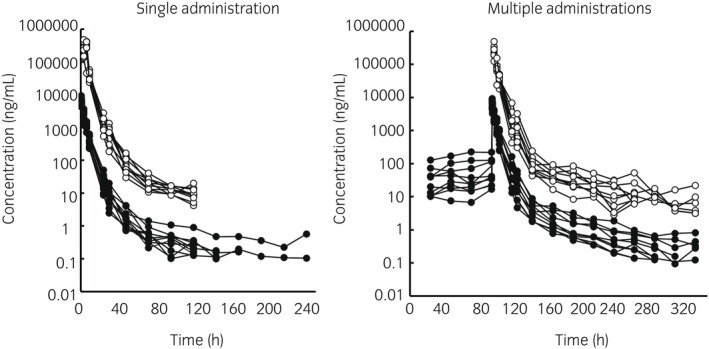
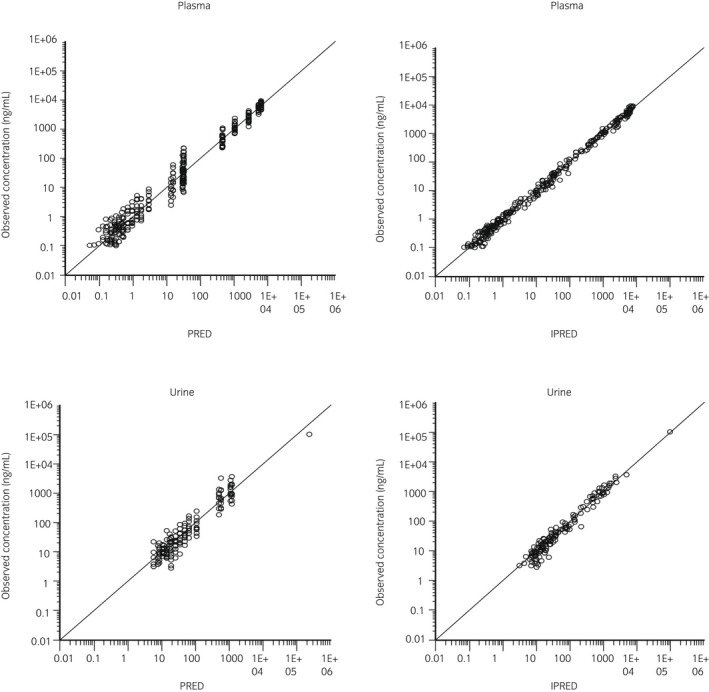
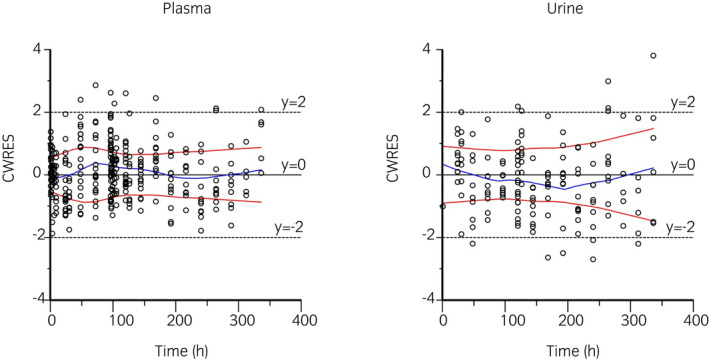
Drug plasma and urine concentrations following single intravenous administration of flunixin 1.1 mg/kg bodyweight (BW) in 10 horses and multiple administration of q 24 hours for 5 days in 10 horses were measured using liquid chromatography with tandem mass spectrometry (LC-MS/MS). Data were modelled using a nonlinear mixed effect model followed by Monte Carlo simulation. Irrelevant plasma concentration (IPC) and irrelevant urine concentration (IUC) were calculated using the Toutain approach. Detection times were obtained considering the time after the last administration for selected quantiles of 5000 hypothetical horses under the international screening limit (ISL) proposed by the International Federation of Horseracing Authorities (plasma: 1 ng/mL, urine; 100 ng/mL).
For a regimen of 1.1 mg/kg BW q 24 hours, the IPC and IUC values were 2.0 and 73.0 ng/mL respectively. Detection times in plasma above the ISL for 90% of simulated horses were estimated as 74 hours after a single 1.1 mg/kg dose administration, 149 and 199 hours after multiple doses over 5 days at either 24- or 12-hour intervals respectively. Corresponding detection times in urine were 46, 68 and 104 hours respectively.
Only female horses were investigated.
Statistical detection times for different flunixin meglumine regimens indicated a delay of detection time in plasma after multiple administrations under ISL.
在多个司法管辖区,停药时间是指在药物给药后停止比赛的时间。它是通过在实验检测时间上加一个安全时间来设定的。然而,目前还没有关于氟尼辛葡甲胺治疗马匹停药时间测定的检测时间的统计分析报告。
通过生成检测时间统计分析数据集并通过蒙特卡罗模拟进行预测,分析氟尼辛在马体内的群体药代动力学。
实验研究。
使用液相色谱串联质谱法(LC-MS/MS)测量 10 匹马单次静脉注射氟尼辛 1.1mg/kg 体重(BW)和 10 匹马每天 24 小时 q 5 天多次给药后的药物血浆和尿液浓度。使用非线性混合效应模型进行数据建模,然后进行蒙特卡罗模拟。使用 Toutain 方法计算无关血浆浓度(IPC)和无关尿液浓度(IUC)。考虑到最后一次给药后的时间,根据 Horseracing 国际联合会(International Federation of Horseracing Authorities,IFHA)提出的国际筛选限值(International Screening Limit,ISL),为 5000 匹假设马中的选定分位数获得了检测时间(血浆:1ng/mL,尿液:100ng/mL)。
对于 1.1mg/kg BW q 24 小时的方案,IPC 和 IUC 值分别为 2.0 和 73.0ng/mL。单次 1.1mg/kg 剂量给药后,模拟马中 90%的检测时间超过 ISL 的血浆检测时间估计为 74 小时,连续 5 天每隔 24 或 12 小时给药多次后,分别为 149 和 199 小时。相应的尿液检测时间分别为 46、68 和 104 小时。
仅对雌性马匹进行了研究。
不同氟尼辛葡甲胺方案的统计检测时间表明,在 ISL 下多次给药后,血浆中的检测时间会延迟。