Department of Migration and Urban Studies, International Institute for Population Sciences (IIPS), Mumbai, 400088, India.
BMC Womens Health. 2021 Nov 1;21(1):382. doi: 10.1186/s12905-021-01515-x.
Globally, one in three women experienced domestic violence. Alike the scenario observed in India, and a very few studies talk about violence and its consequences on women's health. Hence, the purpose of this study is to access the level of various types of spousal violence in India and to understand the association between physical, sexual and emotional violence against ever-married women by their husbands. The study further examines the consequences of spousal violence on women's health in terms of adverse pregnancy outcomes and reproductive health in India.
The study uses secondary data from National Family Health Survey-4 (NFHS-4, 2015-16). The analysis was based on a sample of ever-married women aged 15-49 years. Bivariate descriptive analysis and multiple regression analyses have been carried out to understand the association between spousal violence and its consequences on women's health.
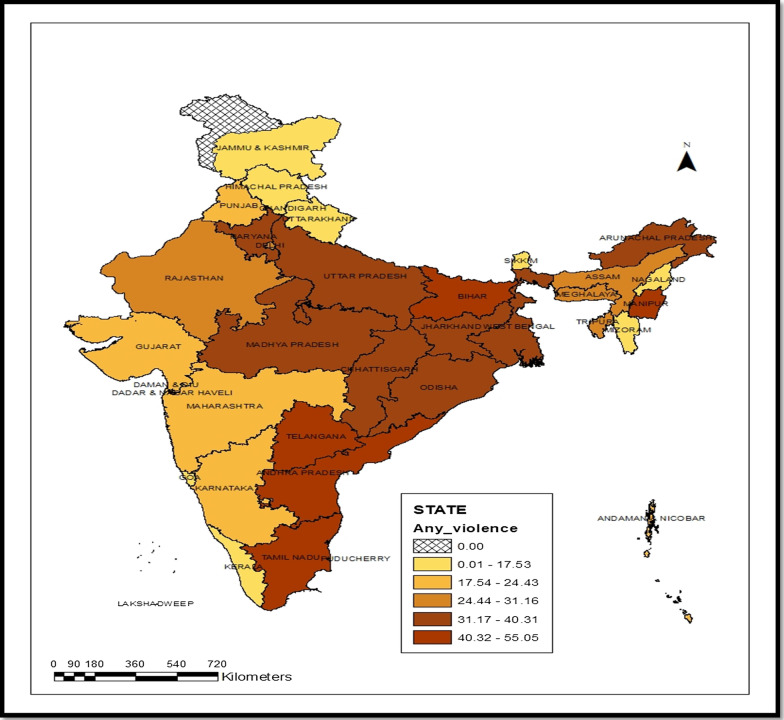
The study finds that the physical, sexual and emotional violence experienced by ever-married women in India are 29.8%, 13.8% and 7.0%, respectively. Further, the physical and sexual violence experienced by women have a significant association with an unwanted pregnancy, abortion, miscarriages and ever had termination of pregnancies. The regression analysis shows that violence by sexual partners among battered women increased the likelihood of unwanted pregnancy. Similarly, abortion and ever had a termination of pregnancies are also adversely affected by partner violence. Further, the risk of sexually transmitted infection increases 77% by sexual violence and 44% by emotional violence among battered women. Also, Sexual violence substantially increases the risk of prolonged labour during pregnancy.
This study revealed that one in three women experiencing violence by their husband and also it is evident that various forms of spousal violence adversely affect pregnancies outcomes and reproductive health among battered women compared to not battered.
全球每三名女性中就有一名经历过家庭暴力。与印度的情况类似,仅有少数研究探讨了暴力及其对女性健康的影响。因此,本研究旨在评估印度各种类型的配偶暴力程度,并了解丈夫对已婚女性实施的身体、性和情感暴力与这些暴力行为之间的关联。本研究还进一步考察了配偶暴力对印度已婚女性健康的影响,包括不良妊娠结局和生殖健康。
本研究使用了国家家庭健康调查-4(NFHS-4,2015-16 年)的二手数据。分析基于 15-49 岁已婚女性的样本。采用双变量描述性分析和多元回归分析来理解配偶暴力及其对女性健康的影响之间的关联。
本研究发现,印度已婚女性经历的身体、性和情感暴力分别为 29.8%、13.8%和 7.0%。此外,女性经历的身体和性暴力与意外怀孕、流产、流产和终止妊娠均存在显著关联。回归分析显示,遭受伴侣暴力的女性中,性暴力会增加意外怀孕的可能性。同样,流产和终止妊娠也受到伴侣暴力的不利影响。此外,性暴力会使遭受暴力的女性感染性传播感染的风险增加 77%,情感暴力会使该风险增加 44%。此外,性暴力会使怀孕期间的分娩时间延长的风险增加 77%。
本研究表明,每三名女性中就有一名遭受丈夫的暴力,而且各种形式的配偶暴力会对遭受暴力的女性的妊娠结局和生殖健康产生不利影响,而对未遭受暴力的女性则没有影响。