Yang Jie, Cheng Yisong, Wang Ruoran, Wang Bo
Department of Critical Care Medicine, West China Hospital, Sichuan University, Chengdu, China.
Front Med (Lausanne). 2021 Oct 15;8:745803. doi: 10.3389/fmed.2021.745803. eCollection 2021.
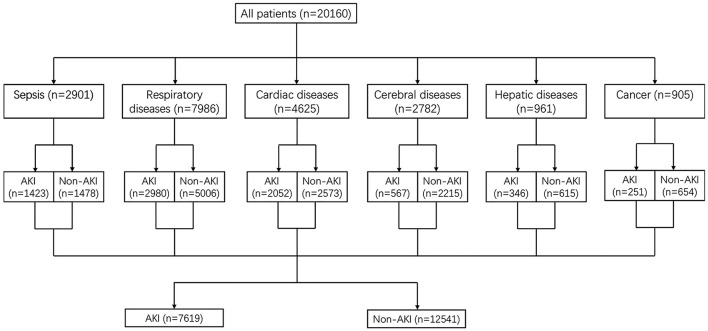
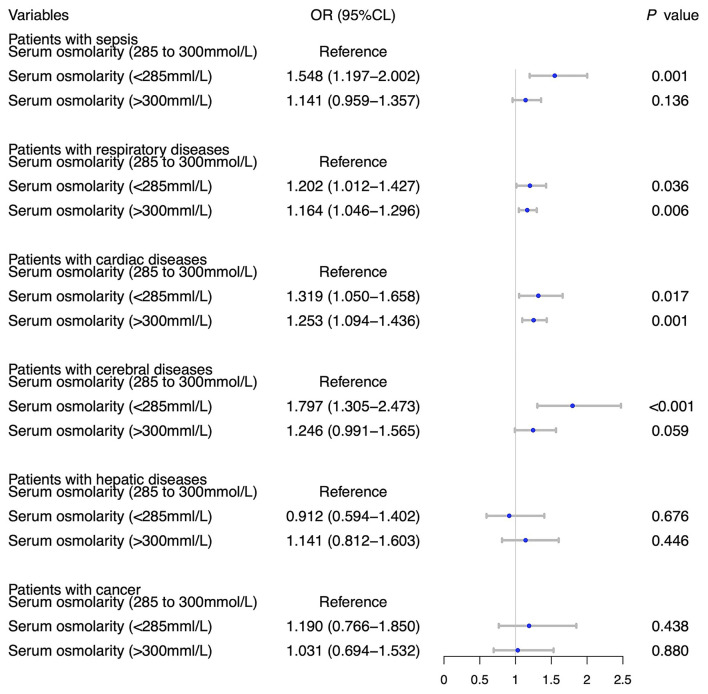
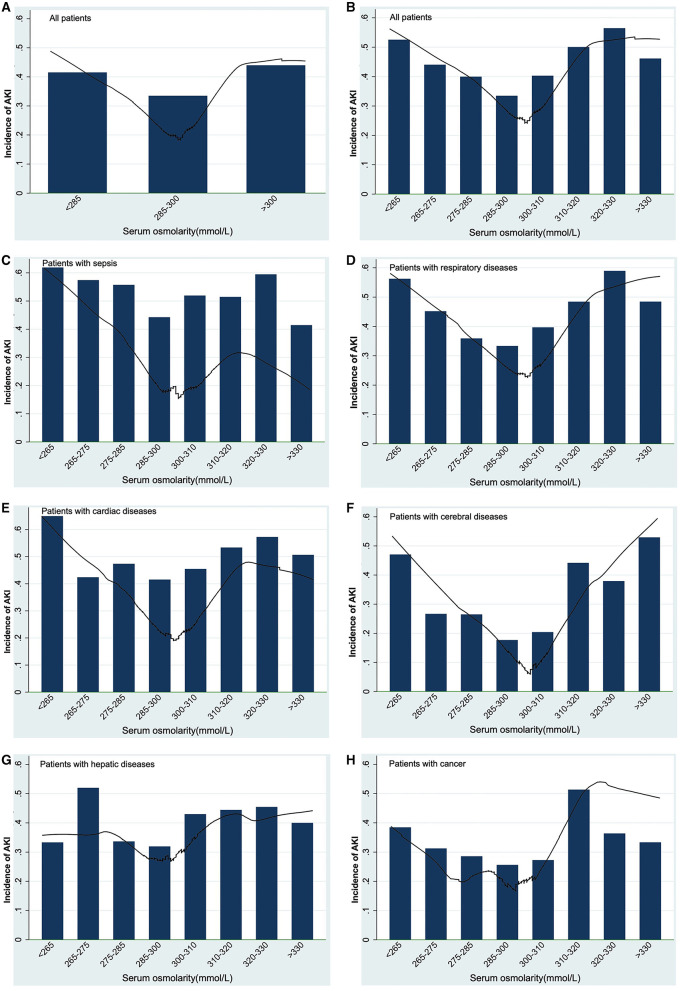
Acute kidney injury (AKI) is a common complication in critically ill patients and is usually associated with poor outcomes. Serum osmolality has been validated in predicting critically ill patient mortality. However, data about the association between serum osmolality and AKI is still lacking in ICU. Therefore, the purpose of the present study was to investigate the association between early serum osmolality and the development of AKI in critically ill patients. The present study was a retrospective cohort analysis based on the medical information mart for intensive care III (MIMIC-III) database. 20,160 patients were involved in this study and divided into six subgroups according to causes for ICU admission. The primary outcome was the incidence of AKI after ICU admission. The association between early serum osmolality and AKI was explored using univariate and multivariate logistic regression analyses. The normal range of serum osmolality was 285-300 mmol/L. High serum osmolality was defined as serum osmolality >300 mmol/L and low serum osmolality was defined as serum osmolality <285 mmol/L. Multivariate logistic regression indicated that high serum osmolality was independently associated with increased development of AKI with OR = 1.198 (95% CL = 1.199-1.479, < 0.001) and low serum osmolality was also independently associated with increased development of AKI with OR = 1.332 (95% CL = 1.199-1.479, < 0.001), compared with normal serum osmolality, respectively. In critically ill patients, early high serum osmolality and low serum osmolality were both independently associated with an increased risk of development of AKI.
急性肾损伤(AKI)是重症患者常见的并发症,通常与不良预后相关。血清渗透压已被证实可用于预测重症患者的死亡率。然而,重症监护病房(ICU)中关于血清渗透压与AKI之间关联的数据仍然缺乏。因此,本研究的目的是探讨重症患者早期血清渗透压与AKI发生之间的关联。本研究是基于重症监护医学信息集市III(MIMIC-III)数据库的回顾性队列分析。20160例患者参与了本研究,并根据入住ICU的原因分为六个亚组。主要结局是入住ICU后AKI的发生率。采用单因素和多因素逻辑回归分析探讨早期血清渗透压与AKI之间的关联。血清渗透压的正常范围为285 - 300 mmol/L。高血清渗透压定义为血清渗透压>300 mmol/L,低血清渗透压定义为血清渗透压<285 mmol/L。多因素逻辑回归表明,与正常血清渗透压相比,高血清渗透压与AKI发生风险增加独立相关,比值比(OR)= 1.198(95%可信区间[CL] = 1.199 - 1.479,P < 0.001),低血清渗透压也与AKI发生风险增加独立相关,OR = 1.332(95% CL = 1.199 - 1.479,P < 0.001)。在重症患者中,早期高血清渗透压和低血清渗透压均与AKI发生风险增加独立相关。