Chen C, Cerri O, Nguyen T Q, Vlimant J R, Pierini M
State Key Laboratory of Nuclear Physics and Technology, School of Physics, Peking University Haidan, Beijing, 100871 China.
California Institute of Technology, Pasadena, CA 91125 USA.
Comput Softw Big Sci. 2021;5(1):15. doi: 10.1007/s41781-021-00060-4. Epub 2021 Jun 9.
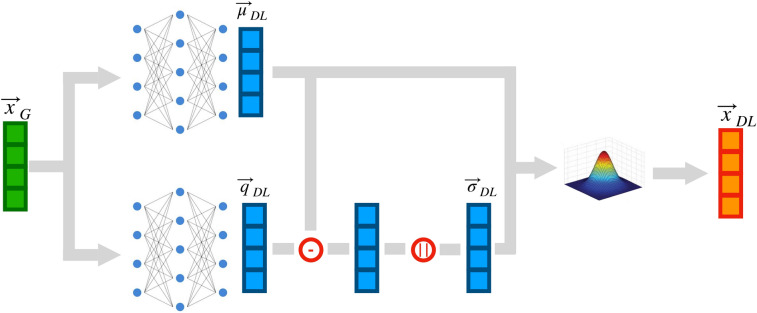
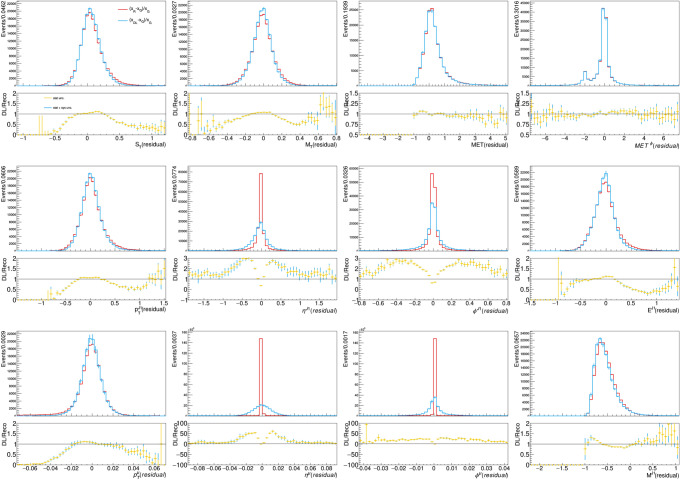
We present a fast-simulation application based on a deep neural network, designed to create large analysis-specific datasets. Taking as an example the generation of + jet events produced in 13 TeV proton-proton collisions, we train a neural network to model detector resolution effects as a transfer function acting on an analysis-specific set of relevant features, computed at generation level, i.e., in absence of detector effects. Based on this model, we propose a novel fast-simulation workflow that starts from a large amount of generator-level events to deliver large analysis-specific samples. The adoption of this approach would result in about an order-of-magnitude reduction in computing and storage requirements for the collision simulation workflow. This strategy could help the high energy physics community to face the computing challenges of the future High-Luminosity LHC.
我们展示了一个基于深度神经网络的快速模拟应用程序,旨在创建大型特定于分析的数据集。以在13 TeV质子-质子碰撞中产生的 + 喷注事件的生成为例,我们训练一个神经网络,将探测器分辨率效应建模为一个传递函数,该函数作用于在生成级别(即在没有探测器效应的情况下)计算的一组特定于分析的相关特征。基于此模型,我们提出了一种新颖的快速模拟工作流程,该流程从大量生成器级别的事件开始,以提供大型特定于分析的样本。采用这种方法将使碰撞模拟工作流程的计算和存储需求降低约一个数量级。这种策略可以帮助高能物理界应对未来高亮度大型强子对撞机的计算挑战。