Service of Endocrinology, Hospital Clínico Lozano Blesa, Zaragoza, Spain.
Service of Endocrinology, Hospital de Fuenlabrada, Madrid, Spain.
J Diabetes Res. 2021 Oct 23;2021:9970859. doi: 10.1155/2021/9970859. eCollection 2021.
To assess factors associated with adherence to clinical practice guidelines (CPGs) for type 2 diabetes mellitus (T2DM).
A cross-sectional multicenter study based on a two-round Delphi survey was designed. A total of 98 endocrinologists (mean age 45 years) involved in the care of T2DM patients completed a 43-item questionnaire assessing different aspects of adherence related to CPGs.
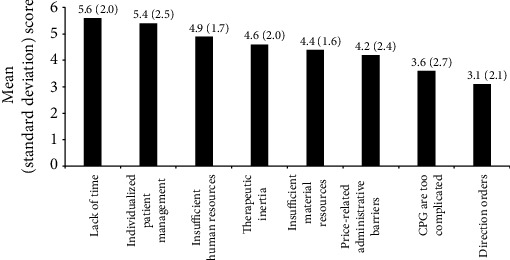
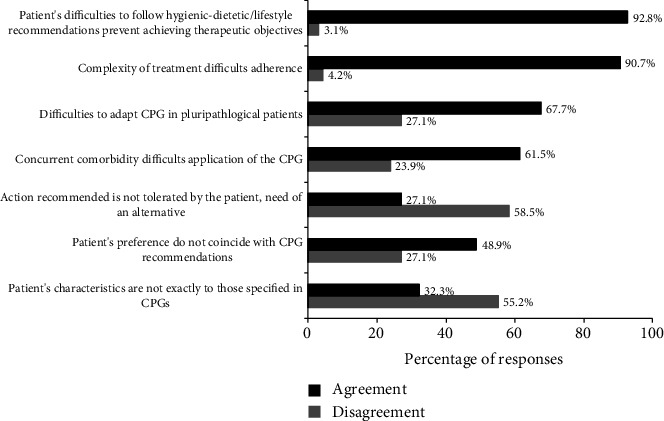
Most participants worked in tertiary care public hospitals. All participants used CPGs, with ADA/EASD as the most common (99%). The lack of time, establishment of an individualized management of patients, insufficient human resources, and therapeutic inertia were scored as the main reasons for not following CPGs recommendations. Participants agreed that insufficient material resources and limitations established by the healthcare system prevent adherence to CPGs. The risk of hypoglycemia was considered to be limiting factor for the patients' integral control. Also, there was consensus on the need to have the support of nursing personnel with specific training in diabetes as well as dietitians and podiatrists. There was disagreement regarding the influence on adherence to CPGs of patient's characteristics not matching those of CPGs, patient's preferences, tolerability of the action recommended, concomitant comorbidities, or pluripathological conditions. Differences according to the participant's age (≤40 years vs. >40 years) were not found. Therapeutic inertia and lack of time did not show a significant correlation.
Nonadherence to CPGs on T2DM is a multifactorial problem but the existence multiple CPGs, the lack of time, the therapeutic inertia, and insufficient human resources have been identified as factors limiting adherence. Hypoglycemia continues to be a barrier for achievement of targets recommended by CPGs.
评估与 2 型糖尿病(T2DM)临床实践指南(CPGs)依从性相关的因素。
设计了一项基于两轮德尔菲调查的横断面多中心研究。共有 98 名参与 T2DM 患者治疗的内分泌科医生(平均年龄 45 岁)完成了一份包含 43 个项目的问卷,评估与 CPG 相关的依从性的不同方面。
大多数参与者在三级公立医院工作。所有参与者均使用 CPGs,ADA/EASD 最常用(99%)。缺乏时间、为患者建立个体化管理、人力资源不足和治疗惰性被评为不遵循 CPG 建议的主要原因。参与者一致认为,缺乏物质资源和医疗体系的限制阻碍了 CPG 的遵循。低血糖风险被认为是限制患者全面控制的因素。此外,还需要有经过专门培训的护理人员、营养师和足病医生的支持。对于患者特征与 CPG 不匹配、患者偏好、推荐行动的耐受性、共患合并症或多系统疾病对 CPG 依从性的影响存在分歧。未发现参与者年龄(≤40 岁与>40 岁)差异。治疗惰性和缺乏时间之间没有显著相关性。
T2DM 不遵循 CPG 是一个多因素问题,但存在多个 CPG、缺乏时间、治疗惰性和人力资源不足已被确定为限制依从性的因素。低血糖仍然是实现 CPG 推荐目标的障碍。